Thursday, April 28, 2011

The Royal Wedding Countdown Begins!

For those of you feeling the royal frenzy as the hours tick down to tomorrow morning, here are a couple wedding necessities, in case you've missed them:

- The official Royal Wedding website provides some great details, videos, and updates, including the official program for the ceremony and the procession to follow.

The cover of the official wedding program,

- In this age of multi-media, you've got a choice as to how and where to catch your glimpse of the ceremony.  For those "traditionalists" (like us!) who prefer the television screen to the computer screen, the wedding will be broadcast live States-side by a number of television networks.  Both PBS and BBC America will host a simulcast of BBC One programming, beginning at 3am Eastern.  ABC begins their live coverage of the event at 4am Eastern.  And for those of you who prefer the "modern" method of watching the big day, the BBC will stream their coverage live online.  Youtube's Royal Channel will also be streaming live, as will ABC

- As a lovely complement to our previous post on British royal wedding gowns of the past, the BBC recently posted a slideshow on their website, which offers another glimpse of some of these stunning pieces of history worn by the fashion icons of days gone by.  Another fun page, also posted by the BBC, is this fascinating overview of eight royal weddings, full of fun little tidbits of trivia including everything from what they ate to the various controversies surrounding each day, to some of the memorable gifts each royal couple received.

So let's take a poll: who else plans to be up at 4am tomorrow?  "See" you then!  :-)

Wednesday, April 27, 2011

Noah Webster, "The Forgotten Founding Father"

Last Thursday, I attended a lecture and book signing given by Joshua Kendall at the New Haven Museum.  Mr. Kendall's latest publication, The Forgotten Founding Father: Noah Webster's Obsession and the Creation of an American Culture, explores the life of American dictionary author Noah Webster.  I have yet to read this book, so I will definitely be back to share more once I do.  I volunteer occasionally (which is not as much as I'd like!) as an interpreter at the Noah Webster House in West Hartford, Connecticut.  Besides the materials provided by the staff, it is surprisingly difficult to find resources about Webster.  The most comprehensive biography that I have seen so far is Harlow Giles Unger's 2000 publication, Noah Webster: The Life and Times of an American Patriot, so you can all imagine my delight when I heard that there was a new book being published about one of our best known local historic personages.

Joshua Kendall shares his insights about Noah Webster.
Photo courtesy of the New Haven Museum facebook page.

Mr. Kendall shared a brief overview of Noah Webster's life that included a sprinkling of facts which were new to me.  Most interesting, though, was Mr. Kendall's claim that Mr. Webster suffered from obsessive-compulsive personality disorder.  This is offered as a possible explanation for Webster's preoccupation with compiling lists.  In addition to his constant work with etymological lists, during his early "book tour" to promote his speller, he counted every house in each of the cities where he stopped (these lists subsequently became part of the first census).  He was also constantly working on large projects, which Mr. Kendall predicts kept him sane.  Webster was viewed by some as quite the curmudgeon and he managed to make a number of political foes as well, one of them being fellow federalist Alexander Hamilton.  I was not aware of his overbearing nature towards his children, which is apparently evident in some of his later correspondence with them.  I am very much looking forward to reading this new work and learning even more that I didn't know about Webster.

Noah in Connecticut 

This book and its corresponding lecture is especially relevant to our home state of Connecticut, as Noah Webster spent most of his life here.  I'll probably end up doing some more in depth posts about Mr. Webster in CT, so for now here is a brief overview.  He was born in the western division of Hartford (now the town of West Hartford) in a four room farm house built by his father.  This home was inherited by Noah's younger brother and remained in private hands until the 1960s.  Now, as the home of the West Hartford Historical Society, visitors can explore this historic house and hear stories about the Webster family and life in 18th century New England.  As the oldest son, Noah was fortunate to receive a college education at Yale.  He then moved around Connecticut working as a lawyer and a teacher.  He moved to New Haven with his wife and daughters in 1799 into what was known as the Arnold House, named for none other than Benedict Arnold (this home was unfortunately demolished in 1917).  In 1812, he moved to Amherst, Massachusetts for a brief time before returning to a newly built home in New Haven in 1823.  He died in this home, which eventually became part of Yale.  In the 1930s, Yale was scheduled to demolish the home, but Henry Ford uprooted the house and moved it to his Greenfield Village where visitors can see it today.  Today, Yale's Silliman College stands on the house's property.  Noah Webster is buried in the Grove Street Cemetery, just two blocks from where his last home stood.

 The site of Noah Webster's grave in the Grove Street Cemetery.

Tuesday, April 26, 2011

The Tiaras of Queen Victoria

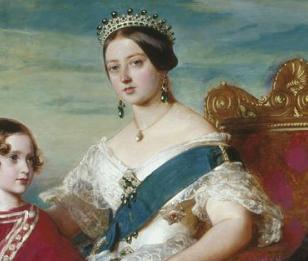
In honor of Friday's royal nuptials (and my fondness for Queen Victoria), here's a look at some of the elegant tiaras that graced the head of Britain's longest reigning monarch. Queen Victoria's collection of jewels was massive; as Queen, Empress of India, and ruler of an empire over which the sun famously never set, Victoria amassed an unrivaled set of precious jewels and stones from across the world. Some of these have been integrated into the Crown Jewels and are thus the perpetual property of the people of Great Britain, while others were the personal property of Victoria and Albert and have been passed down through the various branches of their very large and extended family. That family, of course, includes the present Queen Elizabeth II, who is often seen wearing one of these stunning pieces of history.

1) The Oriental Circlet, 1853

Photo linked from coloreddiamond.info.

This ruby and diamond tiara, made by Garrard's, was designed by Prince Albert for his wife.  Originally, the rubies were opals, which were Albert's favorite stone (and one of mine as well!), but Queen Alexandra later replaced them with rubies that had been given to Victoria in 1873.  The design, which includes lotus flowers and Moghul arches, was inspired by the Indian jewellry gifted to Queen Victoria during the Great Exhibition of 1851.  The circlet was passed down through Victoria's family line and was one of the Queen Mother's favorites.  It is currently owned by the Queen, who still wears it on occassion.


2) The Emerald and Diamond Tiara, 1845


Photo linked from The Anglophile blog.

This tiara (more appropriately a diadem) is part of a set which also includes earrings and two brooches.  All were designed by Prince Albert in the Gothic revival style popular during the period.  The set was produced by Joseph Kitching in 1845 and Albert allegedly paid a total of £1,150 for it.  In 1846, Victoria wrote in her diary, ""My beloved one gave me such a lovely unexpected present - a wreath, going right around the head, made to match the brooch and earrings he gave me at Christmas."

The Royal Family (1846), by Franz Xaver Winterhalter.
Image linked from the Royal Collection website.

Detail of the above painting, showing the emerald and diamond
tiara, along with the matching earrings and brooches.

The current owner and location of this tiara are unknown.


3) The Diamond and Sapphire Tiara, 1842

Photo linked from The Royal Forum.

Another Gothic-revival-inspired design by Prince Albert, this tiara features diamonds set in silver and kite- and cushion-shaped sapphires set in gold.  It cost the Prince Consort £415 when he commissioned it in 1842.  It was later given as a gift to the Princess Royal by her mother Queen Victoria, and then passed down through the family over the years.  It is now currently owned by the Earl and Countess of Harewood.

Queen Victoria (1842), by Franz Xaver Winterhalter.
Image linked from the Royal Collection website.

Detail of the above painting, showing a close-up of the diamond
and sapphire diadem, worn at the back of the head.


And one honorable mention: the "Girls of Great Britain and Ireland" tiara, 1893

Photo linked from GoldenAgedRegina blog.

Even though this piece was not worn or even gifted by Queen Victoria, I have to include it here anyway because it's my favorite of all the British royal tiaras.  This tiara was a wedding present to Princess May of Teck when she married Victoria's grandson; she became Queen Mary when her husband came to the throne as George V and she was thus the present Queen's grandmother.  The tiara is named for the group of women who collected a total of five thousand pounds to contribute this unforgettable gift to their future Queen Consort.  Made by Garrard's of diamonds mounted on silver, the tiara originally featured pearl finials, which Queen Mary later replaced with diamonds. 

Queen Mary with the "Girls of Great Britain and Ireland" tiara.
Photo linked from Golden Aged Regina blog.

"Granny's tiara" was later given by Queen Mary as a wedding present to her granddaughter Princess Elizabeth (Queen Elizabeth II) to celebrate her wedding in 1947.  Though Elizabeth chose the stunning fringe tiara for her special day instead, she has frequently worn her grandmother's piece for formal and state occassions throughout her reign.  And if you think it looks a little familiar, you're right: this is the tiara featured in the Queen portrait on British currency!

The Queen wearing the tiara, her favorite.
Photo linked from The Daily Mail.

So which one is your favorite?  And who else besides me is getting out her tiara for Friday morning's celebration?  :-)

For more on the British royal weddings of the past, be sure to check out our earlier post.  And for more on the tiaras of the British and European royal families, see this great "Tiara-pedia" on Mad Hattery.

Printed Sources featuring some of these tiaras:
- Tiaras: Past and Present, by Geoffrey Munn - This book is a re-release of the exhibit catalogue for "Tiaras," an exhibition staged at the V&A in 2002; it includes photos of several of the tiaras profiled above, with loads of stunning detail shots.
- Tiaras: A History of Splendor, by Geoffrey Munn - I'm honestly not sure how this book relates to the one above, other than that it's four times as long.  I personally have not seen a copy, though I'm sorely tempted to buy one now...!
- The Queen's Jewels: The Personal Collection of Elizabeth II, by Leslie Field - While most accounts of British royal jewels focus on the Crown Jewels, this one is unique in that it offers a rare glimpse at the personal, privately-owned collection of the Queen.

Wednesday, April 20, 2011

Threaded Bliss

A Pink Linen Shortgown,
last third of the eighteenth century

The back of the shortgown, showing its T-shape,
front, back, and sleeves cut entirely from one length of cloth.

Typically described as a T-shaped garment because its sleeves are cut as one with the body and it has no shoulder seams, the shortgown (or short gown, both spellings seem to have been used in the period, though whether they refer to the same garment remains unclear) was presumably worn as informal or working wear.  It features a shaped neckline and was often (though not always) semi-fitted by means of pleats in back (and sometimes in front as well); drawstrings at the neckline and/or waist have also been found.  Extant examples tend to fall between low-hip to mid-thigh length, and the waist height and length of the sleeves fluctuate depending on the general part of the period (generally, a higher waist and longer sleeves points to a later date).  They can be either lined or unlined.  There has been some considerable debate amongst scholars, researchers, and re-enactors regarding how common and widespread the shortgown was in the second half of the eighteenth century.  Some argue that it might have been a regional garment (mid-Atlantic and/or Quaker), while others point to the difficulty of pinning down written references in which "short gown" could mean anything from the T-shaped item above to a jacket or caraco-type piece that is more nearly and more simply a shorter version of a gown.  Because no surviving period image exists which positively identifies or describes a depicted garment as a "shortgown," the term has become the "modern" name used to distinguish a garment with these specific characteristics.  Whether we've matched the correct name with the garment remains to seen as research continues to delve into this enduring mystery!

Back of the shortgown

The pattern: Because shortgowns are pretty consistent in shape, cut, and construction, it was very easy to adapt a single pattern and give it some variation based off of other examples.  I scaled up one of the patterns in Fitting and Proper and slightly altered the front neckline (I prefer it slightly more square, though rounded is perfectly accurate as well) and changed the pleating pattern in back.  I also lengthened it from the hip-length of the original to the mid-thigh length of the shortgown patterned in Costume Close-up (again, that's a change dictated by nothing more than personal choice).

General references on this type of garment and its history:
- Baumgarten, Linda and John Waston. Costume Close-up: Clothing Construction and Pattern 1750-1790. Williamsburg: Colonial Williamsburg Foundation, 1999, pp. 43-46.
- Baumgarten, Linda. Eighteenth-Century Clothing at Williamsburg. Williamsburg: Colonial Williamsburg Foundation, 1986, pp. 30-32.
- Burnston, Sharon Ann. Fitting and Proper: 18th Century Clothing from the Collection of the Chester County Historical Society. Texarcana: Scurlock Publishing Co., pp. 20-25.
- Felshin, Sue. "Of Gowns, Jackets, "Shortgowns, and Bedgowns: What Should I Really Be Wearing?" BAR Courier Jan/Feb 2001; reprinted here at 18th Century New England Life.
- Hersh, Tandy and Charles. Cloth and Costume 1750 to 1800. Carlisle: Cumberland County Historical Society, pp. 142-4.
- Kidwell, Claudia. "Short Gowns." Dress Vol. 4, 1978, pp. 30-65.
- McConnon, Rhonda. "The Shortgown and Bedgown." Online. http://www.18cnewenglandlife.org/short_gown.htm
For additional resources and patterns, see our earlier post on shortgowns.

Construction details: As always, this garment is entirely constructed by hand.  It is by far one of the easiest and quickest projects I've ever done, from drafting to completion.  First, I scaled up the pattern of the second shortgown in Fitting and Proper.  Then I lengthened the pattern several inches so that I would fall at my mid-thigh, and cut it out.  The next step was to sew the side seams, which closes both the sleeve and body seams because of the way the garment is structured.  Because I was doing an unlined example, like the first short gown in Fitting and Proper, I used flat-felled seams to prevent the edges from raveling, with is consistent with that example.

The side seam, which extends from the end of the sleeve to
the bottom hem of the shortgown.

Now that the garment had some kind of shape, I put it on my dressform (which I don't like using for draping purposes because my stays won't fit on it, but Ashley wasn't around to be my body double!) and fiddled with the back pleats until I got a look I liked.  In the two examples in Fitting and Proper, the back pleats are more or less parallel to the center back; they run vertically from neckline to waistline.  I tried this pleating pattern, but wasn't quite happy with the boxy look it gave when I tried it on over my stays.  To give it the illusion that the waist is smaller, I angled the pleats slightly, in exactly the same way I would do an English back gown.  The pleats were then top-stitched down using a spaced backstitch.

Detail of the back with the tapered pleats.

Detail of the bottom of the pleats.  The center back pleat is the
deepest, in keeping with the pleating patterns of en fourreau gowns. 
Because the pleats end exactly at waist level, they release quite gracefully
into the "skirt" when an apron is tied around the waist.

Lastly, I turned all of the edges under and whipped them down.  In the unlined short gown in Fitting and Proper, a facing strip is used to conceal the top of the pleats in the back; I opted not to use one because my fabric folded under quite easily, even with the pleats. 

Back neckline.

This means that the ENTIRE garment it made out of one length of fabric, uncut and unpieced.  Many extant examples are pieced to lengthen the sleeves (and sometimes to widen the "skirt"), but because my linen was 54", it provided plenty of room to make the shortgown in a single piece of fabric.

The unlined interior of the shortgown, with the back
pleating fully visible.  All seams are felled to finish them.

For additional photos, check out the flickr album for this project.

The Fabric: A dusty pinkish/coralish linen, dyed by me (that in itself was an adventure!).  Shortgowns in the eighteenth and early nineteenth century were made of linen, cotton, fustian, linsey, or wool.  Stripes and prints are seen on extant examples.

Finishing the Look: Though an informal and relatively unfitted garment, a shortgown should still be worn over stays (and, of course, a shift!) and petticoat, and its neckline can be filled in with a kerchief.  Some surviving examples are secured in front (neck and/or waistline) with ties, but the majority seem to have been closed with pins and were then further secured with an apron.

The shortgown "in action," properly accessorized with a kerchief and
apron.  No, I'm not wearing stays, but that's because this was obviously
 an exceptional situation (i.e. the stays workshop!). 
Photo by Angela Burnley, linked from the Burnley and Trowbridge facebook page.

PS - I'm thinking of doing a detailed step-by-step tutorial (with lots of step-by-step photos again, of course!) on making a shortgown without a pattern, but want to be sure there is sufficient interest before I take the time to do another example and write it all up.  If this is something you would be interested in reading, please leave a comment or drop us an email to let us know!
Tuesday, April 19, 2011

"Napoleon and the Empire of Fashion"


Beginning with it's official opening in Milan last year, there has been some considerable blogger buzz regarding the exhibition "Napoleon and the Empire of Fashion."  The English-language version of the exhibit catalogue has just been released, and I received my copy over the weekend.  As the official website indicates, there is currently a poll in progress to help determine where the exhibit might travel next, and in an effort to encourage you all to vote to bring it here to the US, I strongly entreat you, gentle readers, to pay a visit to the poll page and vote your hearts out!  What I wouldn't give to see these extraordinary gowns in person!


For those of you unfamiliar with the project, "Napoleon and the Empire of Fashion" brings together hundreds of original garments, shoes, and accessories to represent a total of fifty-one fashionable ensembles from 1795-1815.  What is most fascinating and revolutionary about this particular collection is that its owners and curators, Cristina Barreto and Martin Lancaster, have assembled it around a set of key French fashion plates of the period, most of which appeared in Les Journal des Dames et des Modes (the first successful fashion magazine, according to the exhibit catalogue).  Over the years, Barreto and Lancaster made their purchases based not only on the conditions of items, but more importantly on how well they would coordinate to a gown or ensemble in color, style, provenance, and date.  After hearing Linda Baumgarten describe the difficulties of mounting delicate textiles and fragile accessories in a way that mimics drape and use on the human body (during her tour during the recent conference), I find it even more spectacular that these fifty-one figures have been fully outfitted and accessorized in (almost) all antique items, so that they appear as if they've stepped right out of the fashion pages next to them.

In both the exhibit and the catalogue, the inspiration prints are juxtaposed with their material realizations as gowns, shawls, bonnets, fans, veils, bags, and shoes almost literally come to life.  Part of the project also involved the meticulous cleaning and restoration of each item; as the curators explain in the catalogue, they wanted every piece to look as it appeared when it was first made and worn.  Back to be being "light, bright, and sparkling" (as Jane Austen would put it!), the fifty-one ensembles represent for the curators the revolution and evolution of fashion during the Napoleonic era, reflecting Napoleon's strategic manipulation of the textile and fashion industries to imagine and project a very specific and unique "Frenchness" for the people of France and the world.  As the catalogue introduction describes, mannequins approximating the body shape of an early 19th century woman in period undergarments were specially designed, though each has an identical head so that the fashionable ensemble each wears speaks for itself, creating a character and a specific social situation all its own.


Natalie Garbett, who helped coordinate and literally "dressed" the exhibition, keeps a blog, and several of her posts detail her experiences with staging the exhibition.  Her entries offer a fascinating and unique glimpse behind the scenes, showing not only the type and degree of work that goes into putting something like this together, but also the very personal and touching stories that emerge when one works so closely with garments and accessories from the past.  Her own reproduction sewing work is gorgeous, too, so be sure to check it out!

Besides the photographs on the exhibit site, additional official images of a number of the pieces (including some breathtaking detail shots) taken by Thomason Photography can be found here.  Video footage of the Milan exhibit, with commentary by the curators, can be viewed on YouTube by clicking here and here.

Sunday, April 17, 2011

Drancy Fess Ball

On Friday evening, we attended the annual Drancy Fess Ball held by our English country dance group.  For those of you unfamiliar with the origins of "drancy fess," I present for your reading pleasure the spooneristic tale of "Prinderella and the Cince"!  Enjoy!

Listening to Marshall recounting the tale of "Prinderella and the Cince." 
She's amazing and can do it flawlessly!

Every year, the Drancy Fess Ball is given a theme meant to inspire our choice of dress (err, drancy fess!).  This year, however, we somehow were all so busy that we forgot to settle on a collective theme, so we all came dressed in whatever made us each feel drancy and fessed up, which produced a very fun conglomeration of outfits!  Some (like us) came in period attire, while others came dressed as their favorite dances; The Female Sailor, The Comical Fellow, Sun Assembly, and The Merry Milkmaids were the cleverest of the group for their inspired and creative ensembles!  Next year's theme is "mythical beasts," so this ought to be a challenge!

We're very, very lucky to be able to dance with a splendid English country dance band, led by the incomparable Marshall Barron, with Grace Feldman and Margaret Ann Martin.  The band typically numbers between 10 and 15 members, and they play from Marshall's own lovely arrangements of traditional and modern dance tunes.  It's such a delight and a privilege to be able to dance to live period music each week.  Our instructor, Peggy Vermilya, is impressively well-versed in ECD past and present, and her great sense of fun keeps our evenings lighthearted as we learn and dance together.

Our dance band, during the traditional closing waltz of the evening.

I'm sorry I didn't get any pictures of actual country dancing in action, but we were too busy frolicking all night!  We had a blast enjoying our last meeting of the season, and can't wait to rejoin our dancing friends again in the fall.  Thankfully, there are a couple of upcoming local ECD balls hosted by other organizations that will fill some of the gap and help to satisfy the dancing itch for a couple of months, so we don't feel too deprived until September!  Stay tuned for lots updates on those balls, coming soon!

Thursday, April 14, 2011

Connecticut Needlework, 1740-1840 Exhibit at the CT Historical Society

The Connecticut Historical Society in Hartford, CT.

On 5 March, the weekend before we headed down to Williamsburg for the symposium and conference, we made the short trip to the Connecticut Historical Society in Hartford to visit their exhibit, "Connecticut Needlework: Women, Art, and Family, 1740-1840."  The exhibit had been on our "to see" list ever since it opened last year, and we had to be sure to see it before it closed the weekend we'd be in VA.  We're very glad we did because it was fantastic and included a superb variety of rare New England-made objects, many unique and all quite beautiful.  I apologize for the lack of pictures in this post, but I promise it's worth reading!  All images taken in the exhibit were strictly for private research use according to the museum's policies, so we're unfortunately unable to share them here, but many of the items are available for viewing on the CHS eMuseum.  Here are a few of our favorites:

- Two panels of a crewel-embroidered linen petticoat dating between 1750 and 1755 (acquisition number 1950.518.0).  The documentation and family history provided with the fragments asserted that this was originally two-thirds of a petticoat created specifically to be worn for a wedding.  I suspect instead that this might have functioned as a underpetticoat, which would account for the very narrow circumference if the fragment does indeed represent two-thirds of the original garment, though that's just a personal speculation; on the other hand, though, the panels are fully embroidered from waist to hem, while many underpetticoats (like this one, which was also featured in the exhibit) were embellished mostly around the bottom third, so my speculation could easily be wrong.  Anyone else have any ideas about that?  At any rate, the embroidery is beautifully done in a stunning floral and vines patterns very representative of the period, and I wish they'd make a pattern off of it because I'd love to recreate it.

- An absolutely amazing linen bedcover, decorated with crewel embroidery, dating to 1760-1770 (acquisition number 1964.35.0).  Be sure to check out the close-up photos to get a better view of the incredible detail in this piece.  The center features an eighteenth-century-clad representation of Adam and Eve.  As I refer back to my photos as I write this, I'm amazed at how fully accessorized these figures are.  That may seem like a random and irrelevant comment, but returning to this bedcover after the accessories symposium, I'm struck by the detail here.  The woman wears an apron and a blue-beaded necklace tied with a yellow-gold ribbon; this same colored ribbon also appears at the peak of her cap (which you can't see) and is used as a breastknot pinned to the front of her gown.  She also holds a fan and sports a pair of buckled red shoes.  Her dashing be-wigged gentleman carries a walking stick and a felt hat.  This just goes to support one of the primary arguments made during the symposium: one simply cannot gain an accurate concept of 18th century dress without looking at it in the context in which it was worn.

- This red satin-weave worsted (calamanco) petticoat (acquisition number 1959.54.2) is a fascinating and unique example of regional needlework.  Its design, which integrates its year of execution - 1758 - is full of whimsy and an eye towards the fantastical.  It includes a mermaid (the symbol of vanity), a lion, a leopard, fish, stags, rabbits, birds, a butterfly, and various flowers and vines.  A sketch of the complete hem design, drawn by Linda Baumgarten and John Watson (of Costume Close-up fame), is included in the catalogue for the exhibit (see below for more on that).

- Faith Trumbull's silk-embroidered overmantel (acquisition number 1925.1.3), dated to approximately 1761.  It is one of a set of three intricately embroidered pastoral pieces, the size of which alone is jaw-dropping.  The scene measures 18.25" by 51.25" (yes, you read that correctly!).  The foundation fabric is a black silk, which means that every last inch of it has been embroidered - aside from the man's breeches, hat, and shoes.  Faith Trumbull, you may recall, is the eldest daughter of CT governor Johnathan Trumbull, whose hometown of Lebanon we recently visited.

- This charmingly adorable and stunning cotton muslin dress (acquisition number 1959.11.2) features white-on-white embroidery and was worn by a teenage Charlotte Perkins in Hartford between 1805 and 1810.  The exhibit's curators speculate that the embroidery was done by Charlotte herself, rather than by a professional, because of its relatively uneven qualities.  The muslin is extremely sheer, which means the gown would have been worn over an underdress (the display features one in pink).

The exhibit catalogue, available directly through the
CT Historical Society.

Although the needlework exhibit is now closed, all of these item are owned by the CT Historical Society and can be viewed by making an appointment with the collection's curator.  A gorgeous full-color 220-page catalogue is also available from CHS and is well worth the price.  The photography is beautifully done and it's chock full of fantastic details about the exhibit items and the history of needlework in eighteenth- and early-nineteenth-century New England.  I highly recommend it!

I have also traced a couple of video links of the exhibit on YouTube, which offer further glimpses at some of the treasures on display: video one and video two.  Please note that neither of the videos were produced by us.  More images can be seen with this review of the exhibit from Antiques and the Arts Online.

The CT Historical Society frequently offers lectures, book talks, workshops, youth programs, and special events, so if you're in the area, be sure to check out their events calendar.  Their newest permanent exhibit, "Making Connecticut," provides an interactive historical timeline view of the life in and the culture of the area, from native and colonial settlement up through the 21st century.  We were able to browse through much of the exhibit in its preview form and were struck by the museum's innovative initiatives to engage the "modern" museum-goer in history.  Our father's family arrived in the greater NYC area in the late seventeenth century and we can trace their settlement in southwestern CT back almost that far, so seeing this exhibit, arranged in its timeline form, was particularly relevant and interesting to our personal history as well.  The exhibit formally opens on 25 May and we're looking forward to returning to see it in its finished form.