
A Pair of 18th-Century Cotton Dimity Pockets
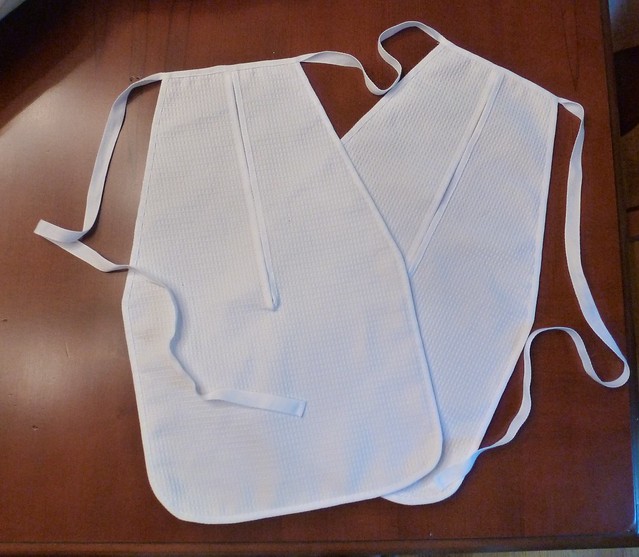
A pair of cotton dimity pockets.
How many of you reenactors and costumers have found yourselves discussing the layers of your 18th-century clothing with inquisitive visitors, only to reach the subject of your pockets and feel your face flush with embarrassment as you're obliged to pull out that ONE ITEM of ugly-fabric machine-made clothing on your body? You try to conceal the offending article as much as you can whilst still demonstrating its function to your audience, but all the while you're mentally kicking yourself for not having spent the extra time to make a hand-stitched accurate example.
Yes, that's me. After finding myself in this awkward position no less than three times at
the OSV reenactment a couple of weeks ago, I have finally reached my breaking point and decided that my old, icky cotton drill pockets are no longer acceptable. They represent one of the first pieces of 18th-century clothing I ever made years and years ago, and I did them quickly on the machine to try to save time, assuming, of course, that "no one will ever see them, so who knows they're machine-made but me?" What worked for me then simply doesn't cut it any more! Yes, they have served their function well over the years, but YES, it is high time they're replaced! If I can completely hand-sew my stays and even make my own shoes, for heaven's sake, there's just no excuse not to have hand-sewn pockets that I can demonstrate at programs with confidence!
So motivated by the three-times-too-many experience at OSV and inspired by Samantha's own recent pocket reincarnation, here's my brand new set of pockets, now perfectly prepared to be exposed to public inquiry!
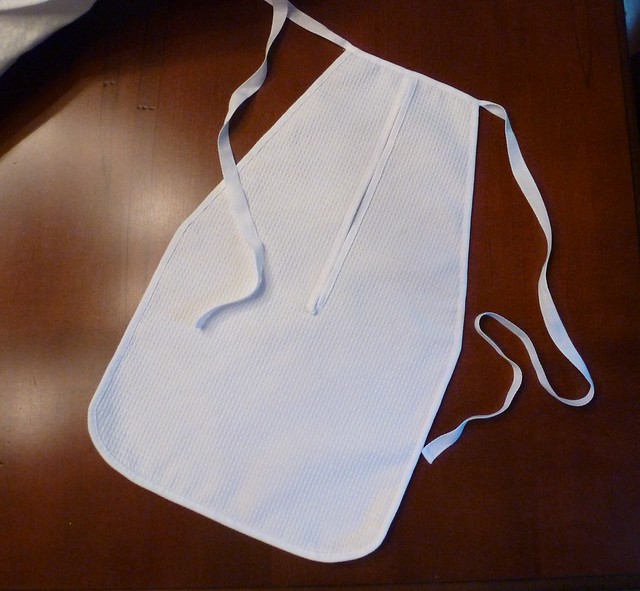
Extant pockets appear both singly and as pairs.
The pattern: The shape of 18th century pockets is pretty consistent across most extant examples and images. Basically, it's just a long vertical rectangle with corners rounded at the bottom and then shaped to narrow slightly towards the top to minimize bulk around the waist. It's such a simple, geometric shape that I just drew it free-hand right onto the fabric, using measurements from museum examples as my height and width guides.
Inspirations: Many surviving pockets are beautifully and heavily embroidered; indeed, this is probably the reason they were treasured and preserved through the centuries. There are, however, a handful of utilitarian examples in museum collections, and these are a lovely testament to the fact that the every-day working woman did not always have the time to devote significant effort to embellishing a functional piece of clothing that no one but she would ever see. These plainer extant pieces are, arguably, more representative of 18th-century pockets than their more pretty embroidered sisters.
In her own post about her new pockets, Samantha highlighted three excellent examples of these plain pockets, and these likewise served as primary sources for my own reproductions here. One is a white cotton-linen dimity pocket, dated 1785-1810, in the collection of Colonial Williamsburg (acc. no. 1964-411). This particular pocket uses different fabrics for the front and back and is lined with a third fabric. It is bound around the edges with white linen tape. The top appears to have a casing through which to insert a tape to suspend it around the waist.

Samantha's excellent sleuthing also unearthed another white dimity example, this one presumably a full cotton. It is dated to the late 18th century and is similar in shape to the CW example. Its edges are also bound with linen tape, but instead of having a channel to insert a tape tie, this pocket is finished with a tape binding across the top and seems to have tape ties tacked to either side of the top.

My third inspiration source, which Samantha also provided a link to in her post, is another white dimity pocket, this one owned by Abigail Adams. What specifically interested me with this particular source, however, is a citation the author listed in the description of a letter written by Abigail Adams to Thomas Jefferson on 10 July 1787. Adams writes asking for reimbursement for "diaper for pockets." This reference is what dictated my choice in fabric.
Check out the 18th Century Notebook page on pockets for a multitude of additional varied examples.
Construction details: Based on the several extant examples I've read specifics on both in books and online, there seems to have been a couple of different ways to construct a pocket. Not knowing exactly how the CW and the MFA examples were constructed, I took the details I had on other pockets and combined them when putting together mine.
To ensure maximum strength (I keep all sorts of period and non-period stuff in my pockets at events, from a cup-and-ball game for the kids to money (period and plastic) to my camera and cell phone!), I did a reinforced seam around the edges and then top-stitched the tape over this to finish the edges. The top is finished with a tape binding that is the same as the waistband tape. This means that the pockets are not adjustable (I can't slide them along the tape to change where they sit on my hips), but I'm okay with that. Based on my research, it was pretty evenly divided between single pockets with tape channels, single pockets with tacked-on tapes, and a set of pockets tacked to the same tape waistband.
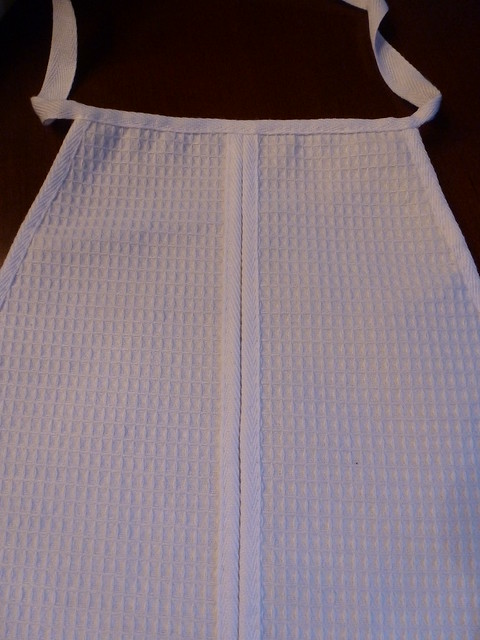
Detail of the access slit.
Because my fabric is a medium weight and can very easily support the weight of the pocket contents on its own, I didn't feel it was necessary to line my pair. Many of the lined examples are only lined in front anyway to help protect the back side of the embroidery from being chafed by items in the pocket. Since that wasn't an issue here, I just did mine with a single layer.
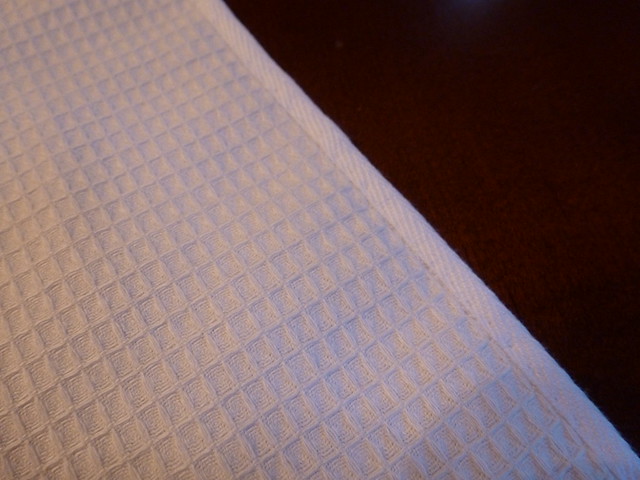
The tape-edge of the pocket.
The fabric: A white diaper-weave cotton dimity from Burnley and Trowbridge. They are unlined and the edges are bound with white cotton tape.

Finishing the look: Pockets, no matter how elaborately decorated, should always be worn under the outermost layer of clothing, concealed from view. Occasionally, you will see period images where a woman's gown has been pulled back and the edge of her pocket is sticking out, indicating that she is wearing it over her petticoat, but still under her gown. In general, though, a lady's pockets should not be seen.

Francis Wheatley's "Fresh Gathered Peas," one in the
"Cries of London" series exhibited between 1792-5.
You can see the woman's pocket peeking out from beneath her pulled-back gown.
Image linked from www.spitalfieldslife.com.
Pockets are tied around the waist, usually over the stays to allow easiest access, and can be worn either singly or as a pair. I've chosen to sew a pair onto a single waistband so that one pocket can contain my modern accessories during events, and the other can be filled with period goodies and can thus be pulled out for inspection by public eyes!

I love my new pockets!

