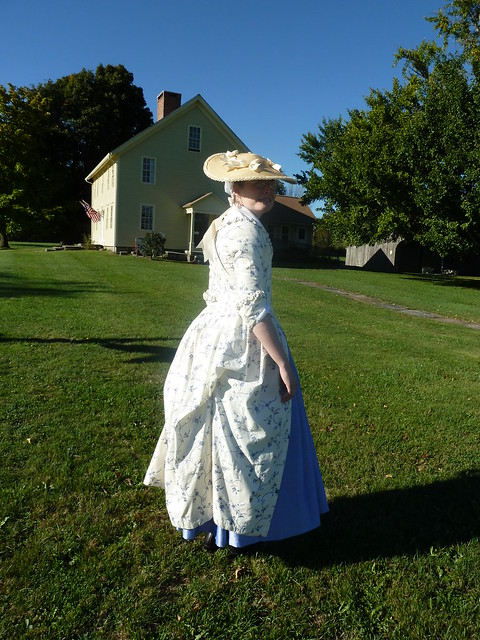
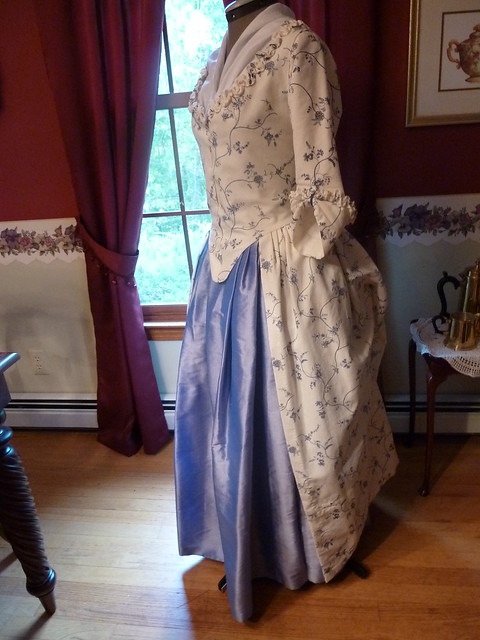
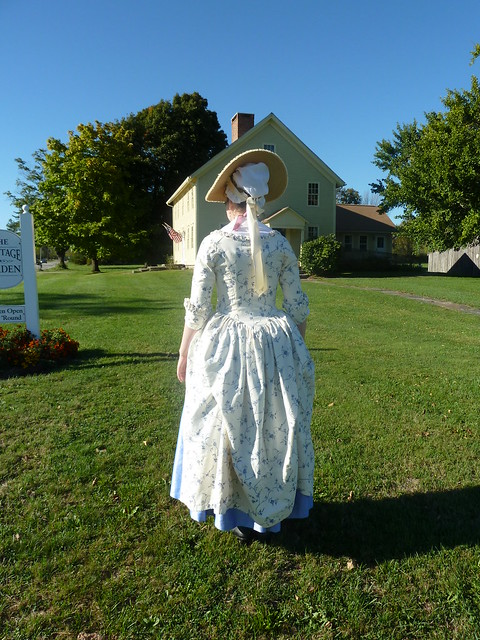
A Blue Flowered Cotton Print Quarter-Back Gown 1770-1785, Reproduced from Janet Arnold
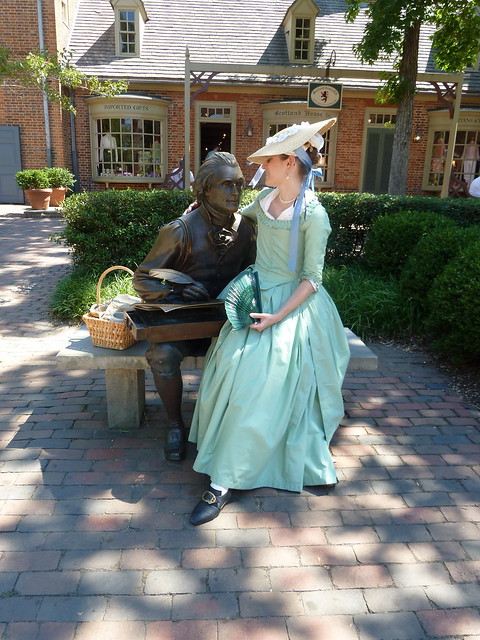
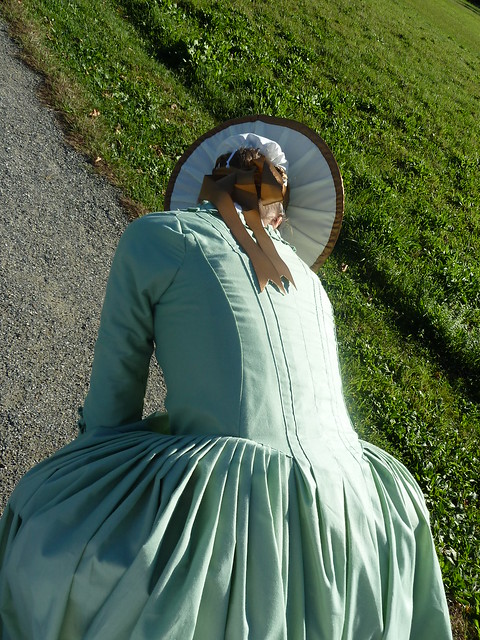
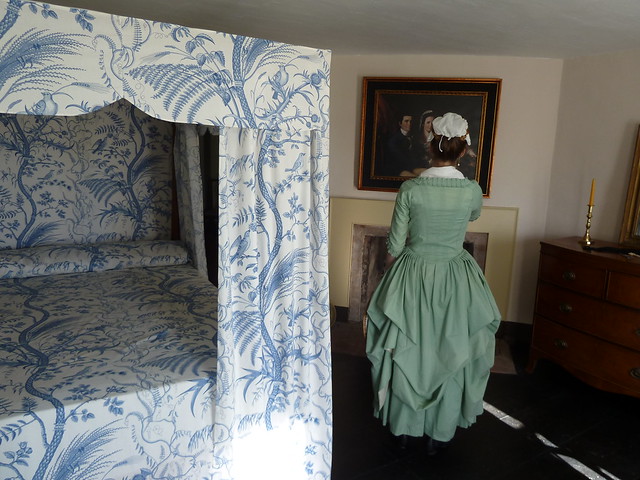
In front of the Jonathan Trumbull, Jr. House, Lebanon, CT
The pattern: Patterns of Fashion 1: 1660-1860, by Janet Arnold, pp. 37-39. The same gown is sketched by Nancy Bradfield in
Costume in Detail: 1730-1930, pp. 57-58. The sleeve cuff details are copied from
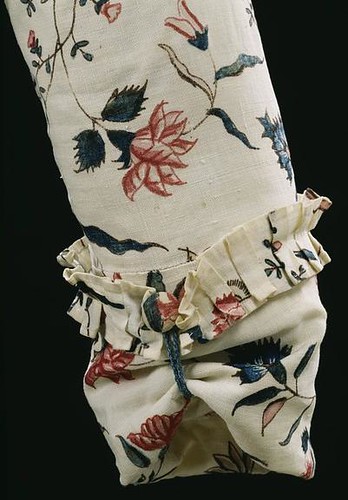
this Indian chintz caraco, dated 1770-1780, that I photographed (albeit it badly!) in the collection of the V&A back in 2006. Incidentally, it's also featured in
Fashion in Detail from the 17th and 18th Centuries, pg. 95, though I only just realized this a couple weeks ago!
Construction Details: This gown is entirely hand-sewn using the period techniques and construction notes provided in
Patterns of Fashion. Though not nearly as detailed as
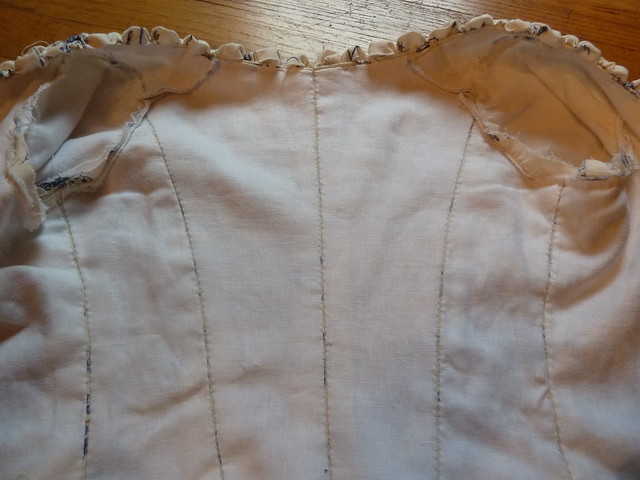
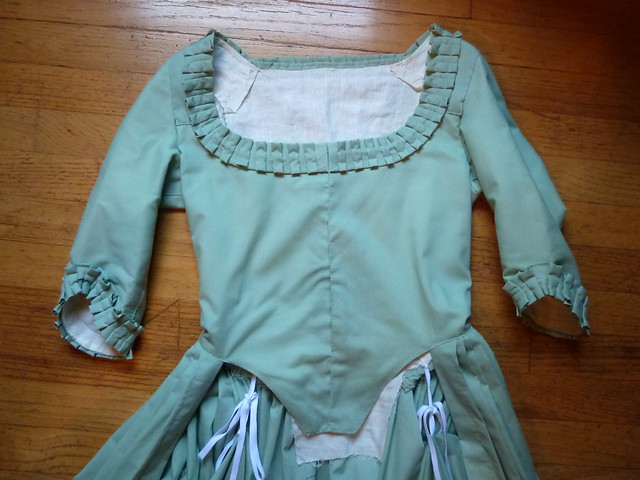
Costume Close-up, Arnold's book provides enough information to garner a good idea of the assembly process for each garment. Each piece of the bodice is lined in cream linen and finished separately; these pieces are then joined together using tiny whipstitches (over-handing) so that they lie flat when opened.
The interior of the bodice, showing the individually finished pieces
whipstitched together to lie flat
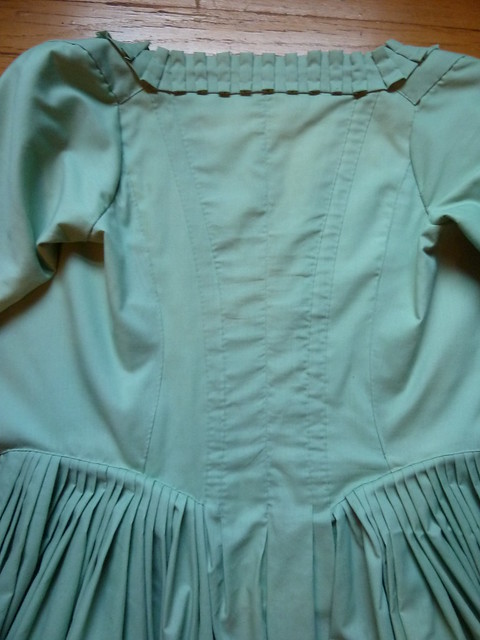
The sleeves are also finished separately, and their bottom half backstitched from the inside before the top half is fitted while on the body and top-stitched to the shoulder strap from the outside. The gown's skirts are folded over, pleated, and then stitched to the bottom of the bodice from the outside. The excess fabric is left to hang loose on the inside to provide a bit of body to the pleats of the skirt.
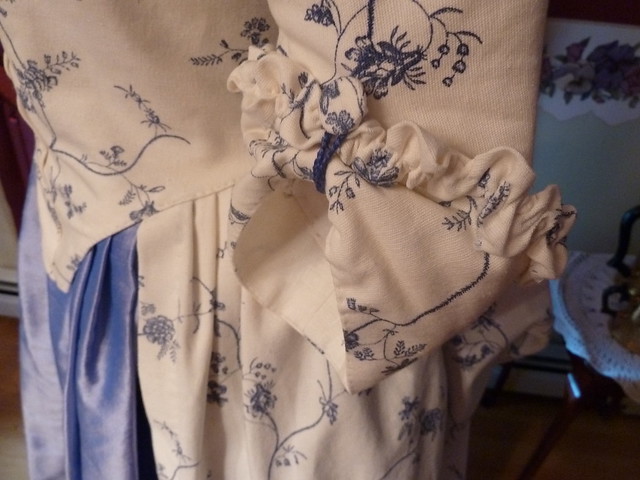
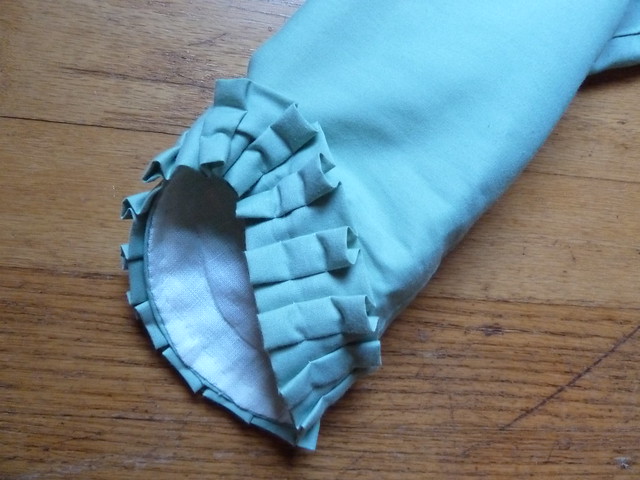
The sleeve cuffs are separate pieces, tacked on at the bottom to the sleeve ends. They are trimmed with self-fabric ruching (I used box-pleats on the sea-greaan gown, so I decided to depart from the "inspiration sleeve" and go with ruching for this gown instead) and shaped by drawing an indigo blue hand-braided cotton cord over a covered button. I was enthralled by this unique little feature when I saw it on a
caraco in the V&A. The caraco dates to the same period as the gown, so I decided it was acceptable to transpose onto my reproduction (that, and I just thought it was so pretty and since then I've been itching to use it on something!).
Sleeve detail of the India chintz caraco, 1770-1780
Sleeve cuff detail, reproduced from the example above
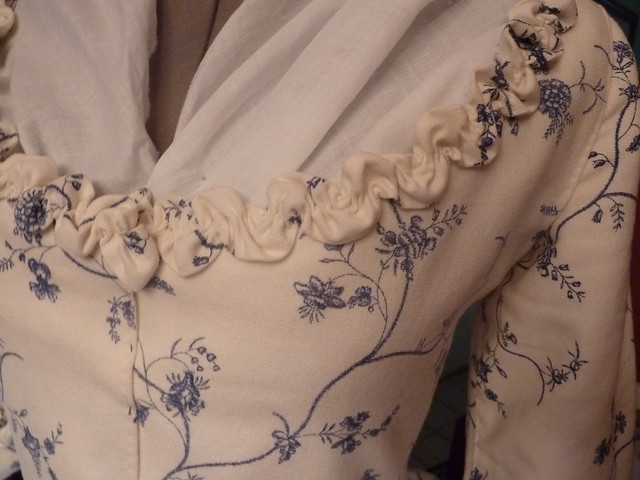
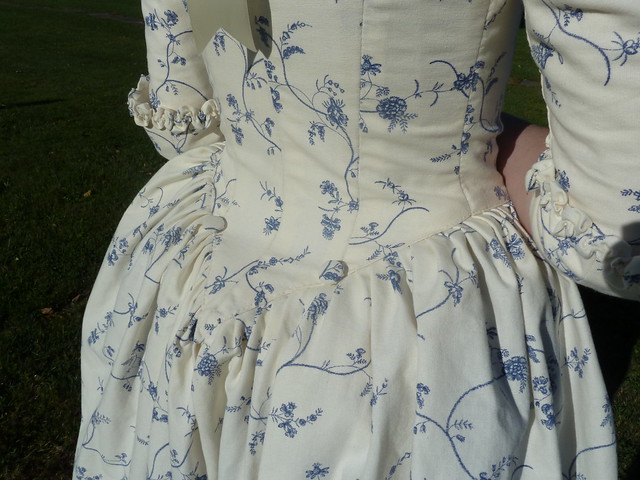
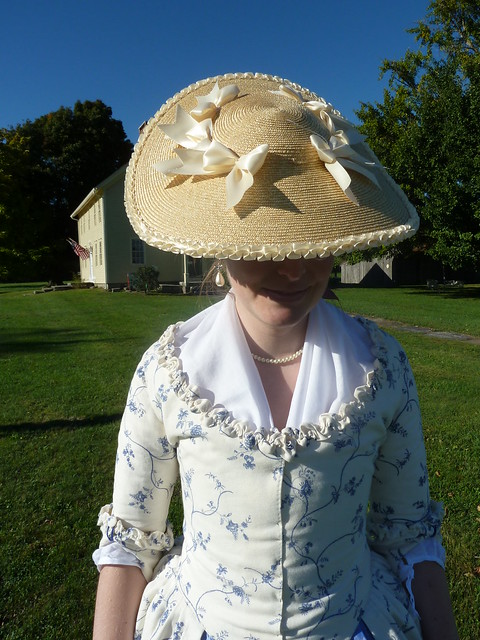
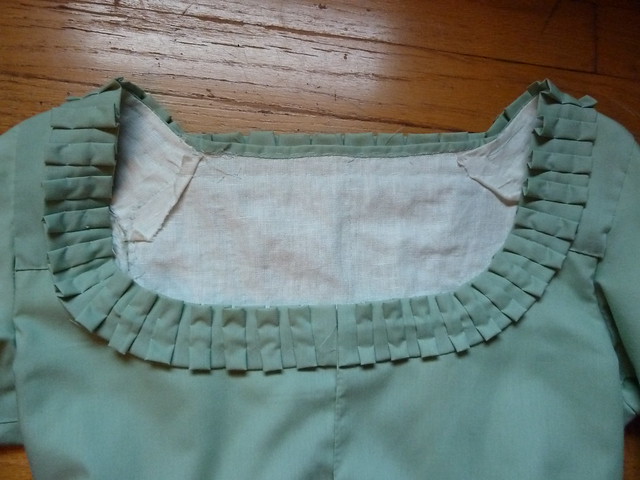
The self-fabric ruched trim on the sleeve cuffs also appears on the neckline of the gown. Many thanks to my costuming friend Laurie for sharing knowledge and inspirational photos to help create this embellishment!
Detail of the neckline trim and the front center closure, secured with straight pins
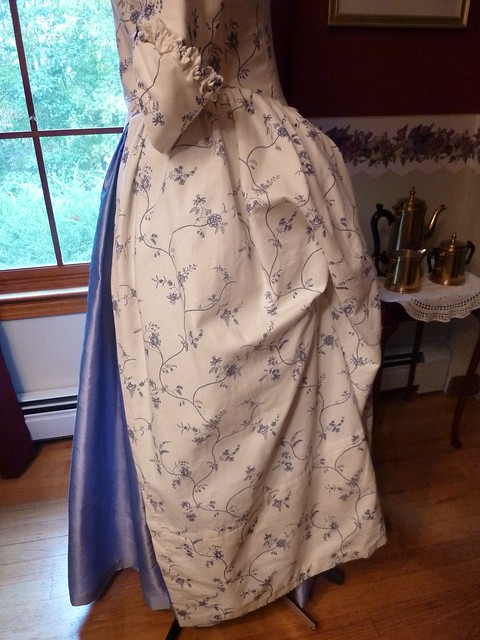
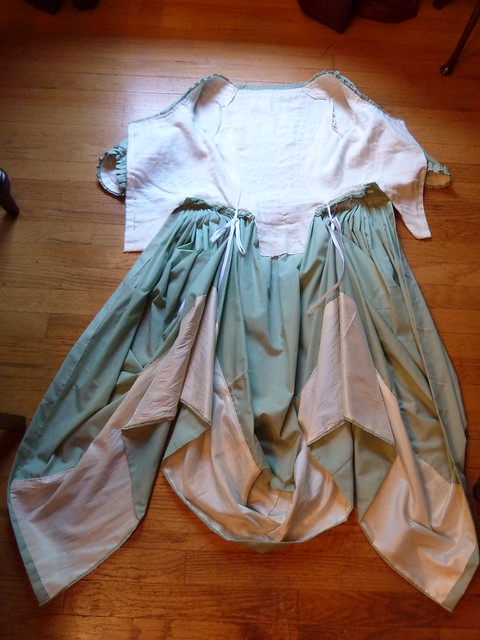
I also decided to line the bottom 9” of the gown skirts with china silk. Because the skirts will often (if not always) be worn a la polonaise, the bottom of the skirt will show and this was the period solution both to making the visible bits of the gown pleasing to the eye and protecting the hem when it is worn down. This feature can be found on the gown on pages 36-7 of Patterns of Fashion 1, which dates to the same period.
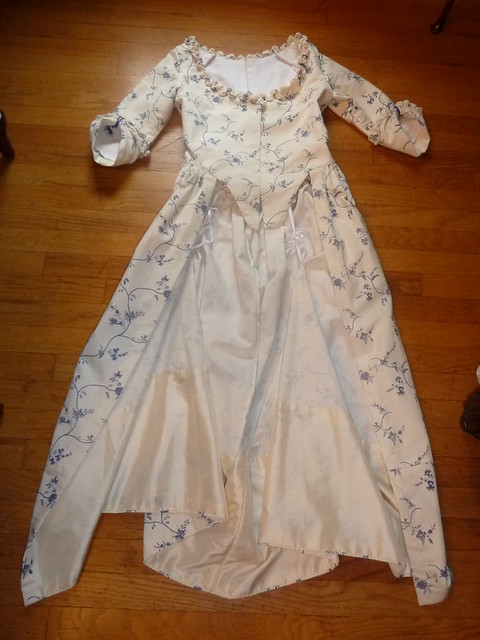
The interior of the gown, showing the folded over tops of the
skirt panels, the cotton ties used to drape the skirts,
and the china silk hem facing
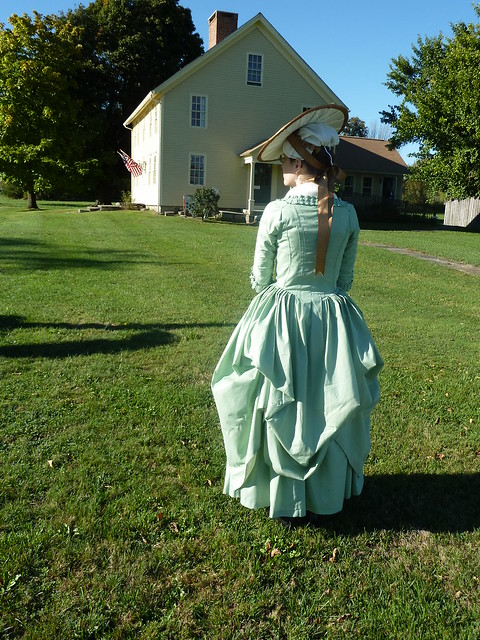
Although the original gown drew the skirts up into the "a la polonaise" draped fashion by drawing a looped cord from the inside to the outside and securing it on self-fabric-covered buttons, I opted for a slightly different technique. Because the sweep of my skirts is only 81" (I had a very limited amount of fabric with which to work), instead of the 114" of the original, I copied the more subtle draping style used in the gown on pages 36-7, which has a sweep of 78".
The more modest draping of this skirt accommodates the
smaller width of fabric available in the skirt panels. Compare this
wider sweep of skirts that is 126". Both skirt widths and both
draping styles can be found in extant garments.
Back detail showing the covered buttons (here only decorative,
though the original used them to drape up the skirts)
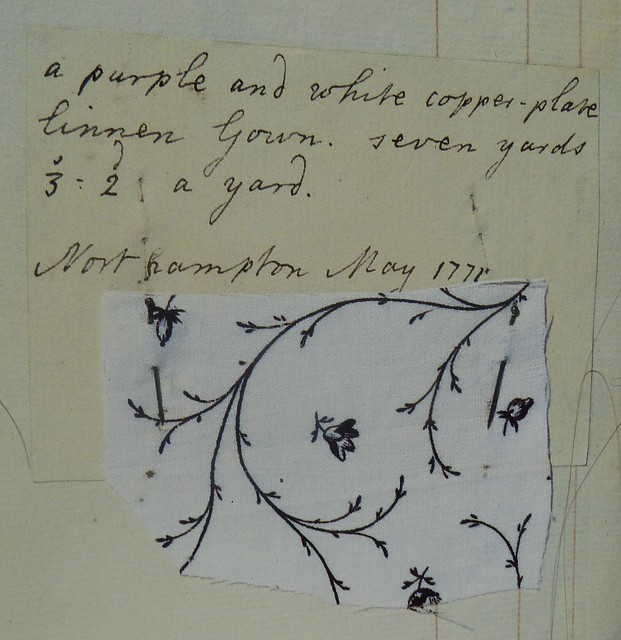
The fabric: This is a discontinued and very hard to find print by Laura Ashley that a fellow costumer very generously helped me identify when I admired it so much on one of her own gowns. It is 90% cotton/10% linen, and though slightly heavier than an 18th century clothing textile would have been, the monochrome indigo blue print is a very close approximation to the meandering floral-and-vines designs popular in the first half of the 1770s. There is a swatch of a purple and white copper-plate linen print in
Barbara Johnson's album (below, from page 14 of the album) that has a similar monochromatic floral/vine pattern.
A swatch of a copper-plate printed linen, dated 1771, from
The bodice is lined with a medium-weight cream linen and the hem faced with cream china silk.
In the photos, the gown is paired with a cobalt blue and white changeable silk taffeta petticoat. As Sally Queen's
Textiles for Colonial Clothing notes, changeable silks were extremely popular throughout the 1770s.
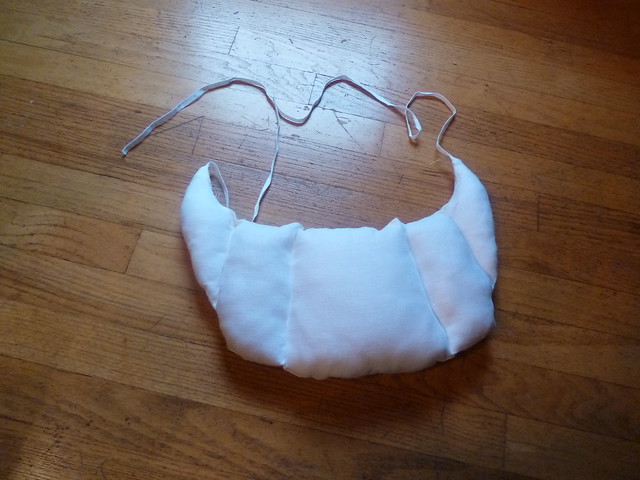
Finishing the look: The gown is worn over a fine linen shift, half-boned Diderot stays, a bum pad (based on those depicted in
Costume in Detail on page 43), and two linen petticoats.
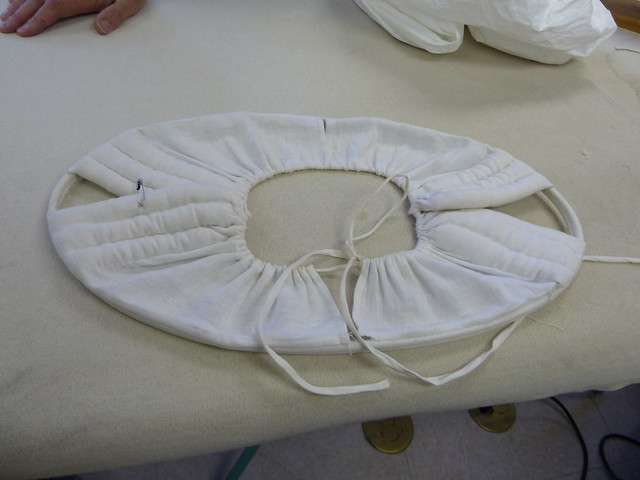
Bum pad, from a pattern I drafted based on examples given in
Costume in Detail. This helps give a fashionable late-70s and early-80s
shape to the draped "a la polonaise" skirts.
Pairing the gown with a silk petticoat creates an upper-middling class impression for this gown (though it could also be worn with either a cotton or linen one to make it a slightly less formal and less costly outfit suitable for a marginally lower social station, as this type of simple, single-color print would not have been particularly pricey by the mid-70s). In keeping with the upper-middling persona, I've accessorized it with a single-strand pearl necklace tied with a silk ribbon, a pair of pearl drop silver earrings by
Janice Erickson Smith, and a straw hat embellished with lots of silk satin ribbon. A fine linen lawn handkerchief fills in the low, wide neckline.