Monday, August 15, 2011

Redcoats & Rebels at Old Sturbridge Village 2011

The weekend of August 6 & 7, I attended the ninth annual Redcoats & Rebels at Old Sturbridge Village.  I was present for last year's events as a spectator and experienced a very different perspective this year as distaff with the 5th CT.  It was reported that this year provided record numbers for both participating reenactors and for visitors, and I can easily believe it!

 
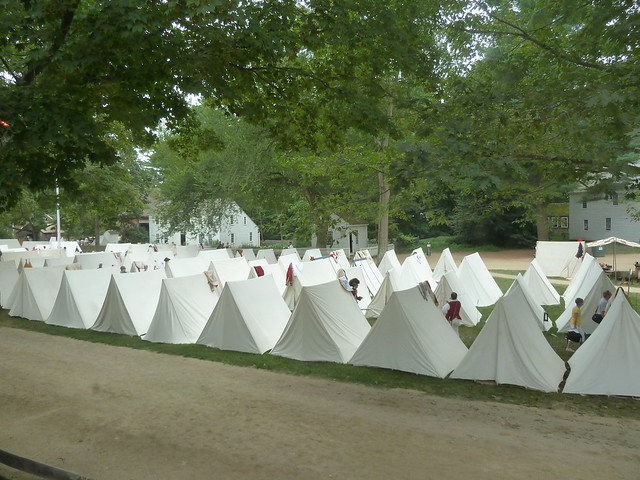
British tents on the Old Sturbridge Village Common for Redcoats & Rebels, 2011. 

Saturday morning I arrived and upon registration was directed to the area where our regiment was supposedly encamped.  Since I've been to OSV before and knew the layout pretty well, I didn't think finding our group would be a difficult task.  Unfortunately, I was directed to the complete opposite side of town from where our camp actually was.  After a great deal of wandering and several inquiries, I made my way to the lower fields and luckily ran into our Commander as he was leaving the morning meeting.  We then walked over to our camp, which was hidden in a back field covered with furrows and where the grass was quite overgrown (oh the grasshoppers!), which made spotting the furrows difficult as you walked.  Despite our unlucky camp ground, it was wonderful to see everyone and to have the opportunity to bond with some more members of the group.
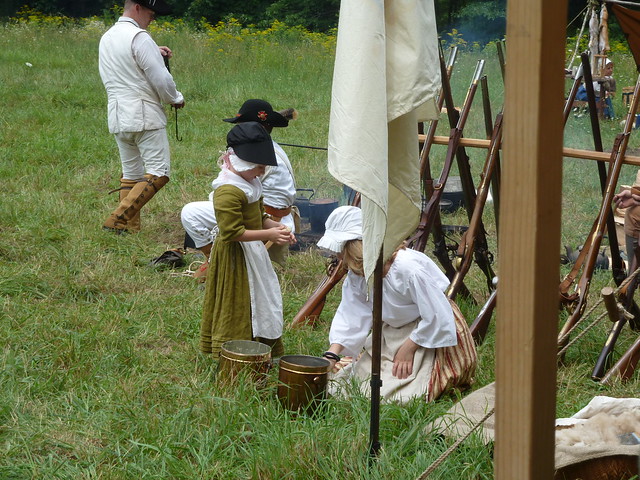
Girls dipping candles in camp at Redcoats & Rebels, OSV 2011

After lunch, the ladies followed the men to the field for the battle reenactment.  We staked a position near the fence in order to capture some action shots.  Unfortunately, as they started retreating, we ended up in the line of the redcoats' fire and we had to retreat as well!
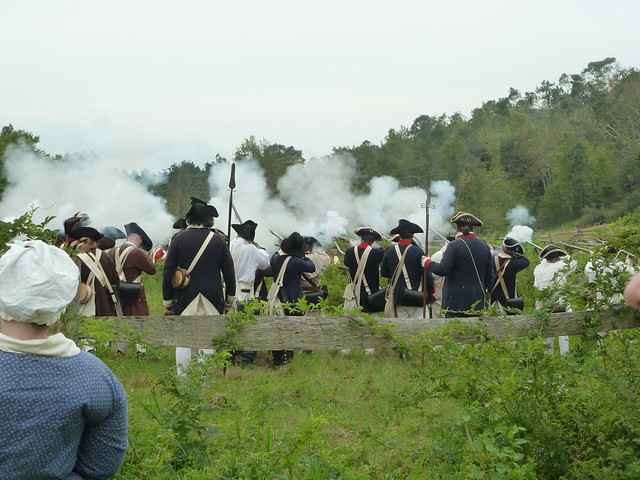
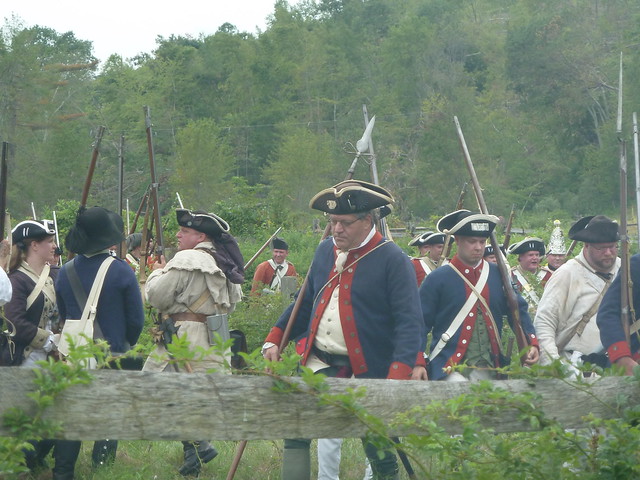
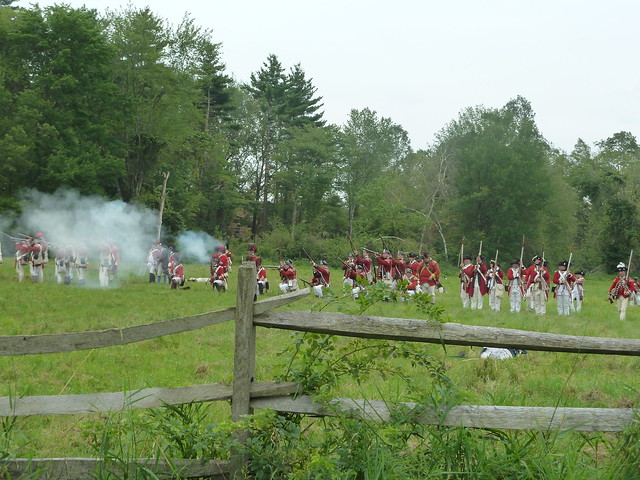
 

Saturday's Redcoats & Rebels battle reenactment at Old Sturbridge Village.

 Since our camp was rather distant from the other sites, we unfortunately did not have many visitors to interact with on Saturday.  Some of the children in the camp next to us dipped candles and I managed to get a few stitches done on a new jacket.  In the afternoon a few of us took a stroll through town to enjoy the fife and drum music and to visit some of the other camps and open exhibits.  We ran into a few acquaintances (although I am sorry to have missed Mary from An Historical Lady!) and stopped for some photo ops along the way.  After dinner, some of our members presented an evening of music in the tavern and we all gathered to attend.  Our Commander debuted his gorgeous new gold silk banyan (lined with sea green silk) and cap, both his own creations!
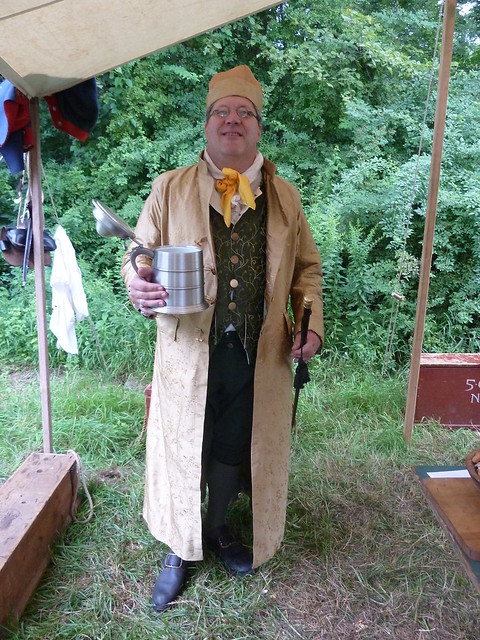
Our Commander prepared for a fun evening in his new gold silk banyan and cap
(this photo, unfortunately, does not do his work or the stunning color justice!),
with his new friend Franken-Stein in hand.

I did not stay for the Jolly and as I drove out of the parking lot to head home for the night, the rain began to fall.  That was an interesting drive home.  It poured all night and was still coming down in the morning.  Even with the inevitable mud and the probability of canceled events, I drove back to OSV on Sunday morning.  On my way to our camp, I stopped at some shops to catch brief reprieves from the rain (and to make some purchases as well!).  We remained gathered under our fly until the rain ceased just after noon and the humidity and sun came rushing back.  With the battle called off, we began packing up and bid farewell to each other until our next event together.  Most of the other groups had gone or were packing up early as well, so I took some time to visit some more exhibits before leaving town.
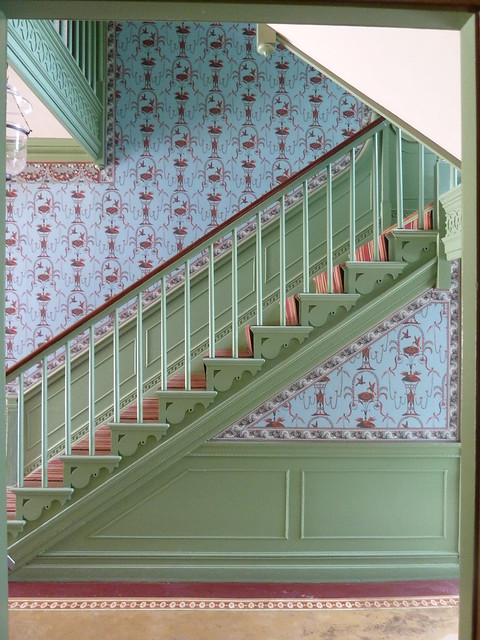
The main staircase at the Salem Towne House, Old Sturbridge Village

As always, I've included a few photos from the weekend in a flickr set for your enjoyment.

Friday, August 12, 2011

18th Century Shoemaking Workshop!

I’m sure by now most of you have seen Nicole’s exquisite pair of hand-made silk shoes on her blog, Diary of a Mantua Maker.  I am also confident that many of you have heard that her most competent instructor, Mr. Walker, will be hosting a week-long ladies shoemaking workshop in New York in just a few weeks!  It will be held at the idyllic Eastfield Village near Nassau, NY, August 20-27.  We are both already registered to attend what promises to be an enlightening and fun week.  Believe it or not, there is still time for you to register, too!  Nicole posted a nice overview of what the workshop entails.  If you have any inquiries or curiosities concerning the workshop, please contact us or comment on this post and we will get you in touch with Mr. Walker (due to possible spam issues we are not posting his e-mail address here).  If you are interested in participating, please get in touch posthaste to ensure your inclusion in this most unique opportunity.  For any of you who might not be able to attend the entire workshop or who are interested in learning about working with leather without investing in an entire pair of shoes, a general leather stitching class on Saturday, August 20 is being offered to the public for a nominal fee and is also still open for registration.

For those of you who are unable to attend, be sure to check back here for updates during the workshop!

Wednesday, August 3, 2011

Finding the Faces of Pride and Prejudice in San Francisco

I'm currently on a two-week trip to CA for a conference and am taking advantage of my time here to visit with some west coast friends I rarely get to see. On Thursday, my friend Kathey and I took a trip into San Francisco to see the SFS perform Music for the Royal Fireworks and both Vivaldi's and Piazzola's Four Seasons, the latter two with Lara St John. It was fantastic, and by far one of the best performances of the Four Seasons I've ever heard, either live or recorded.

But anyway, I digress. Before the concert, we stopped by the Legion of Honor to see the Dutch and Flemish masterworks exhibition currently on display there (quite lovely and worth the trip if you live close enough to go!). After spending some time in there, we explored the rest of the museum and Kathey (who has been to the LOH numerous times before) brought me to what she fondly calls the "Pride and Prejudice" room.  Hung entirely in European (mostly British) portraiture from the eighteenth and early nineteenth centuries, this one particular gallery contains within it faces which look curiously familiar.  Bringing me from one portrait to the next, Kathey would say, "And who's this?" and somehow my answer was always consistent with hers.  It was such fun that I thought I'd share our little adventure in character-finding with you.  See if you can't identify which fictional characters from Pride and Prejudice we found so eerily reflected in these well-known portraits of real people from the past!

First we encountered this gentleman:

Sir Duncan Campbell, Bart., by Henry Raeburn (1812).
Image linked from worldvisitguide.com.

Look familiar?  What about this chap, who we discovered peering at us from the opposite side of the doorway?

Alexander Carre of Cavers, by Henry Raeburn (1802).
Image linked from worldvisitguide.com.

Hung directly to his right (rather condescending of him, don't you think?) was this dashing gentleman who I am sure you must know by sight:

Sir William Napier, Bart., by Henry Raeburn (1811-21).
Image linked from worldvisitguide.com.

Imposingly displayed in another corner was this lady, painted in her youth, of course, and oh-so-appropriately by none other than Sir Joshua Reynolds:

Anne, Viscountess Townshend, by Sir Joshua Reynolds (1779-80).
Image linked from worldvisitguide.com.

And opposite her, we espied this fine looking pair (it looks like they've risen quite nicely in the world, doesn't it?):

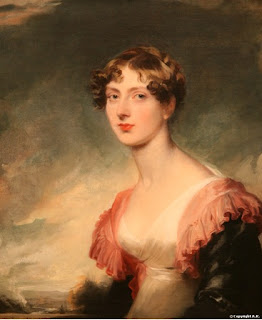
Mary, Countess of Plymouth, by Thomas Lawrence (1817).
Image linked from worldvisitguide.com.

Other Archer, Earl of Plymouth, by Thomas Lawrence (1817).
Image linked from worldvisitguide.com.

I hereby issue a challenge to you all, dear readers, to put forth your suppositions as to the identities of these fair-faced personages!  A rousing "Huzzah!" to anyone who can identify them all!

Incidentally, Jane Austen herself also enjoyed the pastime of searching out the faces of her fictional characters in the real-life portraits of her contemporaries.  In a letter to her sister Cassandra on 24 May 1813, she wrote:
"Henry and I went to the exhibition in Spring Gardens. It is not thought a good collection, but I was very well pleased, particularly (pray tell Fanny) with a small portrait of Mrs. Bingley, excessively like her.
I went in hopes of seeing one of her sister, but there was no Mrs. Darcy. Perhaps, however, I may find her in the great exhibition, which we shall go to if we have time. I have no chance of her in the collection of Sir Joshua Reynolds's paintings, which is now showing in Pall Mall, and which we are also to visit.
Mrs. Bingley's is exactly herself -- size, shaped face, features, and sweetness; there never was a greater likeness. She is dressed in a white gown, with green ornaments, which convinces me of what I had always supposed, that green was a favourite colour with her. I dare say Mrs. D. will be in yellow."
                                                        Jane Austen's Letters, p. 212
The actual portrait Austen singled out as very like "Mrs Bingley" in green ornaments has been identified as "Portrait of Mrs Q (Mrs Harriet Quentin)," by William Blake.  Although our Mrs Bingley isn't sporting green, we felt pretty confident that she was quite fond of pink as well, and that Mr Bingley certainly loved her enough to commission two portraits, at the very least.  :-)

Portrait of Mrs Q, by William Blake (1820).
Linked from arttattler.com.

Friday, July 22, 2011

A Royal Display from "that" Special Day

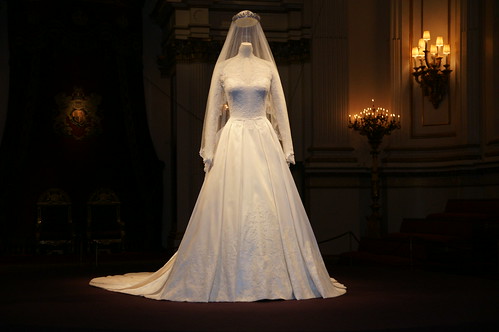
The Duchess of Cambridge's wedding dress
The Duchess of Cambridge's Sarah Burton/Alexander McQueen wedding gown,
currently on display in the regal surroundings of the State Rooms at Buckingham Palace.
Photo linked from the British Monarchy flickr stream.

Today, the Duchess of Cambridge got a new perspective on some of her last memories as Kate Middleton.  Side by side with Queen Elizabeth, she toured a new display that will open tomorrow at Buckingham Palace and which will be a featured part of the Palace's Summer Opening public touring season.  "The Royal Wedding: A Story of Great British Design" features the Duchess's now-iconic Sarah Burton/Alexander McQueen wedding gown, along with her veil and shoes.  It also showcases the stunning jewels worn for the occasion: the Cartier "Halo" tiara lent by the Queen, and the earrings given to the bride as a wedding gift from her parents.  A reproduction of the bridal bouquet and the wedding cake - yes, the real thing, still mostly intact! - complete the royal display commemorating "the" wedding of a generation.

Royal Collection curator Caroline de Guitaut arranges the train of the wedding gown.
Photo linked from ABCNews.com.

By far the best thing about this exhibit - made even more thrilling because it can be fully enjoyed even by those of us who live across the pond and are too far to be able to go! - is the tremendous and unprecedented amount of detail the Royal Collection offers online about the gown and the other items from the display.  At long last, we have photos that allow us a very fine and up-close look at the incredibly intricate craftsmanship that makes this simple yet elegant gown such a landmark creation of British fashion.  Be sure to check out the zoomable photos of the gown (and that lace, oh that lace) on the gown detail page, and don't miss the podcast with Royal Collection curator Caroline de Guitaut, which not only includes a fascinating discussion of the gown's design, but also a supplemental set of photos with even more views of this special piece of royal fashion history.  The podcast is a treasure in itself, well worth the time.

Detail of the gorgeous lace-covered bodice of the wedding gown.
Photo linked from ABCNews.com.

Additional photos of the gown and other pieces can be found on the official British Monarchy photostream on flickr and on ABCNews.com.

Admission to the exhibit is included with the ticket to the Buckingham Palace State Rooms and can be purchased online.  The Summer Opening begins tomorrow and extends through the 3rd of October.  Further information can be found on the Royal Collection website, and the press release about the exhibit can be viewed here.

Thursday, July 14, 2011

Jane Austen Still Sells...in the Millions

Today, one of the few surviving manuscripts written in Jane Austen's own hand sold at Sotheby's in London for $1.6 million, tripling its estimate.  The draft is a fragment of a novel called "The Watsons," which Austen began in 1804 and never completed.  Today's sale included the 68 pages that form the latter part of the autograph manuscript; during WWI, the first 12 pages were auctioned in a Red Cross benefit and are now owned by the Morgan Library, where they are occasionally put on special display.

A number of journalists and bloggers reporting this news today express wonder at the buyer's desire to spend such a prodigious sum on pages that are now readily available online.  Thanks to Jane Austen's Fiction Manuscripts, a joint project to digitize and make freely available images of every known Austen autograph manuscript, anyone can fully access - up very close! - the auctioned fragment of "The Watsons," as well the portion owned by the Morgan, alongside other Austen works.  It is a three-year project that, in its finished form, hopes to bring together once again the over 1,000 pages of the Austen "archive" that were dispersed amongst the Austen family in 1845.

A page from the auctioned "Watsons" fragment.

But it isn't hard to see the appeal of the physical pages...even $1.6 million worth of it.  In an article about the launch of the Manuscripts website, Professor Kathryn Sutherland outlined an often neglected corner of Austen studies: her compositional and editorial processes.  Sutherland explains that even a cursory glance at Austen's manuscripts reveals how different the author's manuscript prose is from its published version, mostly thanks to her editor, likely William Gifford.  The article goes on to detail:
"Gifford was a classical scholar known for being quite a pedant. He took Austen's English and turned it into something different - an almost Johnsonian, formal style," Prof Sutherland said.
"Austen broke many of the rules for writing 'good' English. Her words were jumbled together and there was a level of eccentricity in her spelling - what we would call wrong.
"She has this reputation for clear and elegant English but her writing was actually more interesting than that. She was a more experimental writer than we give her credit for. Her exchanges between characters don't separate out one speaker from another, but that can heighten the drama of a scene.
"It was closer to the style of Virginia Woolf. She was very much ahead of her time."
Part of my time at Oxford involed a bibliography class taught by Professor Sutherland.  Her book on her study of Austen's manuscripts, Jane Austen's Textual Lives, had just been released, so (luckily for me!) many of her examples during the class were drawn directly from that research.  We were priviledged to hear in detail about the discoveries she had made simply by choosing to look at the manuscripts in this way for the very first time.  The book is fascinating and very readable, so if you have an interest in this subject, I highly recommend it.  For those of us who can't afford the $1.6 million to study the manusciprts ourselves, resources like these will just have to be next best thing!


Further Resources:
- Sotheby's catalogue for today's "English Literature, History, Childrens' Books and Illustrations" auction can be viewed here.  The Austen manuscript was Lot 51.
- If you're interested in learning more about the other surviving Austen's manuscripts, be sure to check out the Morgan Library's online counterpart to their recent exhibit, "A Woman's Wit: Jane Austen's Life and Legacy."  The e-exhibit includes a short but very well-done video and access (complete with super-zoom capabilities) to digital images of a number of the pieces in the Morgan's Austen collection - including the first 12 pages of "The Watsons"!

Wednesday, July 13, 2011

Reproducing L.M. Montgomery's Trousseau

Back on January 7th, we did a post about the wedding clothes and trousseau of L.M. Montgomery, a discussion prompted by the discovery of a pattern of Anne's wedding dress from the third Anne movie, Anne of Green Gables: The Continuing Story.  In that earlier post, we marveled that photos, a verbal description, and even swatches of some of the fabric had survived to record Montgomery's trousseau in such intimate detail.  Just imagine my surprise and delight when I discovered this post on Laurie's blog yesterday about a tailor who has just finished recreating almost the entire trousseau in honor of LMM's 100th wedding anniversary.  Talk about a historical costumer's dream project!

Smith with the reproduction trousseau.
Photo linked from the Guardian article.

In a July 4th article for PEI's Guardian, tailor Arnold Smith describes how he got the idea to bring Montgomery's trousseau back to life.  For the 100th anniversary of the publication of Anne of Green Gables back in 2008, Smith costumed Cavendish's commemorative parade and picnic, and it was during his research for that event that he stumbled across the images of the trousseau.  This past February, he began work on it and the six garments premiered a week ago to mark the milestone anniversary of LMM's wedding day.

Smith meticulously researched each of the gowns in order to reproduce them as closely as possible.  As with any true reproduction project, however, some issues had to be thoughtfully addressed.  For instance, because the photographs of the original clothing show only the front sides, he delved into turn-of-the-century issues of the Ladies Home Journal to find similar styles that could provide an idea of how the rest of each garment most likely looked.  Fabrics, too, were carefully researched and selected both for their appropriateness to the period and according to LMM's own stated preferences for color tones, as Smith describes on his blog.  And to make these pieces as close as possible to true reproductions, Smith even constructed them in Montgomery's exact size, using her own detailed description of her physical appearance and measurements (Smith's blog entry offers the full quotation from the Journals).

Smith's reproduction of LMM's favorite gown from the trousseau.
Photo by Arnold Smith, linked from his blog on the project.

What I find most interesting about this project is the fact that it enlightened Smith (and all of us seeing the physical manifestation of these gowns now) not only about the garments themselves, but also about the woman who selected and wore them, offering an innovative way into thinking about the famous author's personality, her preferences, and the social pressures under which she functioned.  "'She liked nice clothes. As an author, she was always being asked to speak, so she knew that she needed things that were classy,' he says.  But, as a minster’s wife, she could never be over the top.  'To be taken seriously she had to be both well dressed and appropriately dressed. Her trousseau reflects that,' says Smith" (Guardian article). 

From now until the end of the summer, half of the reproduction trousseau will be on view at the Green Gables Heritage Place in Cavendish, PEI, and the other half can be seen at the Leaksdale Manse in Uxbridge, Ontario, where LMM lived after her marriage and where 11 of the 22 works published during her lifetime were written.  If you can't make it to see the reproduction trousseau in person, be certain to visit Arnold Smith's blog for many more details on the project, the process, and the products, including lots of superb research and loads of pictures!  For further information, see also the Guardian article mentioned above, and this article in The Buzz.

If you're interested in reading more about LMM's original trousseau, be sure to visit our earlier post (which includes photos and a list of resources), as well as the Confederation Centre's "L.M. Montgomery's Wedding Clothes" page.  Additional photos of the trousseau can be found in The Selected Journals of L.M. Montgomery, Vol. II and in The Lucy Maud Montgomery Album, by Kevin McCabe.

Thanks again to Laurie for discovering this story and sharing it!

Monday, July 11, 2011

No trip to Colonial Williamsburg is ever complete...

...without a trip (or two...or maybe even three...yes, we're very sad!) to the Margaret Hunter milliner's shop.  We know that a number of our readers, like us, delight in wallowing in endless pictures of period clothing, so here's a mini photo-essay of some of the more recent creations of the incredibly talented milliners/mantua makers and tailors at Colonial Williamsburg.  Enjoy the pretties!

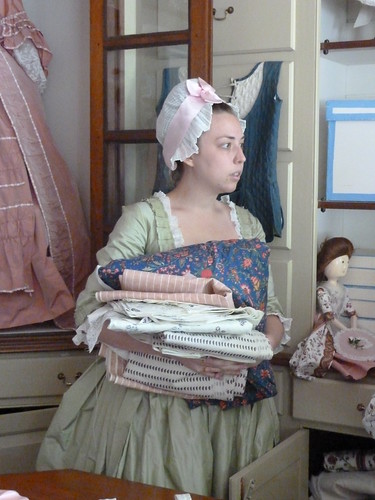
Colonial Williamsburg milliner's shop
Apprentice Sarah organizing the fabric.  Sounds like fun to me!

On Saturday during Under the Redcoat, we stopped by the shop ever so briefly on our way back to camp, just to see what was new on display (and also to enjoy a snatch of much-needed air conditioning!).  Our visit was short lived, however, because the shop was quite busy with visitors, so we snapped a few quick pictures and headed back to "work."

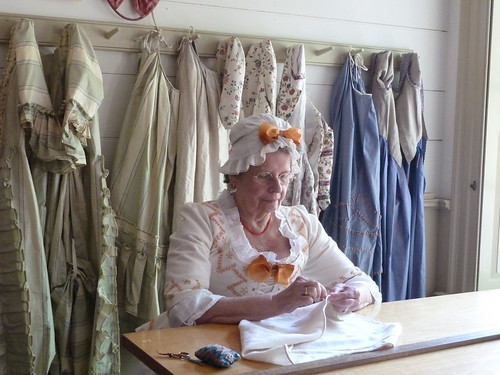
Colonial Williamsburg milliner's shop
Journeywoman Mrs Warren at work
(and wearing her stunning embroidered jacket - I love that color).

Colonial Williamsburg milliner's shop
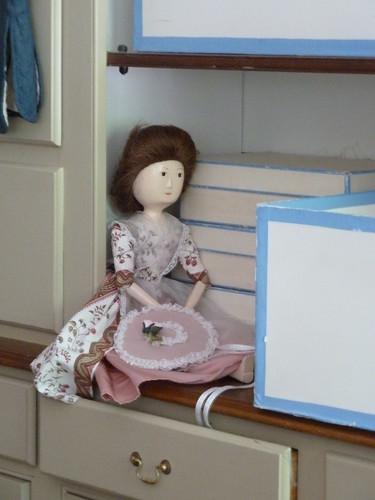
A fashion doll perched on a shelf, silently yet
very ably advertising her wares.

Knowing that Sunday is typically the day in the shop for the tailors, we were sure to make time amongst our UTR duties the next day to stop by again to consult with Mr Hutter about some questions that have arisen about our stays since we started them in the Burnley and Trowbridge workshop back in April.  He very graciously and helpfully assisted with our quandaries, and after chatting a bit more about the progress of our stays (we were incredibly lucky we caught the shop at a rare quiet time), we admired some of the gentlemen's items on display and then ventured back out into the heat to watch our regiment perform in the afternoon's firing demonstration.

Colonial Williamsburg tailor's wares
The "Spruce Sportsman" coat, waistcoat, and hat, along with some infant stays.

Colonial Williamsburg tailor's wares
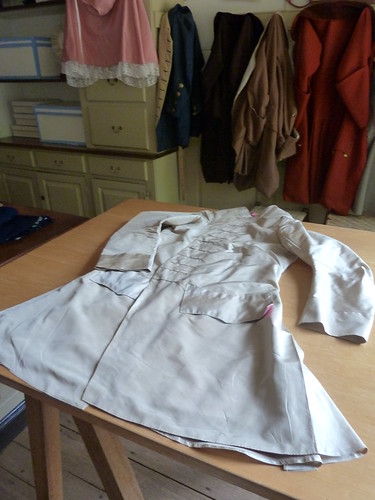
A gorgeous coat of creamy silk taffeta, lined in pink.  It's absolutely stunning;
I wish we had gotten a better shot of the lining contrast!

Colonial Williamsburg tailor's wares
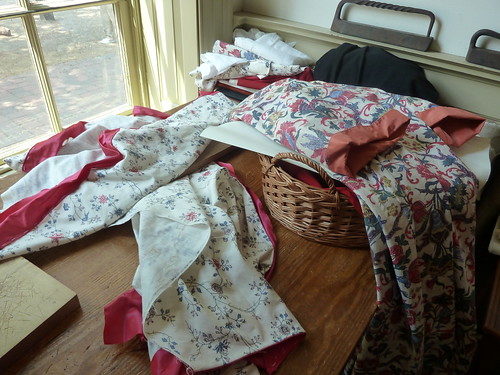
The tailor's worktable, strewn with two in-progress chintz banyans.

Our final visit came the following Saturday, to indulge in the pleasures of "Silk Saturday."  Heavenly silk gowns, hats, and petticoats adorned the shop, which was busy with visitors conversing eagerly with the shop's new young interns.  What a fantastic atmosphere!  After chatting for a bit with Sarah about some of her recent research (thanks so much for so generously taking the time to share all of that with us!), however, we very reluctantly dragged ourselves away.  If only we could have stayed all day!

Colonial Williamsburg milliner's shop
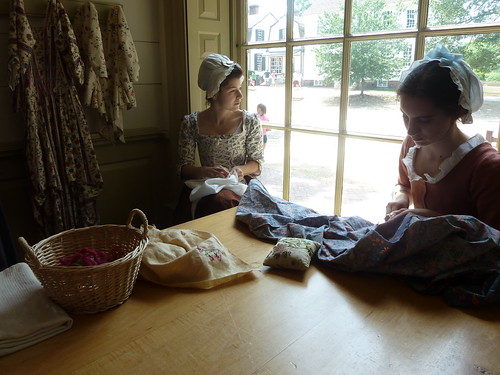
Interns hard at work, catching the sunlight.

Colonial Williamsburg milliner's shop
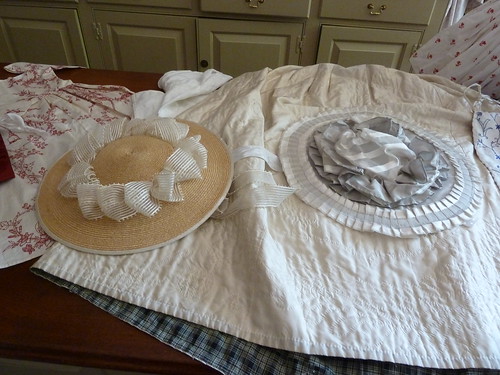
A quilted silk petticoat and a couple of hats, all of which I wanted
to carry home with me!

Colonial Williamsburg milliner's shop
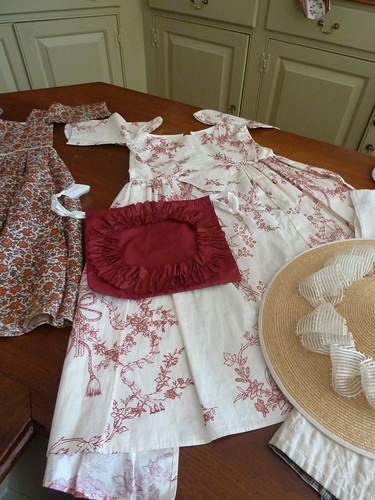
An infant's gown with a red taffeta bag displayed on top.

If you'd like to see more of the impressive work done in the Margaret Hunter shop, be sure to visit their facebook page!  Some additional photos of ours can be found in our flickr set and by clicking on the "CW milliner" tag below.