Monday, January 30, 2012

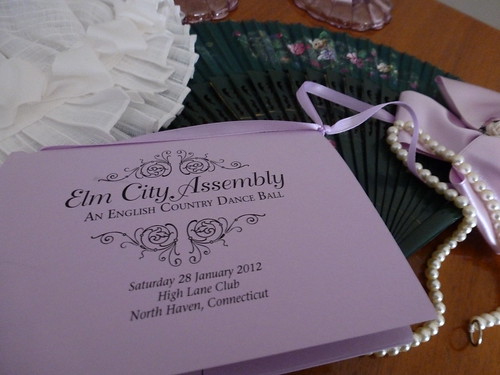
2012 Elm City Assembly

Elm City Assembly

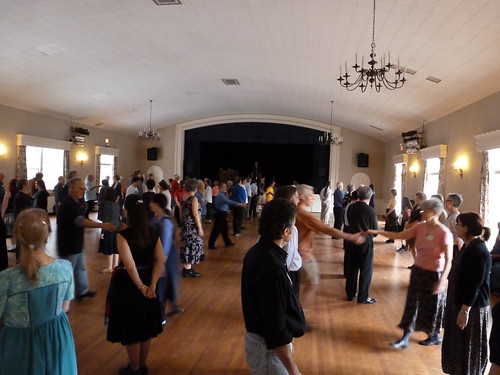
On Saturday, our English country dance group hosted its annual Elm City Assembly.  This year was our first in a new venue, which featured a gorgeous, spacious hall for dancing, a lovely picturesque staircase, and plenty of facilities to accommodate our 150 guests and their armfuls of garment bags full of formal wear.  We had dancers drive in from as far away as Pennsylvania, New Jersey, and New York to attend the event, along with lots of fellow Connecticutians, and it was great fun reuniting and catching up with friends we've met at past balls.  We also were surprised and quite flattered to meet a blog reader; thanks so much for saying hi and for persuading me into that last dance!  :-)

Elm City Assembly
Our lovely new venue...

Elm City Assembly
...filled to the brim with dancers during the afternoon practice.

We attended our usual bi-monthly dance practice on Friday evening, and then were up early on Saturday to do some last-minute food shopping for the big event.  This year, Ashley and I volunteered to coordinate the refreshments for the afternoon practice and the evening assembly.  Although a LOT of work (much more than we anticipated!), we had fun laying everything out and making all of the treats look pretty and festive.  Thank you to everyone who donated something and helped to make the dessert spread so delightfully tasty!

Elm City Assembly
Ashley preparing the "secret recipe" punch.

Elm City Assembly
Our lovely volunteer offered to snap a picture of us with one of the
refreshment tables before it was carried out to be enjoyed.  Thank you so
much again for your help all night!

Our music this year was provided by several of the musicians from our incomparable ensemble from our Friday dances; many thanks to Margaret Ann, Phoebe, and Mark for gracing our evening with your talent.  You make us all feel so elegant!  Joanna Reiner, who called the afternoon practice and the evening ball, selected some fantastic dances, almost all of which were new to us.  From Playford originals to contemporary country dances set to traditional tunes, the repertoire was a perfect balance.  We even discovered a couple of new favorite dances this weekend, including "Interruptions," "Stepping Stones," and "Banish Misfortune."
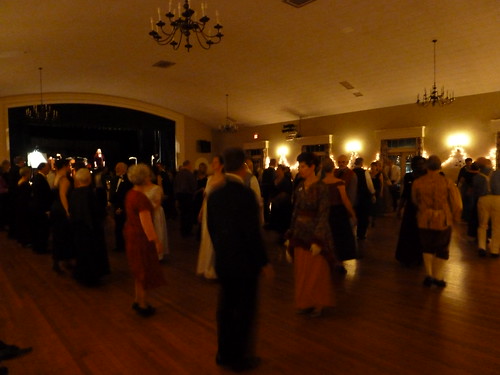
Elm City Assembly
Dancing the night away!

Because the light was so low in the dance hall and throughout much of the building, many of our pictures unfortunately came out quite grainy and blurry.  Ashley did, however, manage to snatch a video of one of the last dances of the evening, "Stepping Stones," and if you listen closely, you can hear the (very!) old floor creaking.  The ballroom was on the second floor, with the dressing rooms beneath, and when you were downstairs during a dance, it sounded as if the ceiling was about to come crashing down around you, it was so loud!


Ashley didn't have a chance to finish her new silk gown for this event, so she wore her favorite brown chintz quarter-back gown.  For the very first time, however, I had my gown finished two weeks ahead of schedule - a definite achievement considering that last year, we were half an hour late for the ball because we were furiously finishing Ashley's blue/yellow sacque-back gown on our way out the door (literally!).  There's a Threaded Bliss post on my new gown forthcoming, but here's a sneak peak.  Stay tuned!
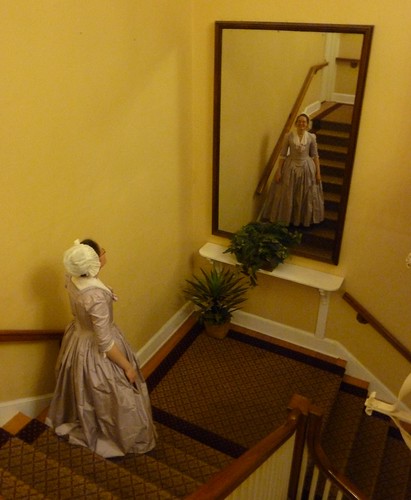
lavender silk anglaise
My new lavender silk anglaise.

Additional photos from the afternoon practice and the evening ball can be found in this event's flickr set.

Thursday, January 19, 2012

History in Hyde Park...NY, that is! (Part Two)

The second and third stops on my Hyde Park travels this past weekend were to two sites related to the first - and not quite as tangentially as you might think!  As I mentioned in the previous post, the Roosevelts were another prominent local family, and the closeness of their connections to the Vanderbilts is evident by the fact that Mr. and Mrs. Franklin Delano Roosevelt opted to spend part of their honeymoon at Frederick Vanderbilt's mansion.  FDR is also responsible for the preservation of the Vanderbilt Hyde Park estate, as it was he who convinced Louise Vanderbilt's niece to donate the house and its contents to the federal government as a National Historic Site in 1940.

It seemed only natural, then, to make my next visit a stop at the FDR home, Presidential Library, and museum, just a couple of miles downriver from the Vanderbilt mansion.  Springwood was purchased by FDR's father, James, in 1867, and it was there that the future president was born in 1882.  When James died in 1900, he left the home and all the surrounding property not to one of his children (he had an older son by a first marriage) as one would expect, but to his second wife.  Sara Delano Roosevelt, Franklin's mother, apparently ruled the home with something of an iron fist and yielded little to her son, despite his increasingly prestigious political career.  When FDR married Eleanor, the couple moved into Springwood with Sara.  Their rapidly growing family - the couple had six children (though one died in infancy) - demanded a home larger than the small Italianate villa that was Franklin's childhood home, but Sara sought to dictate any changes to the house on her own terms.  Franklin favored the Dutch colonial style popular in the area and reflexive of its long, rich history; his mother desired a renovation that would recreate the house in a more stately, early-nineteenth-century English style.  Neither side would budge, so the result is the structure as it appears now, a charming compromise that combines Sara's vision at center, with FDR's fieldstone Dutch wings at the sides.

The front of Springwood, the home of FDR.  When the house was rebuilt
to accommodate FDR's growing family, the middle part was designed according
to his mother's tastes, while the Dutch colonial style admired by FDR was
integrated in the side wings at left and right.

The Park Ranger who led our tour was a wealth of information and anecdotes, and it was her insight that made the tour such a memorable experience.  She made sure to point out the presence of the 36th (or was it the 37th?  I can't remember!) television ever made, which sits in Sara's "snuggery" room.  FDR gifted it to his mother with the firm advice that she was not to invest in this new invention, as it showed little promise for the future.  FDR was also an avid collector of political cartoons, some of his favorites being those printed during the Revolutionary War that depict the struggles between American and British authorities.  When King George VI and Queen Elizabeth visited the Roosevelts at Springwood before WWII, Eleanor suggested it might be best to remove the latter pieces from their prominent places on the walls of the front hall.  Roosevelt declined, curious to see how the royals would react.  As the story goes, upon arrival, the King immediately spied Roosevelt's Rev War cartoon collection and promptly went to take a look.  After reading every single one, the rest of the company standing by in silence, he thoughtfully turned to FDR and said, "It appears, sir, that you have some in your collection that I do not!"  Amongst their other notable accomplishments, the Roosevelts can also be credited with introducing the King and Queen to the hot dog, which was a favorite of FDR.  The Queen Mother, having never seen such a thing, had to ask FDR to explain the proper way to consume it!

One side of the house, as viewed from the back.  I love all of the different angles.

The house's back facade, currently undergoing renovations.

On the same property is also FDR's Presidential Library and Museum, which I unfortunately didn't have the time to see on this visit but will most certainly return to explore in the near future.  This was the very first presidential library, and the only one ever to be built by a president while he was still in office.  FDR dedicated part of the Springwood estate to the construction of the library, which he publicly opened himself in 1941 and promptly donated to the federal government.  Some of its many treasures include FDR's White House Oval Office desk and the original copy of the message he delivered to Congress on December 7, 1941, the corrections to which were made in his own hand (you can view a .pdf image of it online!).

The final resting place of Franklin D. and Eleanor Roosevelt (did you know
her first name was Anna?), in the rose garden at Springwood.

My final stop on my Hyde Park venture was to Val-Kill, to pay homage to one of the our country's most influential and beloved First Ladies, Eleanor Roosevelt.  FDR was (and forevermore will be) the only president ever elected to four terms in office, and his wife is the only first lady ever to be honored by having one of her private homes designed a National Historic Site under the protection of the NPS.  Val-Kill ("val" being short for "valley" and "kill" being old Dutch for a river) was created in 1924-5 as a retreat for the Roosevelts and two close family friends who loved the quiet beauty of the setting and valued it as a escape from FDR's political work and associates.  A Dutch colonial cottage was built on the property, which was supplemented in 1926 by a larger building that became the home of "Val-Kill Industries."  This was an experimental project begun by Eleanor and three friends; they wanted to teach local farmers the handicraft and manufacturing skills that would enable them to support themselves when their incomes from farming were insufficient.

Val-Kill, Eleanor Roosevelt's final residence.

When the small factory was obliged to close because of the Great Depression in 1936, Eleanor transformed the larger building into a home for herself and her secretary, a retreat where she could escape from the daily pressures of being "the First Lady of the World."  There, she lived simply, proud to use and display the furniture and other household items created by the former Val-Kill Industries.  When FDR died in 1945, Val-Kill became her permanent residence and remained so until her death in 1962.  Through its unpretentious rooms passed some of the world's greatest figures, from John F. Kennedy to Khrushchev to Marshal Tito, each of whom came to consult with the former first lady and seek her advice and wisdom.

I hope you've enjoyed this brief little whirlwind history tour of Hyde Park, NY!  I've touched on only the tiniest bit of the incredibly deep history of this area, so I'm very much looking forward to returning at some point to discover more.  Don't forget to mark the next National Parks entrance-free days on your calendar!

Additional photos can be found on this visit's flickr set.
Monday, January 16, 2012

History in Hyde Park...NY, that is! (Part One)

This holiday weekend, the National Park Service waived entrance fees to each of their 397 historic sites and park properties.  I decided this was the perfect opportunity to take in some history closer to home, so despite the cold (it was all of 9* when I left yesterday morning, with a wind chill of  -5*), I headed towards Hyde Park, NY to explore its three very unique National Historic Sites that sit on the banks of the beautiful Hudson River.  Here are some interesting tidbits from the first stop.

A winter view across the Hudson River Valley, from the Vanderbilt riverfront
property.  I'd love to go back in a warmer season to see it all alive, green, and leafy.

Vanderbilt Mansion (originally called "Hyde Park" before the town itself assumed that name) was the home of Frederick and Louise Vanderbilt, who acquired the stunning riverfront property in 1895.  Although only a seasonal home (summers and winters were spent either in NYC, Newport, or abroad), the couple had a smaller 16-room "cottage" Pavilion built to accommodate them during the construction of their Charles Follin McKim mansion, which was finally completed in 1898.  Once the main house was finished, that original Pavilion became the bachelor's quarters during house parties; only married couples and single ladies were permitted to sleep within the mansion itself.  Back then, to be considered genuinely married in the eyes of strictly regulated turn-of-the-century society, a union had to be more than a month old.  So in 1905, when the young Franklin D. Roosevelt and his new bride Eleanor visited the Vanderbilts during their honeymoon only a couple of weeks after their wedding, the future president was obliged to stay in the bachelor's Pavilion, while his new wife stayed in the main house.  How's that for a honeymoon?!

An eastern view of the house, with the river behind.

The interior of the house is stunning, a wealth of Beaux Arts Gilded Age detail, antique European furniture, and (of course) lots and lots of marble. I spent the entire time feeling tortured by not being able to take pictures, every room was so incredible. As "new money" (Frederick was only the grandson of the great, self-made Cornelius Vanderbilt), the couple felt the need visually to establish and assert their superior social status as part of the richest family dynasty in the country (apparently, his father amassed a fortune that exceeded the coffers of the federal government). The house is thus rich in "royal" symbolism, with a de Medici crest on display in the massive and imposing entry foyer and a crown literally crowning the bed amongst the dark, European opulence of Frederick's room. Louise's bedroom is said to have been designed with specific reference to Marie Antoinette's own at Versailles, its gilded French rococo walls echoing an earlier era of similar decadence. And if that wasn't enough to convince the world that the Vanderbilt family had officially "arrived," one of the favorite past times of the Hyde Park locals was the gather on the mansion's lawns at dusk to marvel at the sight of the house being illuminated at night. It was the first home in the area to have electricity, the Vanderbilts beating their Roosevelt neighbors by almost twenty years.

The southern facade.

One of the most fascinating stories surrounding this monument to a bygone era is the tale of how it came to be part of the National Park Service.  When Frederick Vanderbilt died in 1938, the house and all of the property went to his wife's niece.  Uninterested in maintaining the property and unable to sell it (despite rock-bottom pricing - at one point she reportedly was willing to take as little as $250,000 for it) because of the country's weak financial situation, the niece was convinced - by none other than FDR himself - to donate 211 acres, the house, and nearly all of its original contents, to the federal government to be preserved as a memorial of both a family and a unique moment in a uniquely American time.  This means that the house is almost literally a time machine, with virtually nothing having been changed since it was built and first decorated over a century ago.

The western facade which faces the river.  This is the view boaters traveling the
Hudson would see, mounted regally atop the River's high banks.

The tour of the house is fantastic because it gives access to all but the third floor.  The entirety of the first and second floors are open to the public, and we were even taken into the basement (down the windy staff stairs!) to view the servants' hall, kitchens, and living quarters of the male house staff.  Rarely do historic house tours bother to restore, much less show off, original staff areas, so this was an extra special surprise and a very Upstairs, Downstairs/Downton Abbey moment!

There are numerous other Vanderbilt homes across the country that are also open to public tours, though this is the only one owned and operated by the NPS.  Newport, RI, which we've visited numerous times and highly recommend, has two Vanderbilt mansions from the same Gilded Age period, run by the Newport Preservation Society.  The Breakers, a National Historic Landmark and arguably the most famous of the Newport Mansions, was built by Frederick's eldest brother, Cornelius II.  Just down the road is Marble House, recently made famous by its numerous film appearances, but originally the home of William Vanderbilt, another brother of Frederick and Cornelius II.

If you've missed your opportunity to take advantage of this weekend's special fee waivers, the NPS still has fourteen more fee-free days this year!  Make plans and get out to enjoy some history, and let them know how valuable we think our historic sites are!

Additional photos can be found on this visit's flickr set.
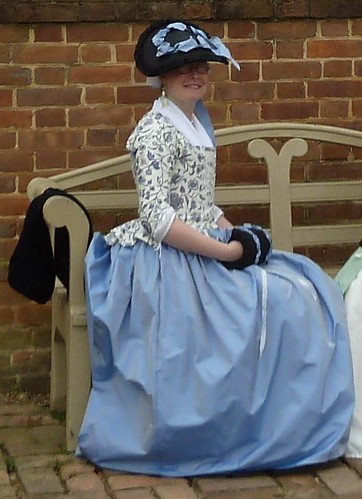
Up next: stops two and three of my Hyde Park adventure!

Saturday, December 31, 2011

Threaded Bliss

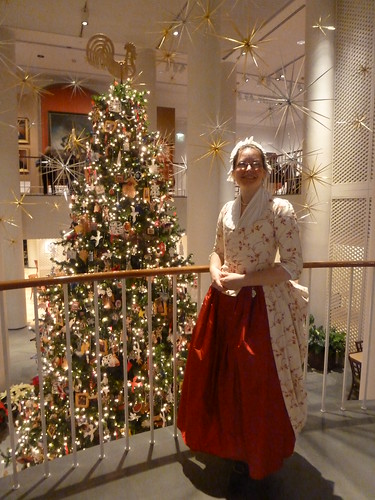
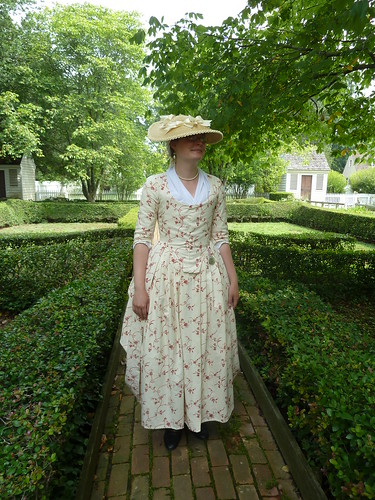
A Red Floral Print English Gown, 1770-1780

red floral print anglaise, 1770-1780
The gown paired with a red silk petticoat.
Photo taken at Colonial Williamsburg, December 2011.

In keeping with the spirit of the holidays, here's a project in the festive, seasonal colors of red and white!  This gown was finished in mid-June and worn for the first time during our regimental tavern dinner during this past summer's Under the Redcoat.  When I brought it out to wear for Grand Illumination a couple of weeks ago, I realized I had neglected to post about it!

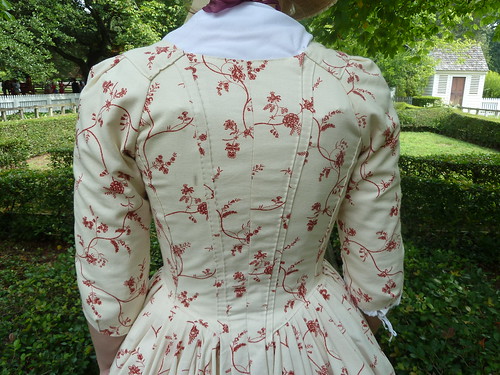
The pattern: Draped by me.  The slightly curved back neckline is a feature of the "en fourreau" gown on page 36 of Janet Arnold's Patterns of Fashion 1; I copied it on Ashley's "DAR gown" and liked the way it looked so much that I decided to do my next gown the same way!  The more modest size of the "en fourreau" back pleats (neither very wide nor very narrow) and their relatively "triangular" shape date this gown generally to the early to middle part of the 1770s.

red floral print anglaise, 1770-1780
The slightly curved back neckline.
Photo taken at Colonial Williamsburg, July 2011.

Construction details: As the construction details for this gown are identical to those on Ashley's lavender linen and DAR gowns, I'll avoid being repetitive by only offering some additional comments here that are specifically related to my experience with this particular project.  I also haven't taken any interior shots, as these too closely resemble those found in the two previous posts.

The biggest challenge to doing this gown for myself was that instead of having a real body to drape on, as I do when I do Ashley's clothes, I had to cut it for myself on a (cheap and icky) dressform that doesn't accommodate my stays in a very satisfactory way.  In other words, I can get the proper bodice measurements using my undergarmented dressform, but anything above the bust (armscyes and shoulder areas, cutting the neckline) is impossible on my plastic horror of a form and has to be done by putting everything on myself and looking in the mirror as I mark lines and make adjustments...and take it off and tweak...and put it back on and tweak...and take it off and tweak some more...and...you know how this story goes!  It's a bit awkward and it takes longer than having a real body to drape on, but I've done several eighteenth-century gowns for myself already using this method and it's worked out fairly well.  I'm currently searching for a more malleable, actual-body-approximating dressform with the hope of facilitating the self-draping, so fingers crossed I find something soon!  Laurie, our friend from Teacups in the Garden, has recommended Uniquely You, which I'm leaning towards at the moment.  If anyone else has a suggestion, I'd be very happy to hear it!

red floral print anglaise, 1770-1780
The back of the gown, showing the "en fourreau" pleats.

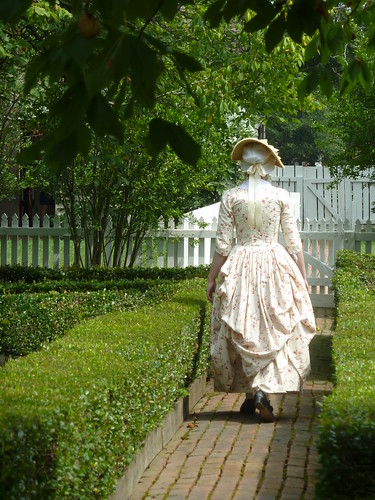
The fabric: If this print looks vaguely familiar, you're right!  This is the red version of the blue print I used on my quarter back gown (which, coincidentally, I'm in the process of pulling apart and remaking...more to come on that!).  It is an out-of-print (sadly, because it's so perfectly period!) Laura Ashley print in a 90% cotton/10% linen blend.  The texture is fantastic; rather than having the smooth hand that we associate with finer imported cottons of the period, it has a very "homespun" feel, a tad bit heavier than a period chintz or other cotton print, and very similar to the rougher textures that can be seen on the cotton and cotton blend textile tokens in John Styles' books.  The interpretive possibilities this opens up are very exciting!  In Fashion's Favourite: The Cotton Trade and the Consumer in Britain, 1660-1800, Beverly Lemire explores the rapid expansion of the cotton industry - both European-produced and imported - during the last quarter of the 18th century and the subsequent spread of cotton's popularity amongst not only the middling classes, but also the working classes, who suddenly found these bright and fashionable prints well within their financial means (pgs. 96-108).

red floral print anglaise, 1770-1780
Photo taken at Colonial Williamsburg, July 2011.

Finishing the look: Because this is a single color cotton print, and because of the weave and the mixed content of this textile, it can feasibly be worn as either a middling day wear impression or as the "nicer" garment of a woman slightly lower on the social scale.  The petticoat choice and the addition of particular accessories (or lack thereof) help convey one identity or another.

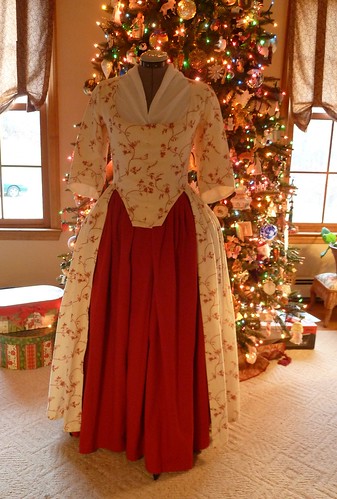
There are three petticoats that coordinate with this gown.  One is the red silk petticoat pictured in the "header" photo above.  The second is a matching petticoat, the "middle" degree of poshness, if you will, that is possible for this gown.

red floral print anglaise, 1770-1780
With a matching petticoat.
Photo taken at Colonial Williamsburg, July 2011.

The third option I've made is a solid red cotton twill of a weight that matches the gown itself, which works nicely because it drapes in a similar way when worn.

red floral print anglaise, 1770-1780

In the outdoor photos and the "header" photo, the gown is accessorized with a cotton lawn neck handkerchief, a linen lawn cap, a single strand of pearls, my favorite pair of silver pearl drop earrings (by Janice Erickson Smith), and a silver pocket watch, to represent the dress of the middling sort.  The indoor Christmas tree pictures pair the gown with the cotton twill petticoat and a plain-weave linen neck handkerchief to convey a slight downplay in the social status of its wearer.  As always, the outfit is pictured being worn over my Diderot stays and two linen petticoats.

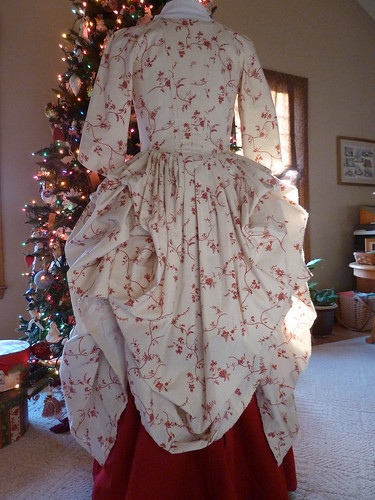
When I took the pictures with the red cotton petticoat, I made the addition of a small hoop, just because I was playing around and wanted to see how it suited the shape of this gown (this is the hoop that's mentioned in the post about Ashley's sea green gown).  The shape it provides is consistent with the early to mid 1770s, when fullness at the sides of the body returned briefly, before being replaced by the fullness at the back which characterizes the silhouettes of the 1780s.  The hoop helps to hold out the skirts nicely (especially when they're worn "a la polonaise"), and after testing it out on the dressform, I wish I had thought to make at least one of my petticoats to accommodate it!  Alas, I did not, because I made the gown and its petticoats to be worn as the "for good" ensemble of a UTR camp-following lady who probably wouldn't have been able to tote a hoop along with her!  Ah well, next time.  At least it works for the sake of the pictures!  :-)

red floral print anglaise, 1770-1780
The "a la polonaise" skirts of the back of the gown, supported by a small hoop.

Additional photos of this project can be found on its flickr set.
Thursday, December 29, 2011

Threaded Bliss

Silk Accessories in Black and Blue, 1770s

black and blue silk accessories, 1770-1785
Photo taken at Colonial Williamsburg, December 2011.

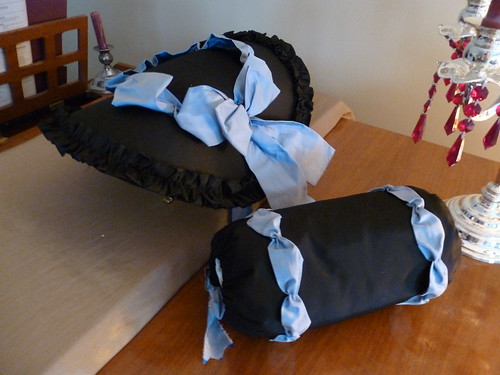
Inspired by March's accessories symposium, and finding myself with a bit of fabric left over from my blue and ivory changeable silk taffeta petticoat, I decided I wanted to make some accessories to coordinate with the petticoat and the chintz jacket I'd be wearing with it.  Since the jacket was completed in time to wear to Williamsburg for our Grand Illumination visit, I decided on a new muff cover and a matching covered hat.  Here they are!

black and blue silk accessories, 1770-1785

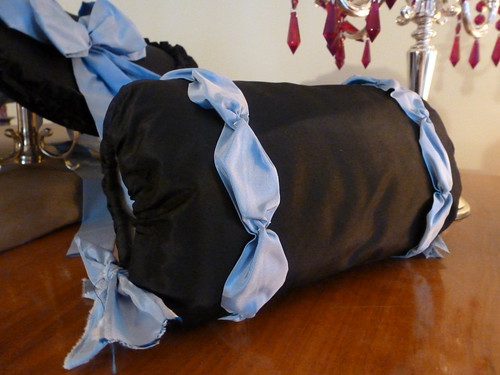
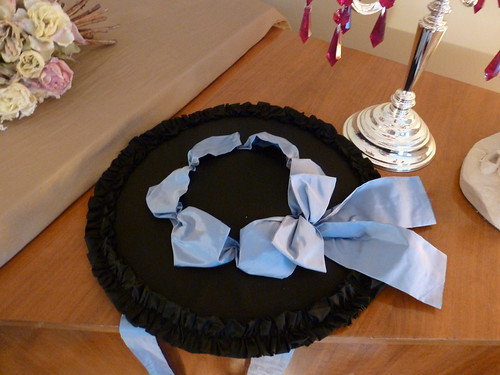
The pattern: The pattern of the muff cover is taken off of the one I made at the silk muff workshop at CW in March.  It's a very simple rectangular design with channels to gather up the ends to secure the seperate pillow inside.  The straw hat I used logically became the pattern for its own cover, as I just traced the brim to cut the top and underside coverings.  Very easy!

Inspirations: I began with an inspiration for the hat, which I found months ago and have been wanting to make ever since.  I had some left over ivory silk taffeta from one of the petticoats I'd just made to go with my blue chintz jacket, and thought I'd do an exact copy of this hat from a 1756 Reynolds portrait of Lady Chambers.  The features that particularly drew me to this design were the contrast between the base color and the trim, and the way that it is highlighted by lining the underside of the hat in the accent color.

Catherine, Lady Chambers, by Sir Joshua Reynolds (1756).

But as I set about cutting out my fabric, I saw the remainder of the black silk taffeta left from my bonnet sticking out of my scrap pile next to me, and I pulled it out and tried how the blue looked next to the black.  Although I did love the ivory with the blue - especially because the blue is shot with ivory - the black just seemed so much more striking.  Then, too, black covered hats seem to have been very popular in the 1770s and very early 1780s, so selecting the black taffeta instead of the ivory also made sense fashion-wise since I was planning to wear the hat with my new 1775-1785 jacket.  So I rummaged through my picture files again and found this image of a black covered hat from 1778:

"The Studious Beauty" (1778).
Image linked from the Lewis Walpole Library.

In the end, as you can see, I used the first image as the primary source for my hat's design, with its contrasting lining and trim colors, just adding the ruched black trim around the edge of the brim that is featured in this second image to help "update" the Reynolds hat to the late 1770s.

I don't really have a single inspiration source for the muff design; its poofs are simply intended to echo those found around the crown of the hat.  Considering that such fabric and ribbon poofs were fashionable not only on hats during this decade, but also as trim on caps, gowns, and even mantles, I figured I was pretty safe putting them on a muff as well.  :-)

Construction details: For details on the construction of the muff cover, see my previous post about the green/ivory silk muff from the workshop.  The blue poofs are quite simply a length of silk gathered at regular intervals.  The same fabric forms the "ribbon" ties that gather the ends of the muff.

black and blue silk muff, 1770-1785

The covering of the hat was also quite easy.  I used the straw hat blank to trace a pattern to cover the top; this was sewn down first.  I then made a hole at the center top of the crown and snipped down a bit on all sides to accomodate the rise of the crown.  Then I took a circle of black taffeta to cover the crown and stitched that down.  The blue trim came next.  As with the muff, this is just a strip of fabric gathered at intervals to form the poofs, and finished at the end into a big bow that hangs down to one side, like in the Reynolds portrait (though it's a little tough to see!).  The black taffeta self-trim around the edge of the brim is made in a similar way, being nothing more than a strip of fabric ruched to create texture and stitched down through both the taffeta and the straw to hold it securely in place.

black and blue silk hat, 1770-1785

The lining was applied next, its pattern taken in the same way as the top cover.  It is stitched down around the edge of the crown and again around the edge of brim, where the stitches are concealed by the ruched black trim.  The lining in turn conceals all of the stitching from the trim from the top.  The final steps were to cut a circle for the crown lining and slipstich it into place, and then to tack on the blue "ribbon" ties.

black and blue silk hat, 1770-1785

The fabric: The top of the hat and the hat's brim trimming, as well as the muff cover, are done in an Italian black silk taffeta (the same that I used on my bonnet).  The underside lining of the hat, as well as the trim on both the hat and muff, comes from the blue and ivory silk taffeta I used on the petticoat that coordinates with my blue chintz jacket.

black and blue silk accessories, 1770-1785
Photo taken at Colonial Williamsburg, December 2011.

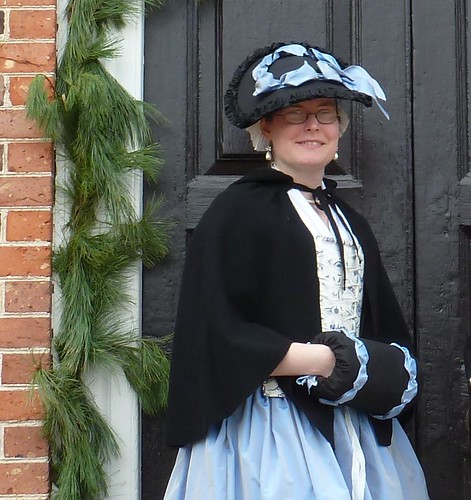
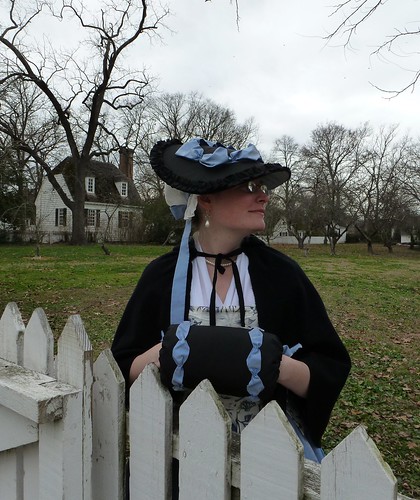
Finishing the look: Although I'm not usually into matchy-matchy accessories, particularly when it comes to the eighteenth century, and although I wasn't too sure about how the black would look, in the end, I really like what the "pop" of the black does for the blue, and how nicely it helps to pull the outfit together.  And although the thought of this didn't even occur to me when I selected the black over the ivory as my base color, I was quite excited at how nicely the accessories ended up working with my old black mantle!  It made me feel so seasonably wintery for the Grand Illumination weekend...even though it was almost 70 degrees the day we took pictures!

black and blue silk accessories, 1770-1785
Photo taken at Colonial Williamsburg, December 2011.

Tuesday, December 27, 2011

Pretties from the Past

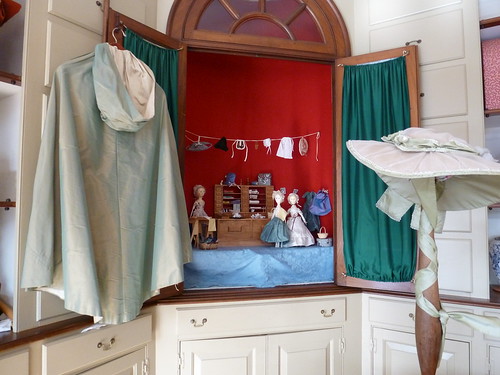
Milliner's shop, Colonial Williamsburg
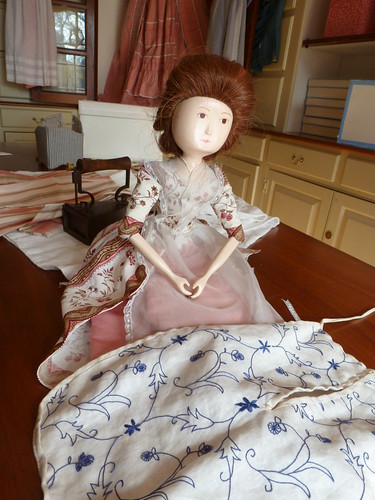
The dolls preparing their tiny but oh-so-elegant and fashionable
wardrobe for holiday festivities.

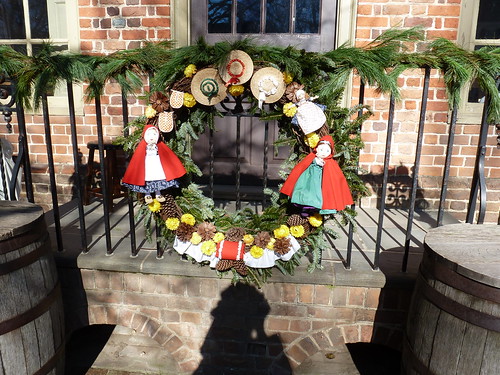
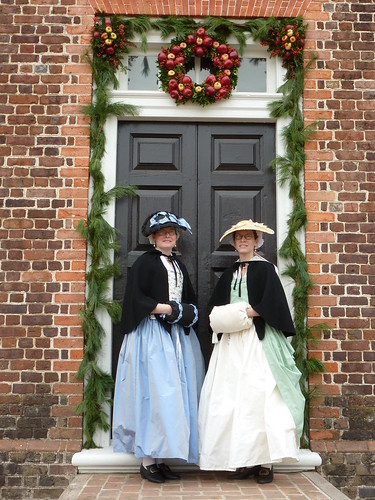
Our entire family was in Williamsburg a couple of weeks ago to enjoy (for the very first time!) the Grand Illumination festivities.  Ashley will be sharing a report of that shortly, but in the meantime, here's a little collection of pictures from our obligatory visit(s) to the Margaret Hunter Shop. As is tradition with Colonial Williamsburg (a modern tradition, not a colonial one, that is!), the shop front was bedecked with an evergreen wreath embellished by the ladies of the shop and designed to reflect the trades practiced within it. This year's wreath included two adorable little fashion dolls in their cardinal red cloaks, a set of pockets, some beribboned straw hats, and a cute little red and white muff.

Christmas decorations at Colonial Williamsburg

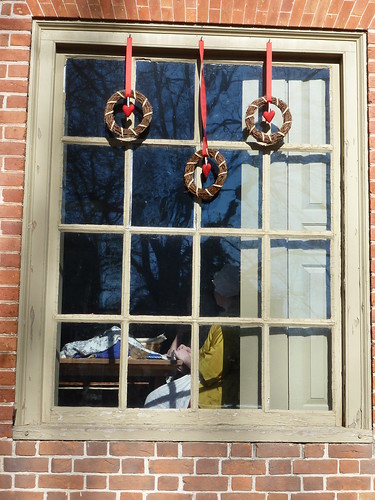
In front of the large windows of the shop were smaller wreaths suspended by red ribbons and very simply adorned with red cloth hearts. Aren't they really cute?

Christmas decorations at Colonial Williamsburg

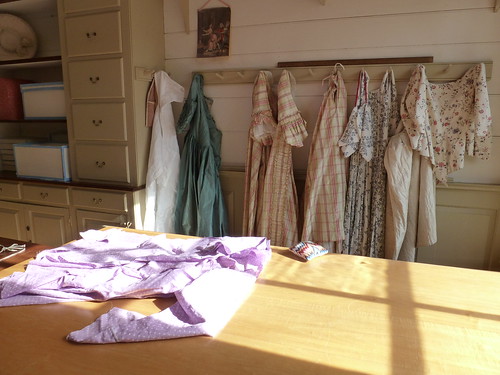
Inside, we found the ladies hard at work on a new bedgown one afternoon. It's made of a purple and white spotted cotton, a resist print that looks strikingly similar to the one pictured in Walton's famous Plucking the Turkey (1776). It will be quite lovely when finished and it got me thinking that we really don't see enough spotted cottons amongst re-enactor and costumer reproduction eigtheenth-century clothing!

Milliner's shop, Colonial Williamsburg

As usual, the counters of the shop were ladden with all sorts of goodies, from this elegant fashion doll presiding over some wares,...

Milliner's shop, Colonial Williamsburg

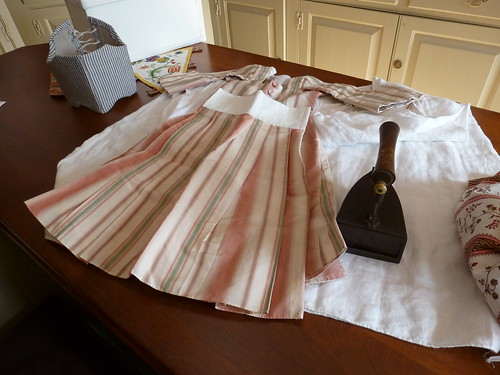
...to this striped silk child's gown and striped infant stays,...

Milliner's shop, Colonial Williamsburg

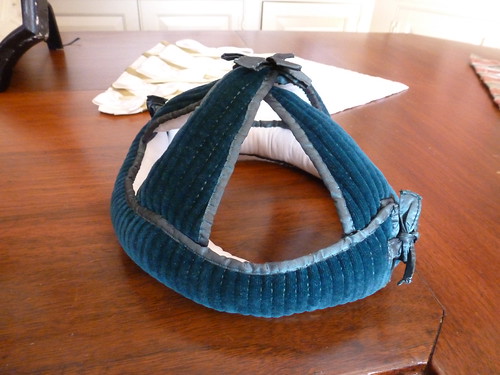
...to this hand-quilted velvet pudding cap, which I never tire of seeing.  It is copied from an original made of cotton velvet in the CW collection (acc. no. 1952-55).

Milliner's shop, Colonial Williamsburg

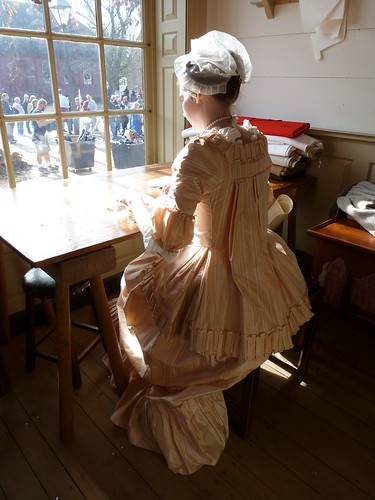
Dressed in a stunning silk ensemble and gauze cap, Miss Emma was perched close by the window to catch the last of the afternoon sun, hard at work on some ruffles and looking like a period painting herself!

Milliner's shop, Colonial Williamsburg

Sunday, December 25, 2011

Merry Christmas!

Best wishes to all of our readers and friends for a healthy and joyous holiday season!