Showing posts with label Mary Todd Lincoln. Show all posts

Sunday, January 20, 2013

Current Exhibit: First Ladies (and their fashions!) at the Smithsonian

The Smithsonian National Museum of American History has just expanded its First Ladies exhibit to include some more tantalizing fashions from some of the most influential ladies in our nation's history.  Just in time for this inauguration weekend, the exhibit now includes the stunning silk chiffon gown that Michelle Obama donned four years ago, complete with gorgeous organza flowers and sparkling Swarovski crystals.  There is also a fun little video on YouTube showing some of the challenges that the curators and conservators faced in preparing the gowns for display in this lovely exhibit.

Michelle Obama’s Inaugural Gown, 2009
Michelle Obama's 2009 inaugural ball gown.

In another interesting video from the Smithsonian, curator Lisa-Kathleen Graddy shows us some additional behind-the-scenes footage (from an earlier version of this exhibit, from what I can tell) and also shares some interesting stories about the history of a handful of these gowns.  Mary Todd Lincoln's 1861 silk taffeta gown with woven black stripes and purple flowers is one of my favorites, and I thoroughly enjoyed learning more details about it through this video.  Ms. Graddy explains how the gown was transformed by a family member who later inherited it.  A panel was taken from the original skirt in order to design a new day bodice, which replaced the evening gown bodice that Mrs. Lincoln had worn with it.  This is one of the gowns used as inspiration for a costume in the recent Lincoln movie; the film's costume designer used an 1861 Matthew Brady portrait of Mary Todd Lincoln wearing the original evening gown to recreate what it once looked like.

Mary Lincoln’s Silk Dress, 1861
1861 striped silk taffeta gown worn by Mary Todd Lincoln (later altered).
 
One of my all-time favorite gowns from the 1860s, which also belonged to Mrs. Lincoln, has been included in this exhibit in one of its past incarnations and you can see some photos in an earlier flickr set from the museum.  This unique purple velvet gown is displayed with both its evening and day bodices, both original to the gown.  All three pieces are piped with white satin.  This ensemble, believed to be made by Elizabeth Keckly, was worn during the winter social season of 1861-1862.  You can read more about this ensemble and see some closer photos on the museum's collections page here.
 
Mary Lincoln’s Purple Velvet Ensemble
Mary Lincoln's purple velvet ensemble (acc. no. 70138) in the First Ladies exhibit at the
Smithsonian National Museum of American History.
 
As a special treat, many of these gowns have been beautifully photographed and just recently added to the museum's flickr account for all of us to admire!  Here a few of my other favorites included in this new online showcase "exhibit":

Frances Cleveland’s Evening Gown
An evening gown worn by first lady Frances Cleveland during her husband's second
administration, 1893-1897.  The colors are gorgeous and there are so many nice details,
including the fur trim at the bottom!
 
Frances Cleveland’s Skirt and Bodices
Another beautiful addition from Mrs. Cleveland with this 1890s evening and day ensembles.
This green color is one of my favorites and so stunning!
  
Mamie Eisenhower’s Inaugural Gown, 1953
I love the style of this 1953 gown worn by Mamie Eisenhower for the inaugural balls that year.
This pink peau de soie gown is embroidered with more than 2,000 rhinestones!

Saturday, December 8, 2012

Bringing Mary Todd Lincoln to Life: The First Lady's Costumes in "Lincoln"

Last weekend, I finally got to see "Lincoln," which I've been eagerly anticipating and reading about for months and months.  The film did not disappoint; all of the hype and praise being lavished on it is very well-deserved and I highly recommend it.  It sounds like a cliche, but the movie truly is very much a monument to the almost super-human accomplishments of one of our most honored presidents.  Daniel Day-Lewis does an unbelievable job at representing the intelligence, the quirkiness, and the heart of the enigma that was Abraham Lincoln, and the film is beautifully filmed with incredible details that will make your heart stop.

In this brief interview, the production designer, Rick Carter, discusses how he created a calendar of the last weeks of Lincoln's life to ensure that what emerged on screen would be as accurate as it was possible to make it.  Because so much documentation exists about what absorbed the president both personally and politically, and about what the spaces and furniture and artifacts of the rooms of Lincoln White House looked like, the production team was able to recreate what would have been in certain rooms on certain days, from the letters and books on a table, to the maps on the wall.  Even the sound of the ticking watch that emerges at moments throughout the film is accurate to the most minute degree: Spielberg had Lincoln's own pocket watch taken out of museum storage so that its own unique sound could be used in the movie.  I don't think any movie has quite captured and conveyed so completely an immersion into a historical period as this one does.  It really is quite an achievement.

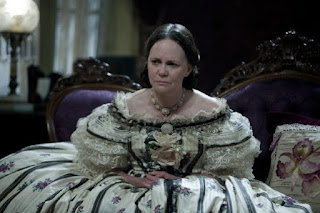
Of course, being a period film, you know where much of my visual attention was drawn!  Sally Field as Mary Todd Lincoln worked well with Day-Lewis's impression of the president, and I was very pleasantly surprised at how much she looked the part.  "Lincoln"'s costume designer, Joanna Johnston, describes in this video how Field strategically gained weight to achieve the exact waistline and body shape of the First Lady she would portray, much to Johnston's delight because it meant the original proportions of Mary Todd Lincoln's gowns could be maintained in the recreations.  Some of the gowns you see in the film were almost exactly reproduced from extant pieces.

Joanna Johnston with two of the gowns she designed for
Mary Todd Lincoln (Sally Field) for the film.
Photo linked from EW.com.

In this previous post that I did after a visit to the Mary Todd Lincoln House Museum, I mentioned the handful of clothing items and accessories that are currently in the museum's collection.  I inquired whether any additional clothes were known to exist, and the docent pointed me to the Smithsonian inauguration gown, but said she didn't know of any more.  I've since discovered a handful of other gowns held in various museums (I feel a new post coming on...!), and Johnston says she inspected many of them - in addition to the numerous photographic and artistic representations of Mary Todd Lincoln, and contemporary fashion plates - in preparation for designing and creating Mary's look for the film.

One of the extant dresses owned and worn by Mary Todd Lincoln (right).
It was one of the inspirations for the film gown below.

It is evident from Mary's gowns, visible in both extant items and in images, and by the (borderline politicized) controversy that raged throughout Lincoln's presidency over his wife's more than extravagant clothing expenditures, that the First Lady delighted in stretching fashion to its limits and was defined by a very unique sense of style.  She loved to display her shoulders (much to the chagrin of Washington society because of her age) and to indulge in bright colors (fuchsia, anyone?), heavy trims, and elaborate decorative elements.

Costume sketches from "Lincoln," by Richard Merritt.
Images linked from SAA Illustration Hub.

One particular dress (shown above and below), Johnston explains in this very interesting video overview of the costumes, is a combination of two of Mary Todd Lincoln's dresses.  Johnston had a French striped silk satin fabric overprinted with the floral design to meld the look of the two original gowns together.  The source for the floral sprays is pictured in the original gown above.  Period antique lace and a typical Mary Todd-sized corsage completes the stunning visual and historical effect of the ensemble.

Sally Field as Mary Todd Lincoln.
Photo linked from imdb.com.

Another fantastic video interview with costume designer Joanna Johnston can be found here.  And here's a link to another article with a close up of another one of Mary Todd Lincoln's movie dresses, complete with bonnet.

Saturday, March 24, 2012

A Visit to the Mary Todd Lincoln House

Mary Todd Lincoln House
Front of the Mary Todd Lincoln House, Lexington, KY

I'm currently in Lexington, KY for work, and when I discovered that this is the home of the Mary Todd Lincoln House Museum, I knew I'd have to squeeze some time into my crazy schedule to pay a visit. This afternoon, thoroughly enjoying the gorgeous spring weather and all the flowering trees, I took a walk to the museum and was fortunate enough to catch the last tour of the day. The guide was fantastic and extremely knowledgeable about the Todd and Lincoln families and the details of the house's history, and those of us on the tour were treated to an hour-plus journey through the home, accompanied by numerous juicy little tidbits of history that one rarely hears recited or discussed today (you know, those "Wow, how didn't I know that before now?" kind of tidbits!).

I wish I could include some pictures of the interior of the house because it is beautifully restored and furnished with some gorgeous antiques and Todd and Lincoln family heirlooms, but, as I'm sure you'd expect, photography was not permitted inside. Much to my immense pleasure, though, I'm very happy to report that the museum's website includes a lovely picture tour of many of the rooms, with detail shots of some of the special items in them.

Mary Todd Lincoln House

Mary Todd was born in Lexington in 1818, in a house several blocks away from the current museum (that house no longer stands). In 1832, the growing Todd family (there would eventually be 16 total children, with 14 who survived into adulthood) moved to the c.1803-5 brick house that is now the Mary Todd Lincoln House. She lived there until 1842, when she moved to Springfield, Illinois to live with her elder sister and her family. It was there, of course, that she met and married Abraham Lincoln, and the couple is known to have visited and stayed in this Lexington home several times during the early years of their marriage. Mary’s father, Robert Todd, died in 1849 and the house and the entirely of its contents were sold at auction. A couple of those original family items have been donated back to the museum in recent years, but the majority of the furniture and other decorative items on display are antiques acquired to mirror those found listed in an inventory taken at Robert Todd's death.

As Kentucky was a border state during the Civil War, it did not surprise me to learn that the Todd family was the quintessential “house divided,” with exactly half of them supporting the Confederacy, while the other half remained staunchly loyal to the Union. Four of the Todd brothers fought for the Confederacy; two of them died in that service. For this reason, Mary was looked upon with great suspicion by both sides throughout the war, with Union supporters worried the President’s wife harbored Southern sympathies, and the Confederates convinced she was a Union spy.

Mary Todd Lincoln House
The back of the house, from the garden.

One of the most interesting things our guide shared today was an account of Mary’s very early exposure to the issue of slavery. Throughout Mary’s childhood and into her adulthood, the Todd family owned between three and five slaves. Her step-grandmother (Robert Todd married a second time after Mary’s mother died in childbirth) also owned slaves and had a very decided opinion on slavery as both a moral and a socio-cultural issue. At her death, she elected to set her slaves free, and Mary’s respect for her would certainly have influenced her own thoughts on that choice.  The very well-educated Mary (who had a keen interest in politics from an early age and whose father would permit her to sit in and listen to the gentlemen’s after-dinner political conversations) would thus undoubtedly have been exposed to discussions about emancipation vs. abolition and the complexities of the institution of slavery, and been able to develop her own educated convictions on the subject before she even met her future “Great Emancipator” husband.

Mary Todd Lincoln House
The back porch.

Our guide spoke a bit about Mary’s keen sense of fashion and how much she enjoyed showing off her shoulders, even after the ripe “old” age of forty (much to the scandal of Washington!). She employed a personal seamstress to make her clothes when she moved into the White House, and her expensive, fashionable tastes were yet another source of controversy for the Lincoln family during the War years. I inquired whether any of the Mary’s clothes had survived, and was shown a delightful little watch, a mourning bonnet, a mourning fan, and a pretty little black mourning jacket that are currently in the museum’s collections. The guide said that following Lincoln’s death, Mary felt obliged to sell a number of her gowns to pay outstanding debts; when she died, the remainder were dispersed amongst relatives. The Smithsonian has her stunning velvet inaugural gown in their collection (click on the image to see multiple views), but for a woman of such prominence, and who was so preoccupied with fashion, it’s strange – and really a shame – that not more of her garments or personal accessories are known to have survived to teach us more about the lady who was Mrs. Lincoln.

Many of the tragic episodes that marked Mary Todd Lincoln's life are well known, from the untimely deaths of all but one of her sons to the tragic assassination of her husband.  Throughout her life, she suffered from poor heath, often plagued by migraines and depression.  What I did not know was that her one surviving son, Robert, had his mother confined in a mental institution in 1875.  Worried by her apparent delusional and erratic behavior, he went so far as to take the stand to testify against her in order to gain the requisite court order to have his mother committed.  Though Mary was released after several months into the care of her sister, the rift that this betrayal caused between mother and son was never healed.  Mary Todd Lincoln died in 1882, and remains one of the most intriguing - and controversial - of our First Ladies.