Monday, March 21, 2011

A Reconstructed Visitable Past: Day One, Part One

Thursday morning began the two day conference at Colonial Williamsburg titled, “A Reconstructed Visitable Past: Recreated Period Attire at Heritage Sites.”  The aim of this conference, following the Costume Accessories: Head to Toe symposium, was to share and discuss topics relating to the use of costumes in museums and living history sites.  The roster of speakers was a broad collection of costume designers, museum managers, and independent scholars from North America and Britain.  The registrants at this conference were just as varied and included museum staff, scholars, re-enactors, and costume enthusiasts from around the globe.  Costuming is an amazing tool for portraying and teaching history and an essential element for any living history museum.  As we discussed during the conference, costumes can also transport and engage visitors in a number of ways.  We touched on so many topics and issues, so I am going to try to keep this outline of the presentations as brief as I can.

Brenda Rosseau (manager of the Colonial Williamsburg Costume Design Center) and James Horn (vice president, Colonial Williamsburg Research and Historical Interpretation and Director of the John D. Rockefeller Jr. Library) welcomed the group to the conference and opened by giving a brief description of the use of costumes at CW.  With over 800 employees to dress, the Costume Design Center currently has approximately 55,000 pieces in circulation, with an average of 50-60 items issued per employee.  The staff at the CDC is responsible for the research, construction, and care of all costumes and accessories used by interpreters throughout the historic area, as well as those worn by the actors in the Emmy-winning Electronic Field Trips series.  In addition, costuming comes to life in the historic area itself, where the mantua makers, milliners, and tailors of the Margaret Hunter shop practice and portray 18th century sewing techniques on a daily basis, producing entirely accurate pieces that are both worn and put on display in the shop.

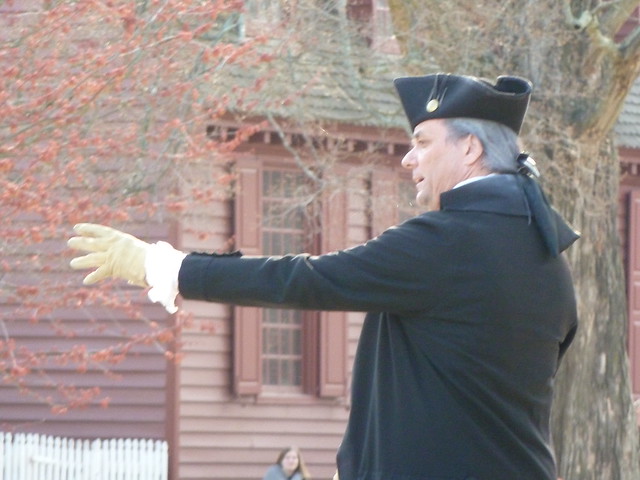
Colonial Williamsburg interpreters, costumed by the CW
Costume Design Center.

The first formal presentation was given by Dr. Pravina Shukla (Indiana University) who discussed "Costume and Sites of Heritage."  Dr. Shukla began by categorizing different types of heritage sites, such as those sites with educational goals, sites where history and culture are interpreted by professionals, or heritage sites that are only significant to the people, where no tourist or official interpreters are found.  For this last type, she gave an example of some traditional costume in Sweden which is only worn for ceremonies as part of their own heritage preservation.  Just like historical interpreters or reenactors, they strive to keep their costumes as accurate as possible.  One of my favorite anecdotes from her presentation was a discussion with a Civil War reenactor who used his own independent research and the resources available to him in order to assemble his costume and persona to be meticulously correct.  He felt that unless he was doing his best to portray his interpretation as accurately as possible, he would be doing the public a great injustice.  And while he knows that he can never fully become the character he interprets, he would not want to wear something or do something in public that would embarrass the historical person he has taken the responsibilty to preserve and portray.

Next on the program was Dr. Jane Malcolm-Davies (director JMD and Company, The Tudor Tailor, Godalming, England) discussing "A World in a Wardrobe: Costume as Communication in Historic Sites."  This fascinating study compiled data from sites currently utilizing costumed interpreters and discussed the use of costumes from the perspective of the costuming staff, the interpretive staff, and vistors themselves.  She explored how much of sites’ budgets on average are allocated to costumes and why these sites decided to start using costumes in the first place.  Information was also gathered concerning any procedures in place for training costumed staff (were they taught how to wear their costumes?), for the maintenance of the costumes (are interpretive staff in charge of cleaning their clothing?), and evaluation processes (do supervisors evaluate the staff's appearance?).  Finally, she shared how the costumed interpreters felt about their costumes, including their attitudes about wearing them and how they felt it influenced the way they perform their jobs.

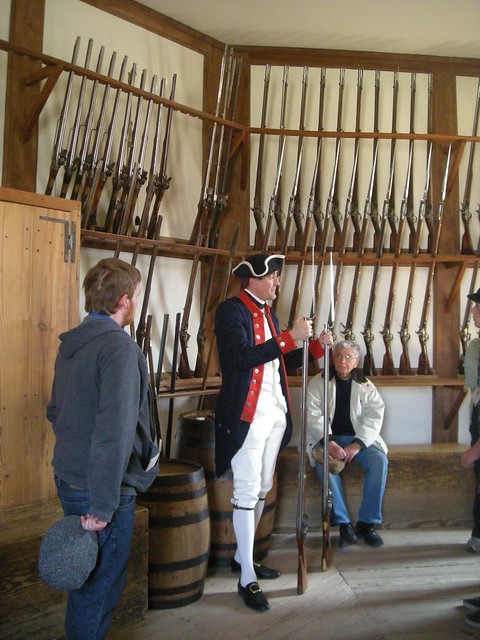
A costumed interpreter at the CW Magazine engages visitors in military discussions.

The final presenter in the first session was Heather M. Meiklejohn (costume curator, Parks Canada) who gave us an overview of her specific job challenges.  As the sole costume curator for an extensive region, she does not even have the opportunity to visit all of the sites she manages in person.  One of the neat ideas she shared with us is something Parks Canada has developed called “History Online.”  This online resource for staff begins with a page listing all of the sites.  From there, staff can explore each site and find anything they might need to know, like details about the educational offerings of the sites and even a section called “How to wear your costume.”  This online “manual” is also available in hard copy or on a DVD for all staff.  One of the biggest challenges, she explained, is getting the staff to actually read this and to refer to it when they have a question.  In addition, they are beginning to explore additional interactive opportunities (such as facebook, flickr, Wikimedia, etc.) to reach out to staff and to encourage questions and conversation among staff and between sites.

After a quick coffee break, Session II: Case Studies began with “'The Devil’s Brood': Interpreting Henry II, His Family and Court at Dover Castle."  Mark Wallis (managing and artistic director) and Stephanie Selmayr (director and head of costume, Past Pleasures Ltd., Godalming, England) shared with us some beautiful slides of the costumes and new interpretations at Dover Castle.  They addressed the challenges posed when one is required to costume a period in which little to no extant examples remain, and images are inconclusive and often difficult to decipher.

Christopher Daley (historical clothing services supervisor, Jamestown-Yorktown Foundation) followed with his presentation titled, “Counterfeited According to Truth”: The Challenges of Accurately Clothing Powhatan Indians at Jamestown Settlement."  I really enjoyed Mr. Daley’s presentation, in which he clearly discussed where their costuming inspirations came from, what their specific challenges are, and how they overcome those challenges.  Because Jamestown is a state-owned site, he explained, certain concessions need to be made, which often conflict with the historical accuracy of their interpretation (for example, wearing latex gloves when slaughtering animals or safetly glasses when working with hot metals).  Another very interesting topic which he brought up was public perception; when visitors come to a site, they bring certain preconceptions and expectations. In some cases, those preconceptions are wrong, and visitors consequently have trouble accepting the truth, which in other cases, they struggle with putting their preconceptions aside to focus on the interpretation.  For instance, some of the interpreters who portray the Powhatans are not Native Americans, so the public sometimes has trouble seeing beyond this necessary inaccuracy of portrayal to learn from the interpretative actions, settings, and lessons being offered by the interpreters.

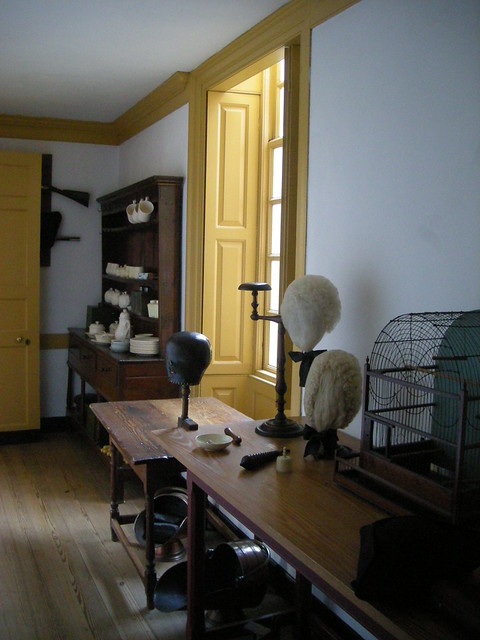
Wigs on display at the Governor's Palace, CW.

The final presentation prior to lunch was Denise Lebica (manager, historical clothing and textiles, Plimoth Plantation, Plymouth, Massachusetts) with “Dressed to Till: Clothing as an Interpretive Tool.”  She described how Plimoth teaches their interpretive staff how to wear their costumes and to be aware of what they are doing and how their clothes should change to fit the task at hand.  For example, when staff are preparing to do some sort of dirty work, they make sure that visitors see them put on their aprons; this conveys through the physical use of clothing the fact that since clothing was valuable, Plimoth's settlers would have done their best to protect it while they worked.  One neat tool they sometimes use in interpreter training is bringing the people of a painting to life.  After looking closely at the painting, a staff member appears wearing the same clothes, which gives the trainees a sort of 3D view of how the clothes are actually worn in the past.

I was told from the café staff at the DeWitt Wallace that Brunswick stew would be on the menu for Thursday, and I was so looking forward to it!  Alas, when I arrived at the café on Thursday, I was greeted with the sad news that the stew never made it, but was promised that it would be there the next day.  So we ran over to the Cheese Shop once again and spent the remainder of our lunch time shopping in the historic area.

Stay tuned for more!

Saturday, March 19, 2011

Colonial Williamsburg & Buttons Workshop

While Rebecca was busy enjoying the symposium of prettiness early this week, I tried to get as much CW fun into my schedule as I could fit!

Saturday was a long drive, but with very little traffic we made good time.  We took the opportunity to sleep in a bit on Sunday and to walk around the historic area.  It was a bit windy, but the weather was absolutely gorgeous compared to the weather we left back in New England.  We stopped by the Margaret Hunter shop where Mr. Hutter was busy shining his buttons and working on a new riding habit for the symposium.  We found some time to chat and look around the shop before heading over to the DeWitt Wallace to pick up our registration packets and to take a walk through the accessories exhibit.  That evening, Rebecca headed to the opening events of the symposium and I found a pleasant bench (running into a friend on the way) to work on some sewing and to enjoy the last of the warm sun.

Strolling with Mr. M.

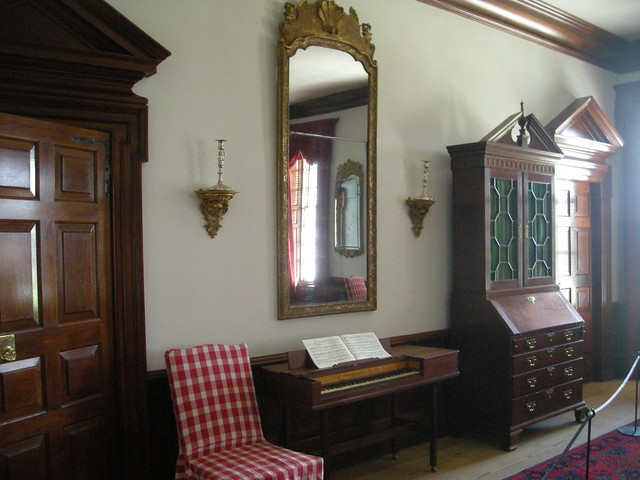
On Monday, my Mum and I visited some CW buildings to see what might be new around town.  We were rather shocked at the new look of the middle upstairs room of the Governor’s Palace.  For as long as I have been visiting CW, the walls of this room have been covered with a very unique and beautiful leather covering.  It added a certain elegance to the room.  The walls are now plain white, which actually made the room feel smaller and definitely took away any “wow factor” to the room.  One of the interpreters told us that the leather covering was in disrepair and was too difficult to maintain.  Also, while they have recently been making other changes to the Palace to bring the decorations specifically into the time of Lord Dunmore’s residence, they don’t believe that the leather covering would have been there at the time.  I was told by one interpreter that the walls will remain white, while another interpreter said that there were plans to recover the walls in a new paper.  These comments were not from anyone charged with studying or interpreting the building itself, so these descriptions may not be entirely true and there may be other plans for the room.  Sometimes it is sad to see objects or an interpretation change that we have become used to.  But at the same time, it is always exciting to see research and perceptions change in front of our eyes.

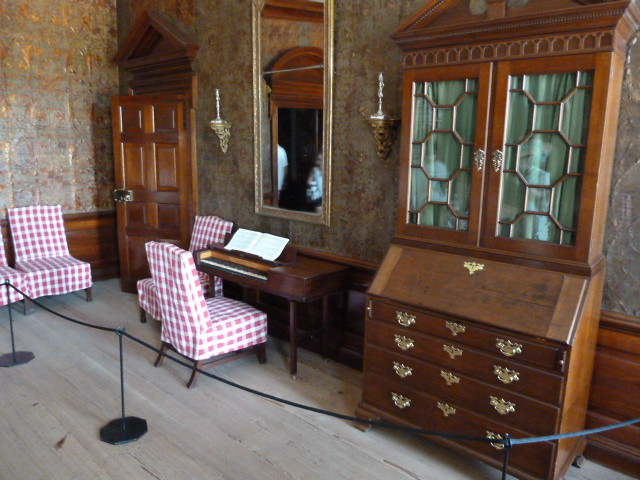
Room in the Governor's Palace with leather wall covering.
Summer 2010

The same wall as seen March 2011 with bare walls.

Monday was also the first day of this season’s Revolutionary City events at CW.  We stood with some friends as we watched Lafayette deliver his speech, which was followed by some examples of music and theater.  We then witnessed the scene of Mrs. Washington visiting the Capitol and aiding a Rev War veteran, which was also a repeat from past seasons.  The events ended with a presentation by George Washington in front of Raleigh Tavern.

Ron Carnegie as George Washington

Tuesday morning I braved the chilly, cloudy weather to listen to Mr. Jefferson behind the Governor’s Palace gardens.  As always, it was a pleasure to hear Mr. Jefferson and to witness his interaction with the audience.  After a brief walk through the gardens I met back up with my family and we all went out to lunch with a friend.  It was great to catch up and to share stories.  Afterwards, Rebecca headed back to the symposium and Mum and I hid from the chill by visiting some more CW sites.

Bill Barker as Mr. Jefferson in the Governor's Palace gardens.

Finally, the day of workshops arrived on Wednesday!  CW tailors Mark Hutter and Neal Hurst began by giving us a brief overview of a few of the different types of buttons and how they may have been used in the late 17th and 18th centuries.  We dove right into making a thread button using linen thread.  Thread buttons were typical on linen garments (linens usually referring to underclothes).  Because these buttons were pure thread, the garments were easy to launder with the buttons still attached.  I needed to restart this button several times before I had a solid starting point, but my stitches were horrendous after that and I had a very sad looking, unfinished button to show.  But I learned a new technique and hope to try this one again with my handy instructions nearby.  Our instructors were also sure to remind us that button making was not a technique that every tailor would have perfected.  Tailors, as well as most housewives, probably knew how to make simple buttons, but they were actually widely produced and available for sale by the 18th century.  A set of “coat buttons” or “weskit buttons” could readily be purchased to finish a garment.

After our attempts at this thread button, we were instructed in the making of a button which Mr. Hurst has researched and examined to recover its construction.  These buttons are covered with fabric and then embellished by interweaving threads.  Getting the threads to make the proper design was the most difficult part, and I have to admit that I didn’t quite manage to master one of these by the end of the class either, but thoroughly enjoyed learning this new technique.  I can’t wait to try this one again too!

Examples of the "Neal Thomas Hurst buttons" on a pair of breeches from the Margaret Hunter shop.

One of the final buttons we learned was the death head.  (I wrote about my attempts at this button in an earlier post.)  Mr. Hutter did an excellent job of explaining the construction of these buttons as he offered us a wonderful demonstration.  His method was slightly different than that of Mr. Fuss.  I actually had success with this one, probably because I already had some practice with it.  At the end of the class Mr. Hutter also briefly demonstrated how to make a multi-colored death head, which I am looking forward to trying at some point.  I also watched as he demonstrated construction of a late 17th century globular button, which made a very neat looking round button.  Thank you to both of our instructors for a fun and very informative class!

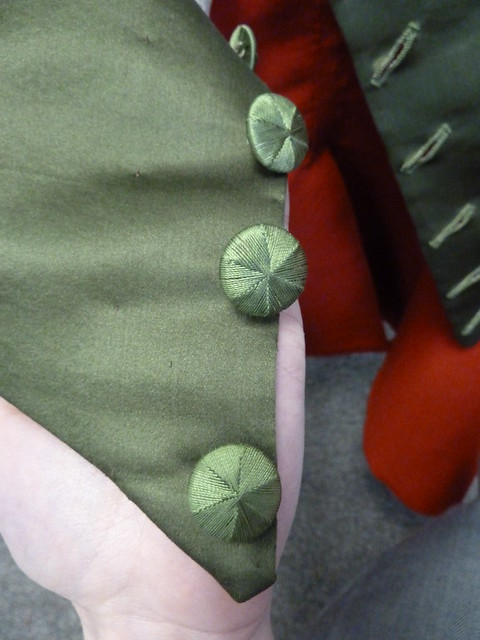
Examples of death head buttons on the waistcoat of a new women's riding habit, featured
in Tuesday's fashion show as part of the symposium.

Rebecca and I both spent the second part of the week engaged in the Thursday-Friday conference entitled “A Reconstructed Visitable Past,” which focused on the use of costumes in museums.  It was a very enlightening two days which I am looking forward to sharing with you all shortly – so stay tuned!

Thursday, March 17, 2011

"Costume Accessories: Head to Toe" Colonial Williamsburg/CSA Symposium

Day Four

Muffs, mitts, caps, fringe, cloaks, and other pretties made by the CW milliners.

The lectures having ended Tuesday evening, Wednesday was the designated optional programs bridge-day between the Sunday-Tuesday accessories symposium and the Thursday-Friday conference on the use of costumes in the interpretation of historic sites.  There were a number of costume- and textile-related tours to choose from in the morning, while the afternoon sessions were set aside to attend one of four workshops.

My first program was a behind-the-scenes tour of the costume collection and the new Fashion Accessories from Head to Toe exhibition, let by none other than Linda Baumgarten herself.  Talk about star-struck and the opportunity of a lifetime!  :-)  First, she took us into the costume storage facilities, which house closets full (and I mean FULL) of hanging original gowns and petticoats and formal jackets, with drawers of breeches and waistcoats in between.  Linda had pulled an incredible gown out for us to see, along with a frock coat.  After about fifteen minutes of drooling and sighing, we headed upstairs where Linda gave us an overview of the challenges she faced and the pleasant surprises she encountered in mounting the accessories exhibit.  She explained some curator's techniques to displaying antique items without damaging them, and also shared some of the secrets revealed by the items themselves as she studied them closely prior to mounting them.  What a special treat this tour was!

A fabulous 1800ish bonnet made by the CW milliners that was
featured in the fashion show on Tuesday afternoon.

The second tour I chose was of the textiles storage facility.  Kimberly Smith Ivey, associate curator of textiles and historic interiors, led us around the state-of-the-art room filled with rows upon rows of drawers full of gowns, jackets, aprons, breeches, waistcoats, dolls, samplers, sewing implements and accessories, quilts, bed hangings, chair covers, and rolls of fabrics, along with buttons and jewelry.  For an hour, we got to explore this plethora of treasures.  We divided into several smaller groups, each group heading towards the items in which they were most interested, and from our corner with the gowns and jackets, we periodically heard from elsewhere in the room gasps and squeals and sighs (meanwhile often exuding plenty of our own!).  It was probably the happiest roomful of people I've ever been around!

A velvet-trimmed silk satin muff made by the CW milliners.

After lunch, Ashley headed to a button workshop (which I'll leave to her more capable hands to describe!), while I scurried off to one on silk muffs, led by Janea Whitacre.  Scattered across a table was a pile (oh, glorious pile!) overflowing with muffs, mitts, caps, bonnets, cloaks, mantles, and fringe.  After explaining the evolution of the style and shape of the fashionable muff across the century, we selected our fabric and trims and got to work.  Three and a half hours later, we had all finished or mostly-finished them.  Of course, there being a big difference between finished and mostly finished, I will refrain from sharing my mostly-finished muff until it's completely done.  I selected a pretty springy-minty green silk, perfect for those cool yet bright spring days.  As soon as it's done, I promise to share lots of pictures!

The Spruce Sportsman muff, made by the CW milliners and featured
 in Tuesday's fashion show and in the accessories exhibit video
at the DeWitt Wallace.

A precious miniature muff, measuring only about 4.5".

Today began the "Reconstructed Visitable Past" conference, with a 9 to 5 day chock-full of back-to-back talks.  But that will have to wait until tomorrow!  Two posts in one day is more than enough for exhausted me!

"Costume Accessories: Head to Toe" Colonial Williamsburg/CSA Symposium

Day Three

Goodies on display at the Margaret Hunter millinery shop.

My apologies for the absence of new posts Tuesday and Wednesday; Ashley and I ended our Tuesday evening with some English country dancing at Newport House and got back so late that I just dropped into bed exhausted (but happy!).  Yesterday I was in bed by 9:30 after a day of pretties information overload.  As a result, I'll be doing two postings this evening, so be sure to scroll up or down to make sure you don't miss one or the other of them!

Tuesday's lectures opened with a prodigiously enlightening discussion of "traditions and revolutions" in hairstyles and wigs from 1748-1804.  Anne Bissionnette, assistant professor of material culture and curatorship at the University of Alberta, suggested that philosophy and history combined in hair at the middle of the eighteenth century, with styles reflecting the trend for recovered ancient cultures and aesthetics.  In general, then, women's wig styles from 1748-1760 favored tight curls worn close to the head.  By the 1760s, wigs were quite affordable and widely worn by all who could afford one.  Bissionnette theorizes that this prompted a brief return to natural hair by the young gentlemen of the aristocracy in an effort to counter the equality of appearance across all social levels that inexpensive wigs allowed.

After a brief summary of the Macaroni movement of the 1760s and early '70s, the discussion turned again to women's hairstyles, which changed rapidly from egg-shaped to an inverted pyramid (again inspired by ancient examples) to the poof and hedgehog styles that dominated the 1780s.  This turn towards informality and a (cultivated) "natural" appearance continued with slight variations into the turn of the century, corresponding to (or reflecting), Bissionnette argues, an increased emphasis on the individual.  This lecture was so jam-packed with information that it's very difficult to try to summarize my pages and pages of notes into such a small space, so pray forgive me if I've omitted something.  I assure you it was by necessity and not neglect!  If there's anything you're interested in hearing about, just let me know and I can go back to my notes for more.

A CW interpreter on Palace Green.

Robin Kipps, the apothecary supervisor at CW, followed with a fascinating look at what might be called medical prescriptions for clothing in the eighteenth century.  Scattered throughout medical manuals, she observed, are suggestions about quilting medicines into waistcoats or night caps (depending, of course, on the location of the malady), advertisements for specially-purposed health-related garments (cork jacket, anyone?), and even advice for parents on the proper use and function of leading strings (yeah, maybe swinging your toddler by them isn't such a good idea after all...).  Her unique perspective on clothing and accessories suggested a fresh and fascinating new way to look at traditional fashionable items that could be re-purposed to serve highly specific functions.

The Pasteur and Galt Apothecary at Colonial Williamsburg -
an most unexpected place to find advice on accessories
(albeit it medicinal ones!).

After lunch, Susan North returned to the podium to reconvene with a talk about linen, cleanliness, and the fashion, form, and function of the white laundered accessory.  Her lecture drew upon her current research project and offered a series of observations and questions prompted by the materials she has thus far encountered.  The pristine white of kerchiefs, caps, cuffs, and ruffles served as an outward manifestation of cleanliness in underwear, North argued.  Medical literature yields contradictions at every turn regarding the preference for and benefits of linen vs. flannel underwear, and civility literature often suggests that clean linen needed to clean more for fashion's and appearance's sake than for the sake of cleanliness.  I'm always intrigued to hear about peoples' current projects, so I'll be eagerly anticipating further results as this one continues to develop.

A satin-striped silk gauze cap on display in the milliner's shop.

The final lecture, given by Cynthia Cooper (head of research and collections and curator of costume and textiles at the McCord Museum), took a tour through the changes in fashion of three prominent accessories: shawls, sashes, and scarves.  Accompanying the talk (which spanned the early eighteenth century all the way to the end of the nineteenth) was a collection of stunning slides of items held in the McCord Museum and scores of illustrative prints and paintings.  I found her focus on the "otherness" of these items of dress to be particularly illuminating.  Shawls, for instance, arrived in Europe and England from India in the late 1790s.  While images of them display a certain willingness to incorporate such an exotic item into fashionable continental dress, contemporary images simultaneously reveal an ambiguous relationship to it; while the shawl was a masculine article of clothing in India, Europe's aesthetic reaction to it, removed from its original function, re-imagined the shawl into a feminine accessory worn in a completely different way.  There were scores of additional examples, but again, the limits of space prevent me from being able to include everything here!  Again, just let me know if there's anything you were looking to hear about that I've left out and I'll happily post more.  :-)

The formal part of the conference concluded yesterday with a jaw-dropping, show-stopping fashion show featuring the reproduction costumes and accessories of the Colonial Williamsburg milliners and tailors.  Janea Whitacre, mistress of the trades of millinery and mantua-making at CW, narrated the development of the professions from the time of Elizabeth I to the invention of the sewing machine.  As she shared amusing period anecdotes and historical tidbits related to the evolution and eventual divergence of the trades, costumed "characters" walked the stage, sometimes pausing to recite a piece, act a dramatic scene, or even sing a song of fashion for the audience (yes, certain accessories deserve to be immortalized in song, and the calash is definitely one of them!).  The sheer number of gowns, cloaks, hats, mitts, caps, neckerchiefs, and shoes on display was incredible, each one more beautiful than the last.  Oh what a dream job those milliners have here!  If you'd like to see some photos from the fashion show, check out the facebook page of the Margaret Hunter Shop.

Reproduction unfinished child's stays.

PS: Just in case you're wondering where all the pretty pictures are here and on other blogs, photography during the conference is strictly on a private-for-personal-research-use-only policy, so to respect that, all of the photos in our conference posts are drawn from various other sites around Colonial Williamsburg, and not from the symposium itself.

Monday, March 14, 2011

"Costume Accessories: Head to Toe" Colonial Williamsburg/CSA Symposium

Day Two

The miniature milliner's shop on display at the Margaret Hunter shop,
which features more than a dozen pint-sized accessories.

Today was the first of two full days of lectures.  CW's Linda Baumgarten (of Costume Close-Up and What Clothes Reveal fame) opened the morning with an introduction to the accessories held in the collections of Colonial Williamsburg.  Many were examples drawn from the new exhibit, "Fashion Accessories from Head to Toe," and it added an extra special dimension to that experience to hear the exhibition's curator discuss some of the items from her meticulously informed perspective.  Her explanation of her approach to studying and understanding historic accessories was accompanied by a series of superb close-up views of the items, permitting us rare peaks at angles and details impossible to see through the glass of the museum display.  If you're unable to visit the museum in person, many of the items can be seen in the "Historic Threads" online exhibit here.

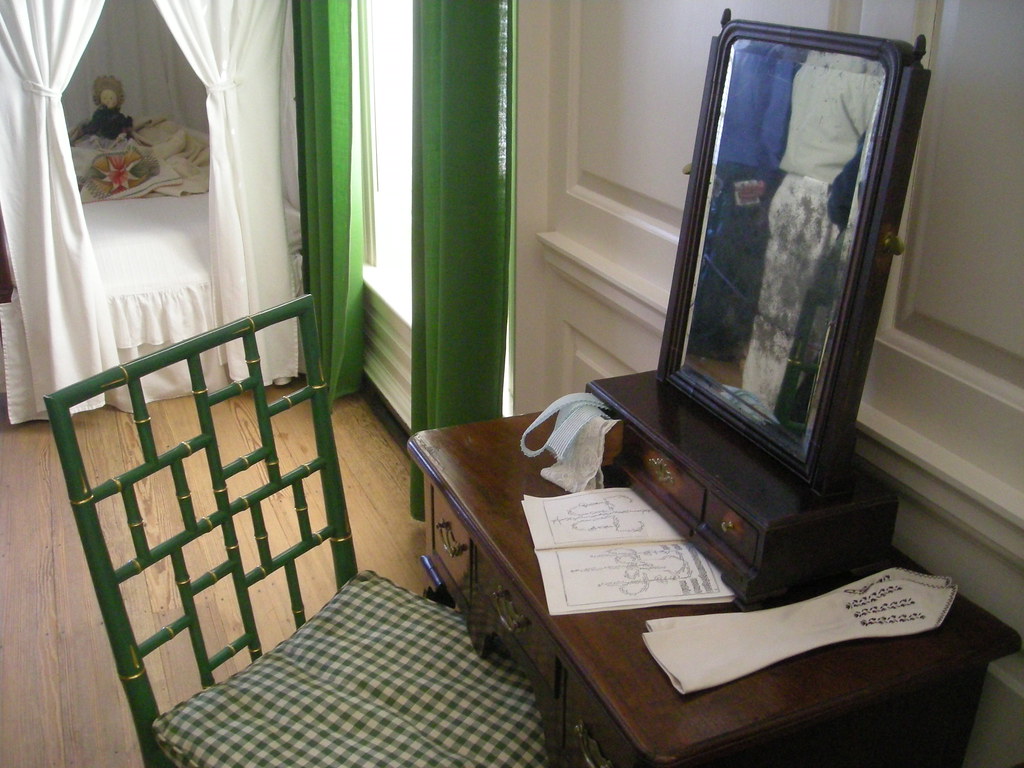
Accessories espied in use around CW: a bedroom at the Governor's Palace.

Phil Dunning's talk followed with a case study of accessories and textile fragments recovered from a 1690 shipwreck.  His contribution offered a fascinating glimpse at one process of recovery available to historians, curators, and researchers: the use of archaeological objects to enhance our understanding of how, where, and why accessories were used in the past.  He even brought with him all the way from Canada a selection of the recovered late seventeenth-century items, eliciting a series of "ooooos" and "ahhhhhs" from the enthralled audience.

The afternoon continued with a tremendously entertaining contribution from Mark Hutter (CW's journeyman tailor) and Erik Goldstein, curator of mechanical arts and numismatics at CW.  In a friendly bantering exchange, the two gentleman offered an outline of the use and production of men's accessories (or more appropriately "accoutrements" and "toys," which Mark explained were the terms current in the eighteenth century for such fashionable objects).  From sleeve buttons and walking sticks to "hard toys" (small metal items like keys and seals) and the etiquette of hats, the lecture featured a fantastic collection of period prints and paintings that helped to bring the accompanying antique pieces to life.

The green silk waistcoat that forms part of the riding habit we saw
in progress at the milliner's shop yesterday.

D.A Saguto, CW's master boot and shoemaker, closed the day with a timeline overview of the development of footwear from the time of ancient Rome to the early nineteenth century.  With expert detail, he addressed the changes in production techniques and fashionable preferences that contributed to the evolution of one of our favorite accessories.  The lecture closed with a show-and-tell of reproduction shoes made by Al and the staff at CW (and yes, he even brought a red leather pair, *sigh*).

A silk gown displayed at the Governor's Palace.

It's been a busy day, and I'm thoroughly enjoying the chance to meet and mingle with fellow costumers - amateur and professional - museum experts, and enthusiasts drawn for all manner of reasons to an interest in this unique and fascinating topic.  It's been especially fun discovering the faces behind many of the online presences of the historic costuming world.  If only this could last longer than just two short days because there is so much to see, so many people to meet, and way too much to learn in too brief a time!  Check back in tomorrow night for day three!

Sunday, March 13, 2011

"Costume Accessories: Head to Toe" Colonial Williamsburg/CSA Symposium

Day One

Rebecca pondering the symposium schedule.

This evening saw the opening of "Costume Accessories: Head to Toe," a two-and-a-half day symposium co-sponsored by Colonial Williamsburg and the Costume Society of America. We arrived in Williamsburg last night and spent today walking the historic area, enjoying the sunshine and the warm weather. After checking-in for the symposium and doing a bit (alright, more than a bit...) of shopping, we dropped in to the milliner's shop to catch a glimpse of the last-minute symposium preparations. We found Mr. Hutter, the tailor, diligently polishing silver buttons and finishing up a stunning 1770s riding habit with green silk facings. Despite his pressing timeline, he generously took the time to chat for a few minutes about the project, and I'm eagerly anticipating a glimpse of the finished habit on Tuesday!

A gorgeous red silk taffeta gown on display in the
Margaret Hunter milliner's shop.

This evening, I attended the opening keynote lecture for the symposium. Susan North, curator of fashion at the V&A and best known (and vastly appreciated) for her Seventeenth- and Eighteenth-Century Fashion in Detail, gave a spectacular context-setting introduction to a revisionary methodology for studying and re-presenting accessories and articles of clothing. She called for a re-integration of costume pieces with the bodies they were meant to adorn, stressing the importance of that relationship and of an understanding of the contexts in which such objects were manufactured, used, and exchanged. Over the next two days as we delve into "fashion in detail," her words will continue to echo their relevance. I can't wait to begin the lectures in earnest tomorrow!

Ashley frolicking in a new gown at CW.

Thursday, March 3, 2011

Online 18th Century Patterns in Unexpected Places

As the majority of re-enactors and costumers are aware, Duran Textiles (based in Sweden) is one of the few resources for high-quality 18th century reproduction silks and printed cottons.  But what you may not know is that they periodically publish an online newsletter peppered with all sorts of fascinating and unique information, from the details of their own (period-accurate) printing processes to articles on perfume, fans, and period hairstyles to stunning photos and descriptions of reproduction garments and accessories.  Occasionally, they'll even include clothing patterns from their inspirational sources.  Below are a couple of our favorites:

- A Swedish short gown, dated approximately 1750-1770.  Note the collar piece, which is fairly uncommon.  The construction details are superbly documented, from the assembly to the stitches used, making this a great resource for a period-accurate project.  The original print, a block-printed cotton, has been reproduced exactly in scale and colorway as "Anemon" and is available on the website if you'd like to make an exact copy of this original short gown.

The original 1750-1770 short gown, from the Duran website.

- A late-18th century Swedish short gown.  The cut and construction of this short gown closely resemble the one above, though its shorter skirt and slightly higher waist date it slightly later in the 18th century, or even into the early part of the 19th.  The original resist-dyed block-printed cotton has been reproduced as a screen print and is available here.  Additional photos of the interior of this shortgown can be found in this article.

The front of the original short gown, from the Duran website.

Other costume-related newsletter articles that caught our eye were this one on a recreated 1780s robe a l'anglaise in a gorgeous Duran striped silk (*sigh*), a collection of cap and bonnet patterns conjectured from period images, and this short account of 18th century stays with some great photos. 

Shortgowns are a quick and easy project that swiftly help you achieve a period look (when worn with the correct period undergarments and accessories, of course!).  If anyone attempts a reproduction from either of the patterns above, we'd love to see your final product!  Here's a recent one made by Katherine (Koshka the Cat) from the second pattern above. 

If you're feeling in a shortgown mood, additional shortgown patterns taken from extant garments can be found in Costume Close-up (pgs. 43-6) and Fitting and Proper (pgs. 20-2 and 23-5).  If you'd like to draft your own shortgown pattern, visit Mara Riley's page, or see Beth Gilgun's instructions in Tidings from the 18th Century (pg. 48) for more information.