Day Three of the "Millinery Through Time" conference maintained the trend of impressive and inspiring presentations. Paper after paper, lecture after lecture continued to introduce some pretty incredible research. The range of topics alone was staggering, and I only wish it could have lasted another day (or two or five) because there was just so much good stuff to soak up in such a short amount of time!
The talks before lunch spanned topics that included everything from early American shoe-makers' labels to an overview of the popular fashion for turbans at the turn of the nineteenth century. The morning saw two stand-out moments for me, however, the first of which was Mela Hoyt-Heydon's consideration of the use of artificial flowers in eighteenth-century millinery. As fascinating as that is, what really made her talk so prodigiously awesome was that she then proceeded not only to discuss how these flowers were made in the period, but also how those historical methods can be reproduced today. I think the entire auditorium was just in awe, and I left fully motivated to go forth and make flowers in abundance! This made me (and probably everyone else who hadn't signed up!) really, really wish I'd elected to do Mela's velvet flower workshop scheduled for the following day... ;-)
The other notable paper from the morning was CW apprentice Abby Cox's exploration of the westward "expansion" of the millinery and dress-making trades at the beginning of the nineteenth century. Using information culled from city directories, she literally mapped the growth and change of the fashion trades in a completely novel way. Her approach was intriguing and highly original, using physical landscapes and spatial readings to document how "millinery" and "the milliner" evolved, simultaneously expanding and contracting her business to meet shifting socio-economic and fashion trends.
After lunch, we continued our chronological movement forward into the nineteenth and twentieth centuries. Samantha McCarty (of Couture Courtesan) presented an inquiry into a long-overlooked and under-researched area of Civil War-era clothing: mourning millinery and accessories. As the "visible signs of sorrow," mourning collars, cuffs, and bonnets, specific fabrics and colors all occupied a broad (and lucrative) spectrum of the fashion industry. In an age when clothing was "read" and interpreted as an outward expression of an individual's place in society, tiny details like those distinguished by Samantha spoke volumes. She's hinted that there's a mountain of additional research left to pursue, and I know I, for one, am most eager to hear more!
Then it was on to the final panels on the conference schedule. From a study of the life and career of a single, enterprising milliner in turn-of-the-century Newfoundland, to a consideration of the millinery trade in Ontario, to a glamorous overview of the distinctive, defining style of American millinery in the years surrounding WWII, to a first-hand glimpse into the career of modern-day milliner-artist Ignatius Creegan, each of the speakers that contributed to the concluding afternoon helped to round out the incredible range of scholarly contributions on millinery and fashion history that we'd experienced over the course of the two previous days. I sincerely hope that it won't take another sixty years before we get the opportunity to do this again! If this conference confirmed anything for me, it's the sheer wealth of untapped information left to be uncovered in the study of historical fashion.
Many thanks to all who contributed their knowledge, skills, and time to make this conference such a rare and special treat!
Friday, April 4, 2014


Tuesday, March 25, 2014
Are you missing the Frolicks on Facebook?
How much would you "LIKE" a chance to win a discount coupon to the Fashionable Frolick Shop on Etsy? We want to thank our Facebook subscribers for their support and encouragement by offering them a very special, exclusive opportunity!
To enter for a chance to win 10% off your total purchase in our Shop, simply "LIKE" our Facebook page and then post a comment on the official contest entry post there by answering the question provided. Sorry, comments here on the blog cannot be accepted for entry purposes.
TWO discount coupons will be awarded, drawn at random from the names listed in the Facebook comment replies. The drawing will occur on Friday, April 4th at 5pm and the two lucky winners will be posted on our Facebook page then.
SPREAD THE WORD!!!! Good luck, and thank you again to all of our FF Facebook friends! :-)
To enter for a chance to win 10% off your total purchase in our Shop, simply "LIKE" our Facebook page and then post a comment on the official contest entry post there by answering the question provided. Sorry, comments here on the blog cannot be accepted for entry purposes.
TWO discount coupons will be awarded, drawn at random from the names listed in the Facebook comment replies. The drawing will occur on Friday, April 4th at 5pm and the two lucky winners will be posted on our Facebook page then.
SPREAD THE WORD!!!! Good luck, and thank you again to all of our FF Facebook friends! :-)
Sunday, March 23, 2014
"Millinery Through Time" Conference: Day Two
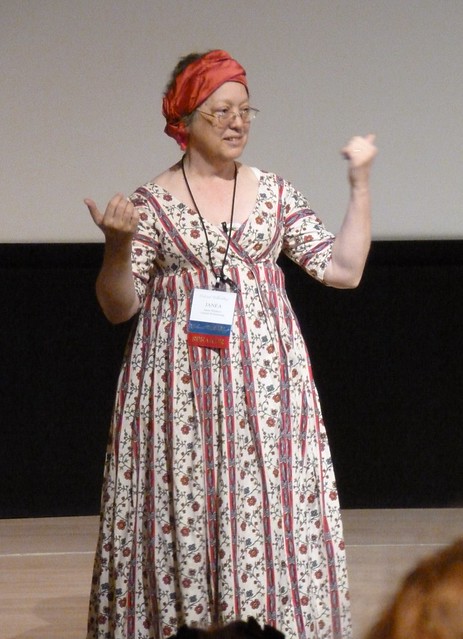
Janea opens the conference with a brief history of the
millinery and mantua making trades.
Monday morning convened with Janea Whitacre offering a comprehensive overview of the milliner’s trade and all that it encompassed in the eighteenth century. She explored in fascinating detail the various divisions of the trade (black millinery vs. white millinery, shop milliners vs. private milliners, etc.) and described how the millinery trade was often paired with other similar trades to help maximize the milliner’s offerings, clientele base, and profits. Mantua-making was one of the trades most often practiced alongside millinery, so Janea’s presentation even included demonstrations of the mantua-maker’s art of pleating an early-century mantua and of cutting a later gown bodice directly on her client.
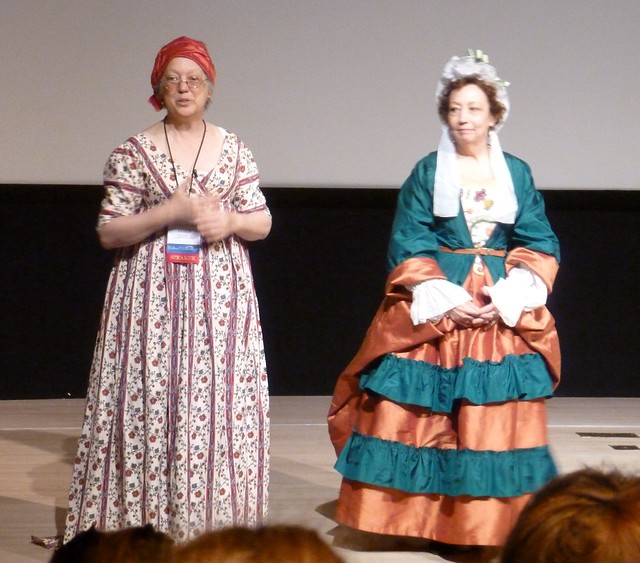
Explaining the fashion for mantuas, with Angela playing the role of model!

Demonstrating the pleating of the mantua.
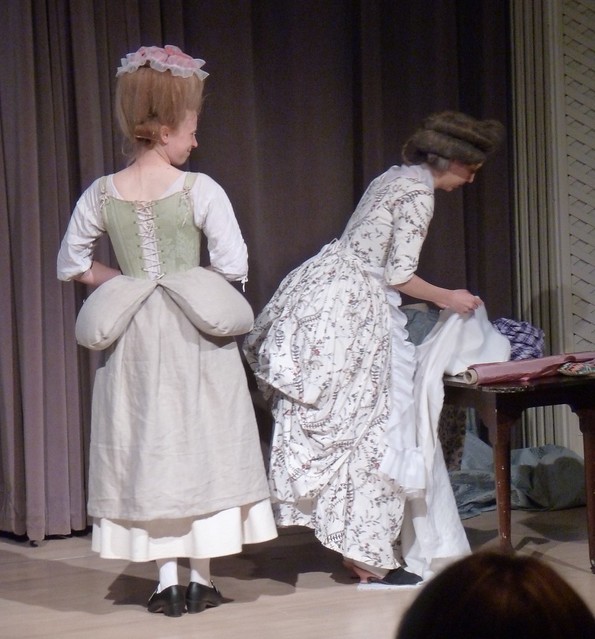
Apprentice Sarah demonstrating the cutting of a gown bodice on Miss Aislinn.
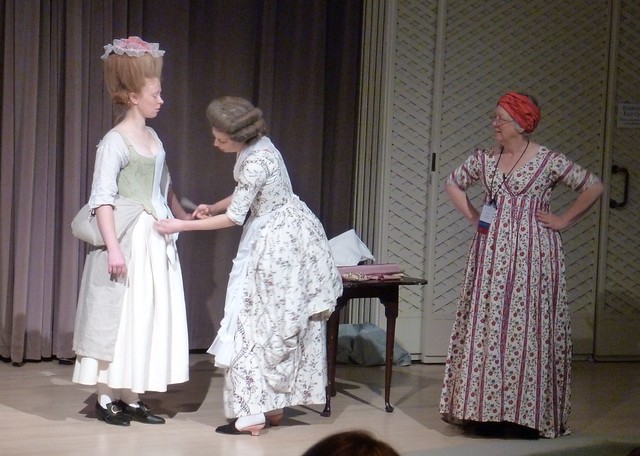
The day continued to bring one inspiring talk after another, with papers exploring a plethora of topics including everything from Monsieur Beaulard, “man milliner” to Marie Antoinette, to the milliner’s vulnerability to theft, to an examination of an extant whitework apron, to a tantalizing glimpse at the rather curious eighteenth-century fashion for black velvet masks. Angela Burnley (of Burnley and Trowbridge) spoke at length about eighteenth-century textiles and their availability, sharing slide after slide of pictures from her extensive research into period sample books and the Foundling Hospital’s tokens archive. Addressing not only the names and variations of common fabrics, but also their identifying weave structures and most popular colors, Angela offered a glimpse into an enthralling avenue of inquiry that can contribute so much to the work done by material culture historians, textile and costume specialists, and reenactors alike.
One of the highlights of Monday’s talks was apprentice Sarah Woodyard’s “live action” analysis of a 1782 print entitled “A Morning Ramble, or – The Milliner’s Shop.” Reading the details of the image like a text, she highlighted elements of the eighteenth-century milliner’s identity, work, and cultural stereotypes, exposing period connotations and nuances to words and objects that have largely become lost or obsolete over time. As she spoke, the print’s image literally took shape on stage in tableau, piece by piece and figure by figure, brought to life through reconstructions of both the physical image and its period meaning. For more on this particular paper, see Susan's post on her Two Nerdy History Girls blog. More about the costumes featured in the presentation can be found on the Margaret Hunter Shop's facebook page, where the ladies documented the beginnings of the "Morning Ramble" project.
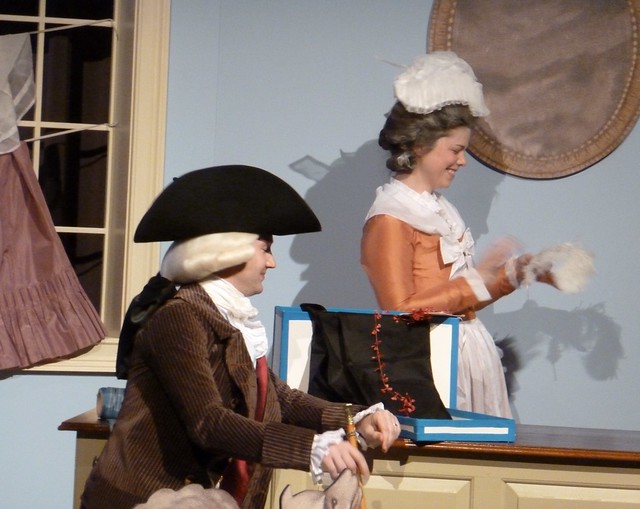
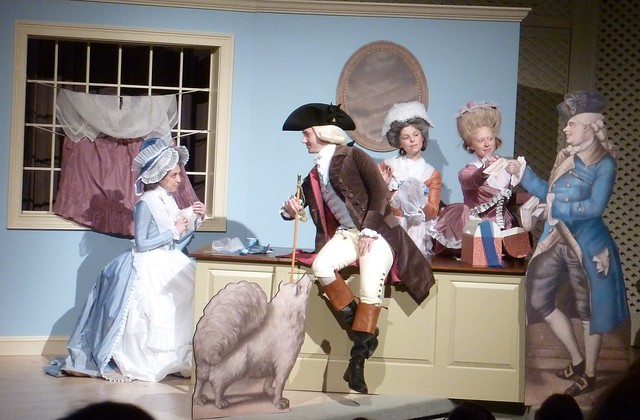
"A Morning Ramble" brought to life before our eyes.
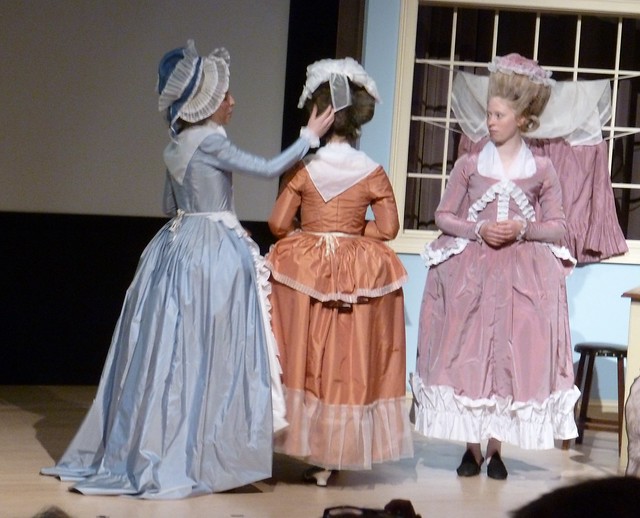
A brief discussion of the fashions featured in the print.
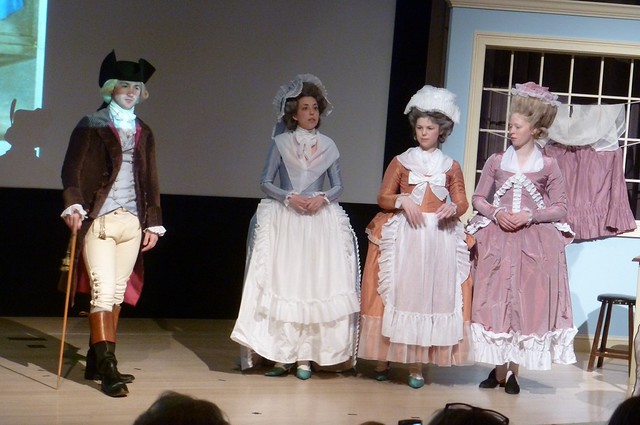
We all enjoyed a very special treat Monday evening with a staged performance of a 1780s comic burletta/operetta, appropriately entitled - of course, what else?! - "The Milliners"! Hilariously acted with true period flair for satire, irony, and downright delightful silliness, the play took aim at both "man-milliners," perceived to be overrunning the traditionally feminine realm of millinery work, and French fashions, increasingly popular in England in the 1780s. We laughed until our sides hurt, relishing all of the fashion-related humor and the eighteenth century habit for poking fun at everyone and everything. The cast did a marvelous job and we were so impressed and most thoroughly entertained!
Day Three to come in the following post! In the meantime, there are additional photos available in our conference Flickr set.
Monday, March 17, 2014
"Millinery Through Time" Conference: Day One
Sunday found us at Colonial Williamsburg for the opening of the "Millinery Through Time" conference celebrating sixty years of the Margaret Hunter Shop. The evening began with the Mistress of the shop, Janea Whitacre, sharing a "scrap book" history of the restored 18th-century shop building, along with an overview of the evolution of the trades of millinery and mantua-making as they are now practiced at CW. A presentation of media clippings from film, television, print, and digital sources followed, providing a fun glimpse into not only the impact that the Shop has made within the culture of Colonial Williamsburg, but also the deep impression its staff and the trades they interpret have had on the wider history and education communities. Next came a very special peek at a digitally recreated MHS as it might have appeared in the 1770s, and a quick summary of some of the antique costumes and textiles acquired by Colonial Williamsburg during the first years immediately following the shop's opening.
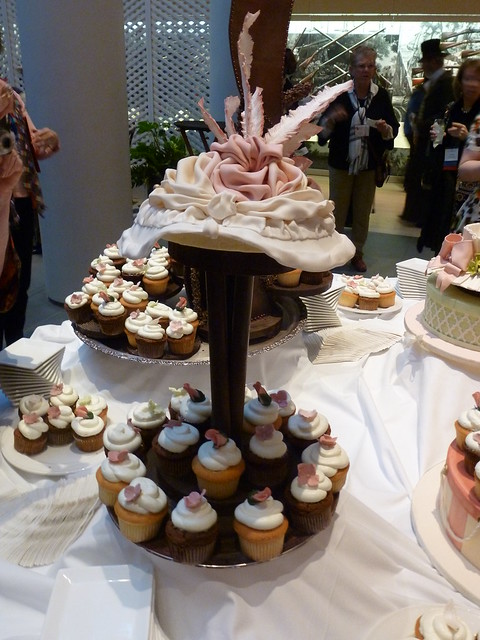
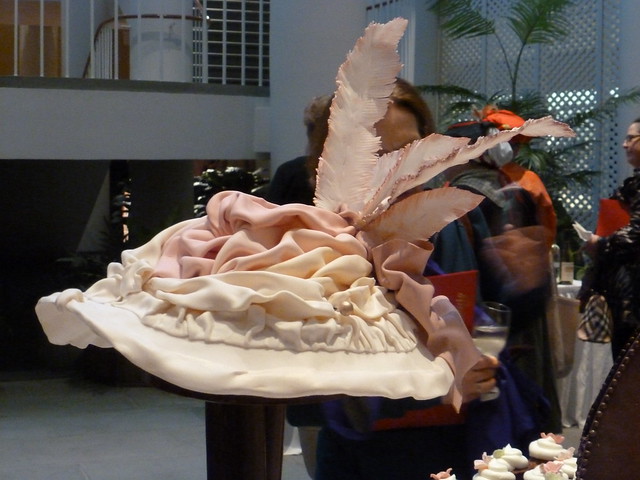
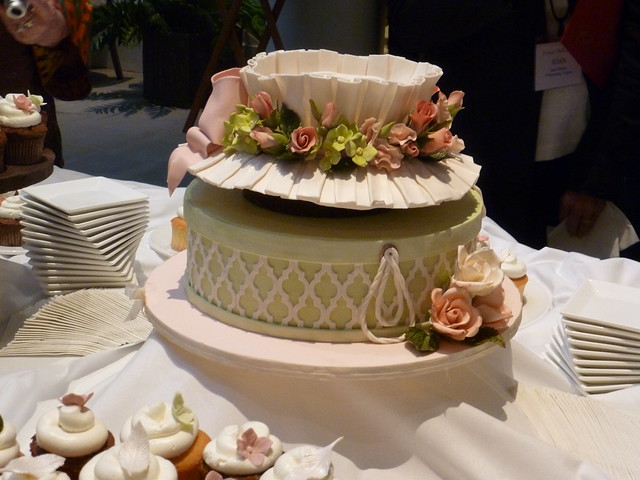
Then it was time for the party officially to begin! Two amazing millinery confections made of elaborately crafted pastel sugars, frosting, and cake were on display. They both looked good enough not only to eat, but even to wear! The details on each of them, from feathers to gathered gauze to flowers, were unbelievable in their meticulous attention to every minute little detail.

We had a marvelous time catching up with old friends and making the acquaintance of new ones. Many of the participants came in their favorite period or vintage clothing and it was such fun strolling about admiring all of the beautiful finery. Recognizing fellow bloggers by their costumes became one of the pleasures of the evening, and we had such fun finally being able to put faces to some of the digital names we've grown accustomed to seeing! :-)
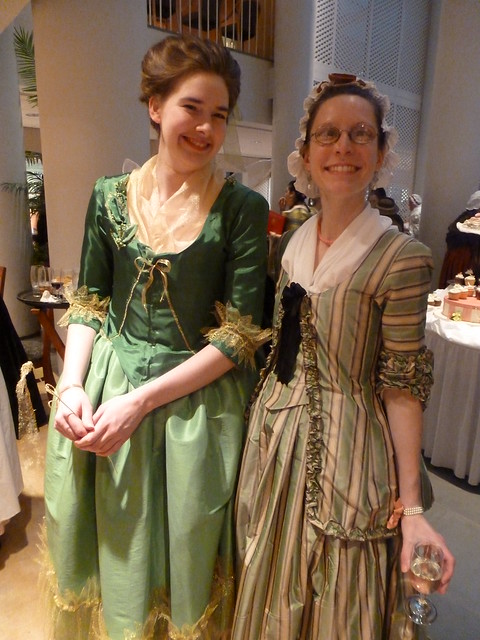
Emma and Ashley "going green" in silk!
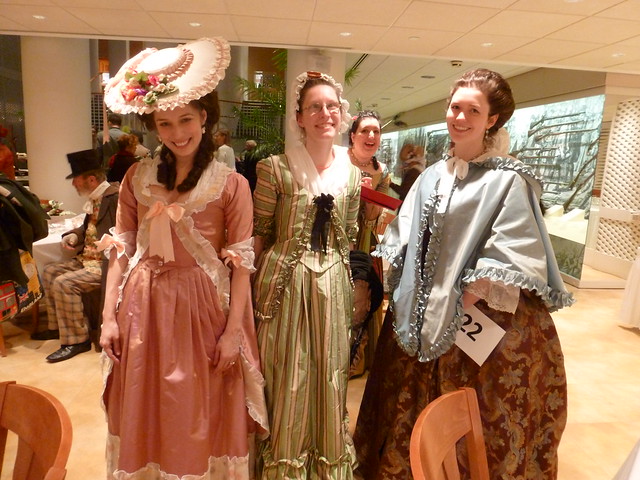
Leia, Ashley, and Aubry enjoying the evening's festivities.
We were so busy mingling and chatting (and eating cupcakes!) that we didn't even get a chance to take a picture of the two of us together all dressed up! We went as "silk sack sisters," both in our striped silk sack jackets. Hopefully some time later this week (praying the weather improves!), we'll try to get some quality pictures of our newest creations to share. In the meantime, look forward to further conference updates over the next few days!
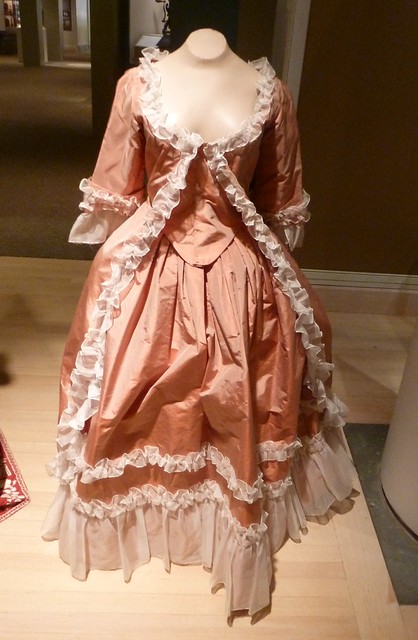
Then it was time for the party officially to begin! Two amazing millinery confections made of elaborately crafted pastel sugars, frosting, and cake were on display. They both looked good enough not only to eat, but even to wear! The details on each of them, from feathers to gathered gauze to flowers, were unbelievable in their meticulous attention to every minute little detail.
We had a marvelous time catching up with old friends and making the acquaintance of new ones. Many of the participants came in their favorite period or vintage clothing and it was such fun strolling about admiring all of the beautiful finery. Recognizing fellow bloggers by their costumes became one of the pleasures of the evening, and we had such fun finally being able to put faces to some of the digital names we've grown accustomed to seeing! :-)
Emma and Ashley "going green" in silk!
Leia, Ashley, and Aubry enjoying the evening's festivities.
We were so busy mingling and chatting (and eating cupcakes!) that we didn't even get a chance to take a picture of the two of us together all dressed up! We went as "silk sack sisters," both in our striped silk sack jackets. Hopefully some time later this week (praying the weather improves!), we'll try to get some quality pictures of our newest creations to share. In the meantime, look forward to further conference updates over the next few days!
One of several creations on display during the evening,
a timeless testament to the incomparable skill and
talent of the ladies that are the MHS.
Wednesday, February 5, 2014
Another Victorian Bustle Gown Costume for Sale, Just in Time for Valentine's Day!
Exactly a year ago, we did a cursory rummaging around in the costume closet and I uncovered a green/blue taffeta 1870s-inspired evening gown I'd made about ten years ago for a Victorian costume event. It was one of the very first historical "costumes" I'd ever made, and though I was sad to see it go, it was time to bid it farewell and send it off to a new home to make some room in the closet for new creations.
While Ashley was visiting a couple of weeks ago, we finally got around to doing a more massive purge of the costume and fabric closet and uncovered the gown I'd made for her for that same event back in 2005. This one is made of a stunning ruby red satin fabric. At first, she was tempted to keep it, as it's always been one of her favorite pieces in her absolute favorite color, but after she tried it on and found that it no longer fit, she decided she's ready to part with hers as well. It is now listed on Ebay!

As I mentioned in last year's post when the first gown was listed, this gown was made before Ashley and I really got serious and nit-picky about historical fashion on a research-oriented level. This means that if you'd like to bid on it, please be aware that this is very much a costume - not a meticulously researched "reproduction" piece like those we typically share on the blog. The gown is entirely machine sewn. Like the blue/green gown, this red one was one of my very first sewing endeavors and as such, it certainly has its flaws, though Ashley still adores it and I do have to admit that it came out looking quite pretty.
As you can probably tell, I made this gown using the same pattern base as mine, though it was so long ago now that I honestly can't recall which pattern it was. The gown comes in three pieces: bodice, skirt, and bustle. Please forgive the lack of detailed photos this time around; the dress is too small for my dressform, so we've opted to just use the original pictures because they give the best sense of how the dress drapes when worn.

The sleeveless bodice has a deep V-neckline in front and back that is trimmed with matching patterned red satin ribbon. It is stiffened with interfacing and plastic boning and fully lined in red as well. The armscyes are bound in the same red ribbon that surrounds the neckline; this same ribbon also edges the bottom of the bodice, following along the center front point that dips several inches beneath the natural waistline. The back has a short peplum that flounces out over the bustle and the back laces closed.

The skirt hemline is edged with a row of red ribbon. It has an apron front that is attached at the waistband; its bottom edge, too, is finished with the same red ribbon. The bustle attaches to the skirt with hooks and eyes at the waistband and with a series of ties and plastic rings down the back of the skirt. The bustle is fully lined and is interlined with crinoline to give it fullness and body.

Four large deep red roses are suspended on a fabric strip down one side of the bustle, in imitation of period fashion plates (the other side of the bustle is left plain). Beneath the roses is a large, wide bow in the same coordinating ribbon.

Please see the listing for measurements, pricing, and further details. Let us know if you have any questions. We'll be thrilled to know that this is going to go to a new home!
And if you're in the mood for shopping in another period, we also currently have listed a couple of 18th-century pieces and some taffeta fabrics on Ebay!
While Ashley was visiting a couple of weeks ago, we finally got around to doing a more massive purge of the costume and fabric closet and uncovered the gown I'd made for her for that same event back in 2005. This one is made of a stunning ruby red satin fabric. At first, she was tempted to keep it, as it's always been one of her favorite pieces in her absolute favorite color, but after she tried it on and found that it no longer fit, she decided she's ready to part with hers as well. It is now listed on Ebay!
As I mentioned in last year's post when the first gown was listed, this gown was made before Ashley and I really got serious and nit-picky about historical fashion on a research-oriented level. This means that if you'd like to bid on it, please be aware that this is very much a costume - not a meticulously researched "reproduction" piece like those we typically share on the blog. The gown is entirely machine sewn. Like the blue/green gown, this red one was one of my very first sewing endeavors and as such, it certainly has its flaws, though Ashley still adores it and I do have to admit that it came out looking quite pretty.
As you can probably tell, I made this gown using the same pattern base as mine, though it was so long ago now that I honestly can't recall which pattern it was. The gown comes in three pieces: bodice, skirt, and bustle. Please forgive the lack of detailed photos this time around; the dress is too small for my dressform, so we've opted to just use the original pictures because they give the best sense of how the dress drapes when worn.
The sleeveless bodice has a deep V-neckline in front and back that is trimmed with matching patterned red satin ribbon. It is stiffened with interfacing and plastic boning and fully lined in red as well. The armscyes are bound in the same red ribbon that surrounds the neckline; this same ribbon also edges the bottom of the bodice, following along the center front point that dips several inches beneath the natural waistline. The back has a short peplum that flounces out over the bustle and the back laces closed.
The skirt hemline is edged with a row of red ribbon. It has an apron front that is attached at the waistband; its bottom edge, too, is finished with the same red ribbon. The bustle attaches to the skirt with hooks and eyes at the waistband and with a series of ties and plastic rings down the back of the skirt. The bustle is fully lined and is interlined with crinoline to give it fullness and body.
Four large deep red roses are suspended on a fabric strip down one side of the bustle, in imitation of period fashion plates (the other side of the bustle is left plain). Beneath the roses is a large, wide bow in the same coordinating ribbon.
Please see the listing for measurements, pricing, and further details. Let us know if you have any questions. We'll be thrilled to know that this is going to go to a new home!
And if you're in the mood for shopping in another period, we also currently have listed a couple of 18th-century pieces and some taffeta fabrics on Ebay!
Wednesday, January 22, 2014
Exciting news for Downton Abbey fans in the United States!
Exciting news for Downton Abbey fans in the United States! This February, The Countess of Carnarvon of Highclere Castle (the spectacular setting of Downton) will be visiting a few states to promote her latest book, Lady Catherine and the Real Downton Abbey. On her blog, Lady Carnarvon mentions a couple of different stops on her tour, including one in Nashville, TN, just before heading to Virginia; I have not been able to find a more detailed tour schedule listing, however. Colonial Williamsburg will be hosting two events with Lady Carnarvon on February 9th & 10th. You can join her for tea on February 9th at the Williamsburg Lodge to hear her speak about Highclere and its past inhabitants. And February 10th she will speak about life at Highclere at the DeWitt Wallace Museum in Williamsburg. A book signing will follow the lecture. You can find further information and purchase tickets online here. If anyone has heard about additional stops on her book tour, please let us know so we can post those here as well!

Don't forget about the upcoming exhibit of fabulous Downton Abbey costumes at Winterthur, starting March 1, 2014!
The second of the Countess' books will be the subject of her
upcoming book tour in the U.S.
Don't forget about the upcoming exhibit of fabulous Downton Abbey costumes at Winterthur, starting March 1, 2014!
Wednesday, January 15, 2014
Threaded Bliss
A Fitted Back Gown
in a Reproduction 1780 Cotton Print

Oh my. Was September really the last Threaded Bliss we did? That's minorly embarrassing. It certainly isn't a case of not having anything new to share, but between creating items for the Shop, finishing up some commission projects, and doing some "real work" in between, we've been so prodigiously busy that the blog has slipped silently by the wayside. I had to laugh this morning when I saw that Samantha sent up a similar cry, and all I could think was, "Oh, I'm *so* glad we're not alone in this blogging backlog!"
So...here's the beginning of what I hope to be a quick succession of make-up-for-lost-time posts! This gown was finished back in January of 2013 and I wore it a number of times over the past year. Unfortunately, as these wearings included a couple of school programs, a dance, and our town's 225th anniversary parade, I didn't manage to get any pictures of it at all. During the Christmas trip to Williamsburg, then, I made it my mission to finally get some quality proof that yes, indeed, I have finished this gown, and yes, indeed, I have actually worn it!

The pattern: Draped by Ashley at a Burnley and Trowbridge workshop in November 2012.
Inspirations: The inspiration for this gown was the fabric, which, as I will detail below, is reproduction exactly from a cotton gown in the collections of Colonial Williamsburg (acc. no. 1991-450). The gown was featured in Linda Baumgarten's What Clothes Reveal (pp. 48-9).

1780 cotton print gown (acc. no. 1991-450).
Image linked from Colonial Williamsburg's Online Collections.
Construction details: Since the construction process of the gown was partially described in the original workshop post, and as it is exactly the same as all of our previous fitted-back gowns, I won't spend any time reiterating those details here.
The most challenging part of making this gown (and the reason I saved this fabric specifically for the workshop!) was matching all the viney curves on both the front and the back. I had forgotten to bring a picture of the original gown with me to the workshop, but of course Janea had the benefit of experience of having already made a gown out of this fabric and she worked her magic figuring out how to make the printed design balance and flow as it ideally should. I'm so chuffed at how perfectly it came out, thanks to her expertise!

The front of the gown...

...and the back pleats.
Here are a couple detail shots, including the back waistline,

the pleating of the skirts,

the top-stitched back pleating that helps to fit the gown closely to the back of the body,

and a detail of the shoulder and sleeve from the back.

The interior of the bodice reveals the construction process of the gown, with the stitching of the back pleats visible, along with the overlapped front linings,

as well as the unfinished armscyes, common in 18th-century gown construction.

The edge of the bodice neckline and center fronts are finished by turning the edges in towards each other.

The fabric: As I mentioned above, the fabric is part of Colonial Williamsburg's exclusive line of fabrics that are reproduced from pieces in their collection. This particular one is taken from the block printed and penciled English cotton used on a fitted-back gown dating to 1780 (CW acc. no. 1991-450).


An eerily similar English chintz textile appears in Barbara Johnson's album (V&A acc. no. T.219-1973), and her dating reaffirms the 1780 date of the CW piece. Johnson records that she purchased her fabric in June of 1781 and paid thirteen shillings a yard for it. I still can't get over how very similar the motifs are.

Finishing the look: The trouble with only having a single set of photos to share with an outfit is that they don't give any sense of the sheer variety of ways that I've worn this gown. For one, it's got several other petticoats that look splendid with it (you can see one in the workshop photos), and for another, I regret that I decided to leave my neckerchief out when I wore this for the pictures because it obscures the front of the gown. The front is visible in the dance video, but not to any real satisfying degree because it's so far away (and moving!). I suppose this just means that a "Threaded Bliss Postscript" post is necessary in the near future! :-)

When I wore the gown at Christmas, I accessorized it with a windowpane checked linen neck handkerchief, left untucked and secured in front by a breastknot of purple/yellow changeable silk taffeta. A string of deep purple glass beads further underscored the "best" middling impression suggested by the gown's textile.

I also added my favorite hat, which is trimmed, edged, lined, and tied in a blue/green changeable silk taffeta, and my B and T red shoes. Somehow, both accessories just seem to coordinate so perfectly with every outfit. I especially love wearing them together!

A set of removable windowpane checked white linen ruffles - part of the suit of kerchief, apron, and ruffles - are basted into the sleeves.

In the pictures, I have the gown drawn up through two sets of interior loops and ties to create a double draped look, giving a bit of extra body to the skirts. This feature it copied from the original inspiration gown.

These ties can be easily let down to allow the skirt to hang free. Next time I wear the gown, I'll be sure to get a view of the back left undraped.

Many more photos can be found in this project's flickr set. Stay tuned for a Threaded Bliss Postscript for more variations on this outfit soon!

Subscribe to:
Posts (Atom)