Exactly a year ago, we did a cursory rummaging around in the costume closet and I uncovered a green/blue taffeta 1870s-inspired evening gown I'd made about ten years ago for a Victorian costume event. It was one of the very first historical "costumes" I'd ever made, and though I was sad to see it go, it was time to bid it farewell and send it off to a new home to make some room in the closet for new creations.
While Ashley was visiting a couple of weeks ago, we finally got around to doing a more massive purge of the costume and fabric closet and uncovered the gown I'd made for her for that same event back in 2005. This one is made of a stunning ruby red satin fabric. At first, she was tempted to keep it, as it's always been one of her favorite pieces in her absolute favorite color, but after she tried it on and found that it no longer fit, she decided she's ready to part with hers as well. It is now listed on Ebay!
As I mentioned in last year's post when the first gown was listed, this gown was made before Ashley and I really got serious and nit-picky about historical fashion on a research-oriented level. This means that if you'd like to bid on it, please be aware that this is very much a costume
- not a meticulously researched "reproduction" piece like those
we typically share on the blog. The gown is entirely machine sewn. Like the blue/green gown, this red one was one of my very first sewing endeavors and
as such, it certainly has its flaws, though Ashley still adores it and I do have to admit that it came out looking quite pretty.
As you can probably tell, I made this gown using the same pattern base as mine, though it was so long ago now that I honestly can't recall which pattern it was. The gown comes in three pieces: bodice, skirt, and bustle. Please forgive the lack of detailed photos this time around; the dress is too small for my dressform, so we've opted to just use the original pictures because they give the best sense of how the dress drapes when worn.
The sleeveless bodice has a deep V-neckline in front and back that is trimmed with matching patterned red satin ribbon. It is stiffened with interfacing and plastic boning and fully lined in red as well. The armscyes are bound in the same red ribbon that surrounds the neckline; this same ribbon also edges the bottom of the bodice, following along the center front point that dips several inches beneath the natural waistline. The back has a short peplum that flounces out over the bustle and the back laces closed.
The skirt hemline is edged with a row of red ribbon. It has an apron front that is attached at the waistband; its bottom edge, too, is finished with the same red ribbon. The bustle attaches to the skirt with hooks and eyes at the waistband and with a series of ties and plastic rings down the back of the skirt. The bustle is fully lined and is interlined with crinoline to give it fullness and body.
Four large deep red roses are suspended on a fabric strip down one side of the bustle, in imitation of period fashion plates (the other side of the bustle is left plain). Beneath the roses is a large, wide bow in the same coordinating ribbon.
Please see the listing for measurements, pricing, and further details. Let us know if you have any questions. We'll be thrilled to know that this is going to go to a new home!
And if you're in the mood for shopping in another period, we also currently have listed a couple of 18th-century pieces and some taffeta fabrics on Ebay!
Wednesday, February 5, 2014
Wednesday, January 22, 2014
Exciting news for Downton Abbey fans in the United States!
Exciting news for Downton Abbey fans in the United States! This February, The Countess of Carnarvon of Highclere Castle (the spectacular setting of Downton) will be visiting a few states to promote her latest book, Lady Catherine and the Real Downton Abbey. On her blog, Lady Carnarvon mentions a couple of different stops on her tour, including one in Nashville, TN, just before heading to Virginia; I have not been able to find a more detailed tour schedule listing, however. Colonial Williamsburg will be hosting two events with Lady Carnarvon on February 9th & 10th. You can join her for tea on February 9th at the Williamsburg Lodge to hear her speak about Highclere and its past inhabitants. And February 10th she will speak about life at Highclere at the DeWitt Wallace Museum in Williamsburg. A book signing will follow the lecture. You can find further information and purchase tickets online here. If anyone has heard about additional stops on her book tour, please let us know so we can post those here as well!
Don't forget about the upcoming exhibit of fabulous Downton Abbey costumes at Winterthur, starting March 1, 2014!
The second of the Countess' books will be the subject of her
upcoming book tour in the U.S.
Don't forget about the upcoming exhibit of fabulous Downton Abbey costumes at Winterthur, starting March 1, 2014!
Wednesday, January 15, 2014
Threaded Bliss
A Fitted Back Gown
in a Reproduction 1780 Cotton Print
Oh my. Was September really the last Threaded Bliss we did? That's minorly embarrassing. It certainly isn't a case of not having anything new to share, but between creating items for the Shop, finishing up some commission projects, and doing some "real work" in between, we've been so prodigiously busy that the blog has slipped silently by the wayside. I had to laugh this morning when I saw that Samantha sent up a similar cry, and all I could think was, "Oh, I'm *so* glad we're not alone in this blogging backlog!"
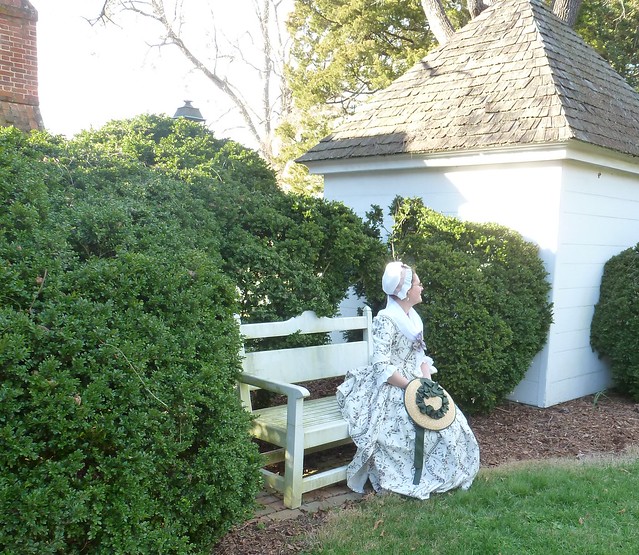
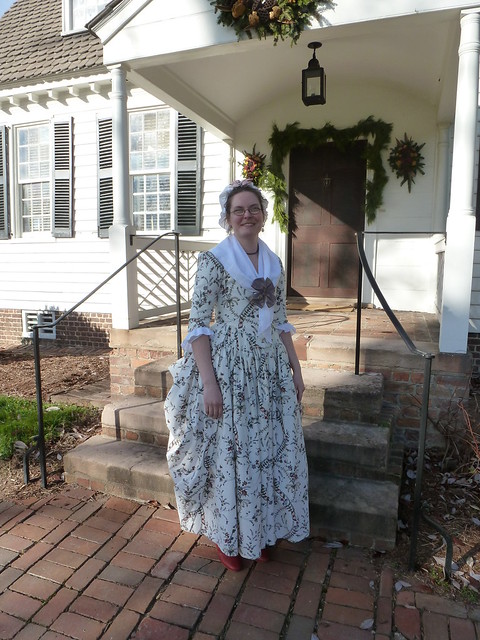
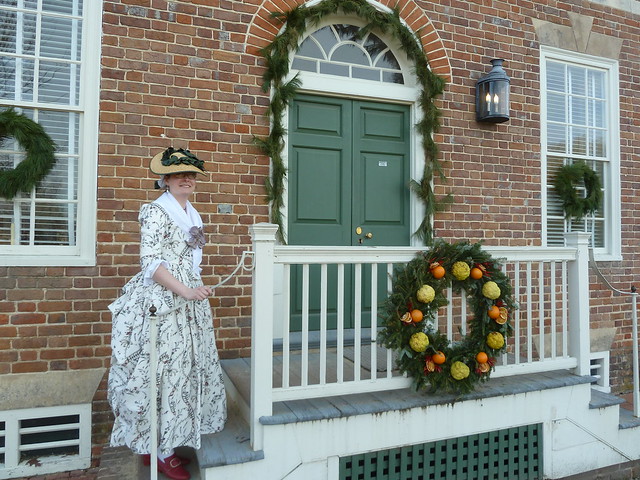
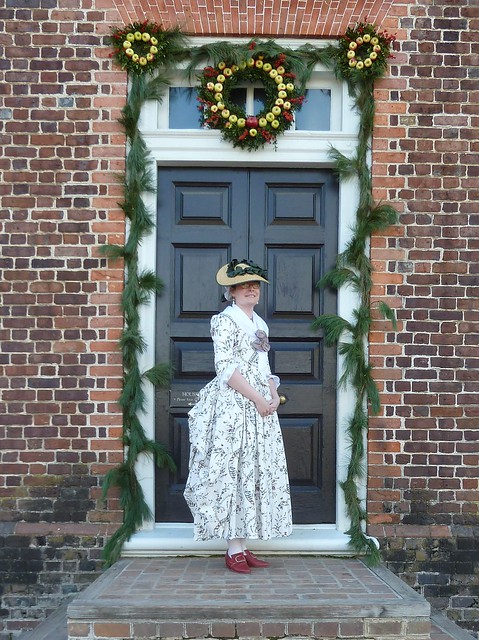
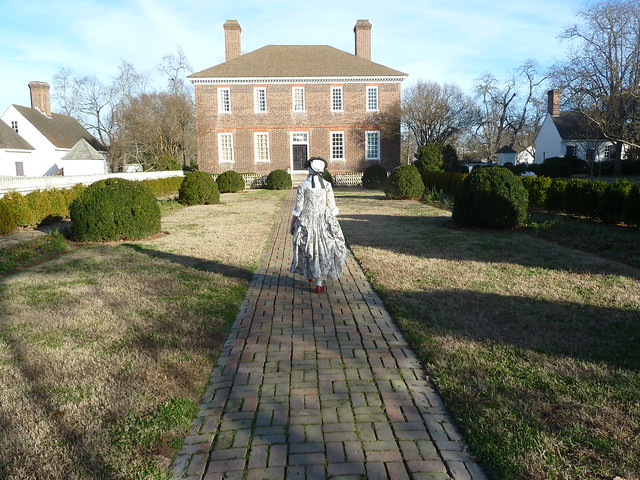
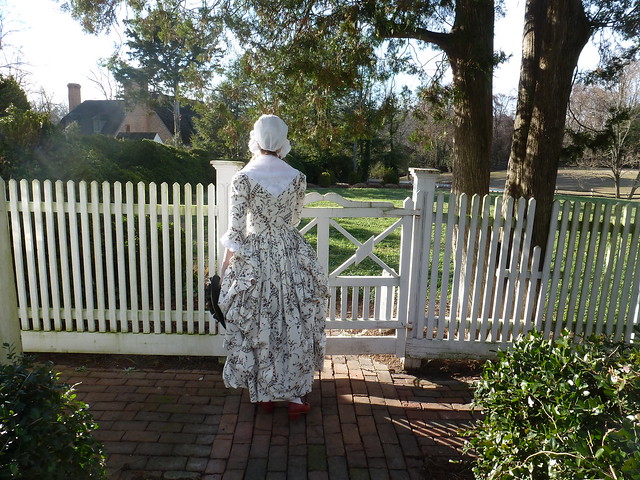
So...here's the beginning of what I hope to be a quick succession of make-up-for-lost-time posts! This gown was finished back in January of 2013 and I wore it a number of times over the past year. Unfortunately, as these wearings included a couple of school programs, a dance, and our town's 225th anniversary parade, I didn't manage to get any pictures of it at all. During the Christmas trip to Williamsburg, then, I made it my mission to finally get some quality proof that yes, indeed, I have finished this gown, and yes, indeed, I have actually worn it!
The pattern: Draped by Ashley at a Burnley and Trowbridge workshop in November 2012.
Inspirations: The inspiration for this gown was the fabric, which, as I will detail below, is reproduction exactly from a cotton gown in the collections of Colonial Williamsburg (acc. no. 1991-450). The gown was featured in Linda Baumgarten's What Clothes Reveal (pp. 48-9).
1780 cotton print gown (acc. no. 1991-450).
Image linked from Colonial Williamsburg's Online Collections.
Construction details: Since the construction process of the gown was partially described in the original workshop post, and as it is exactly the same as all of our previous fitted-back gowns, I won't spend any time reiterating those details here.
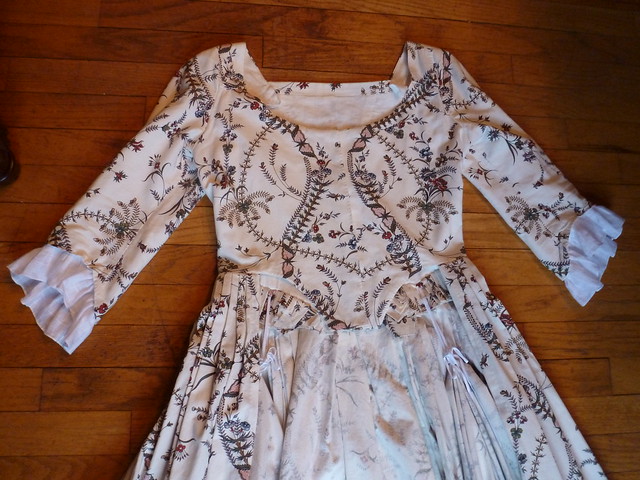
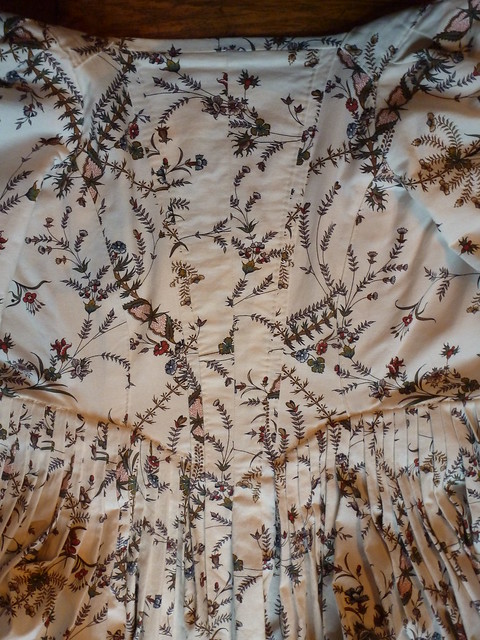
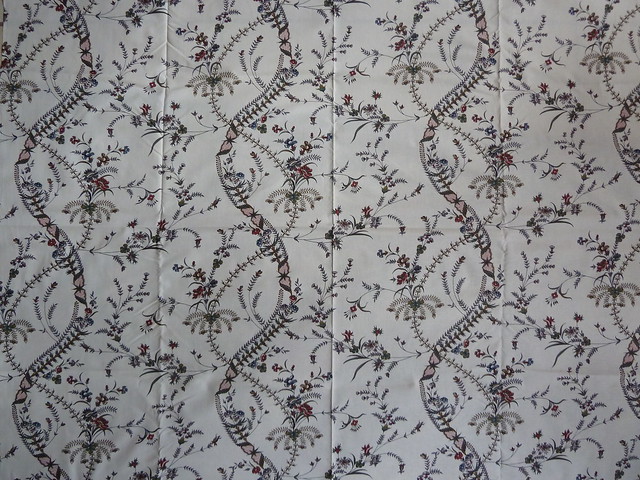
The most challenging part of making this gown (and the reason I saved this fabric specifically for the workshop!) was matching all the viney curves on both the front and the back. I had forgotten to bring a picture of the original gown with me to the workshop, but of course Janea had the benefit of experience of having already made a gown out of this fabric and she worked her magic figuring out how to make the printed design balance and flow as it ideally should. I'm so chuffed at how perfectly it came out, thanks to her expertise!
The front of the gown...
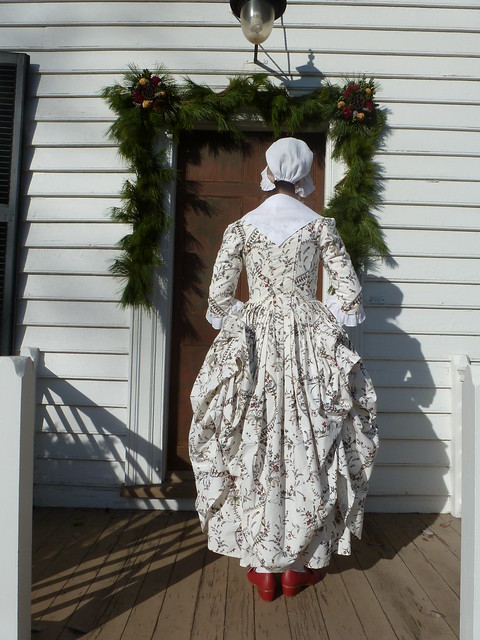
...and the back pleats.
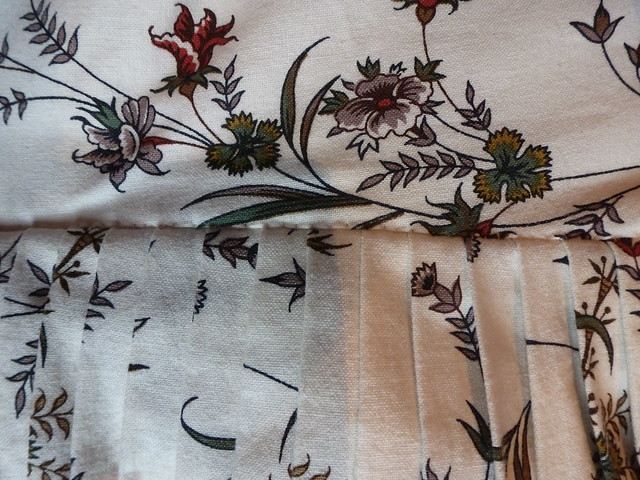
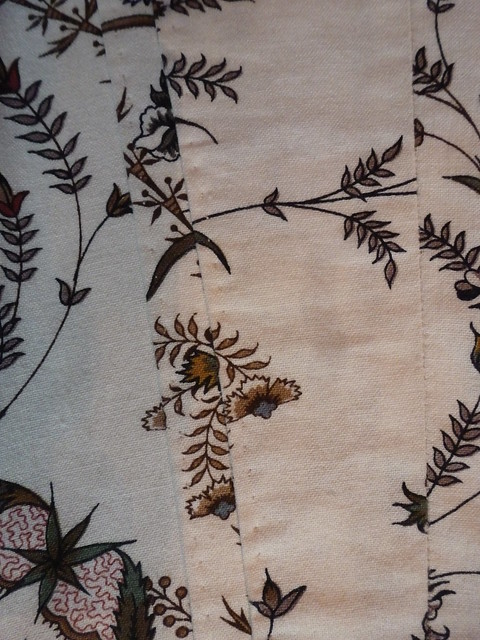
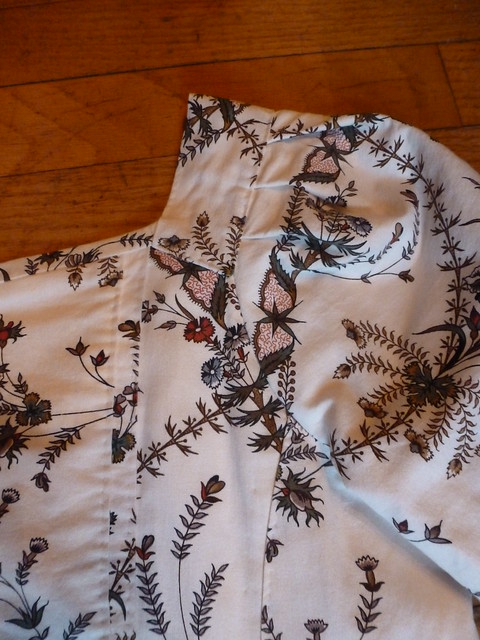
Here are a couple detail shots, including the back waistline,
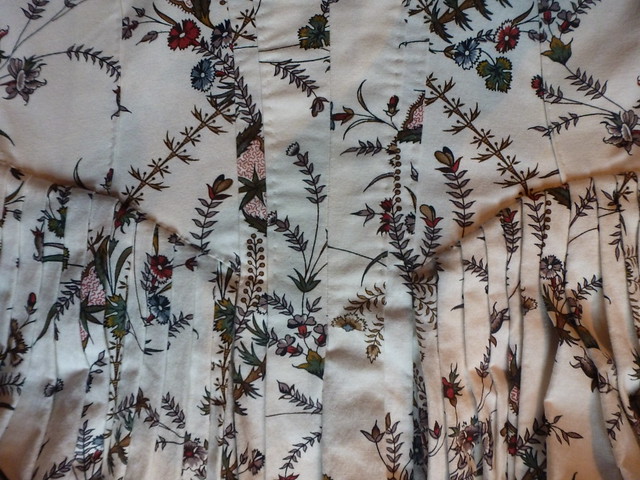
the pleating of the skirts,
the top-stitched back pleating that helps to fit the gown closely to the back of the body,
and a detail of the shoulder and sleeve from the back.
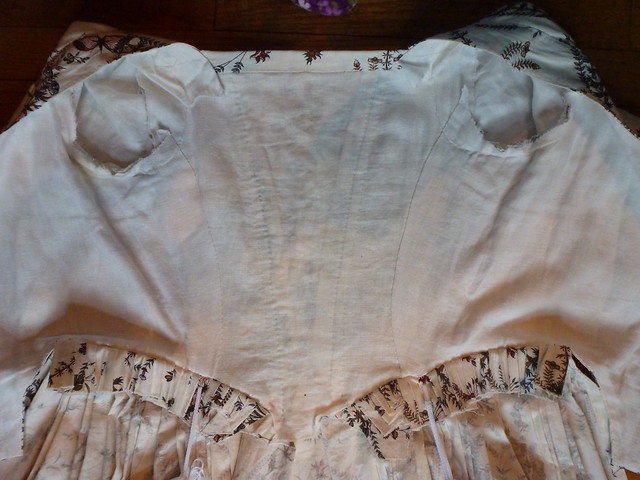
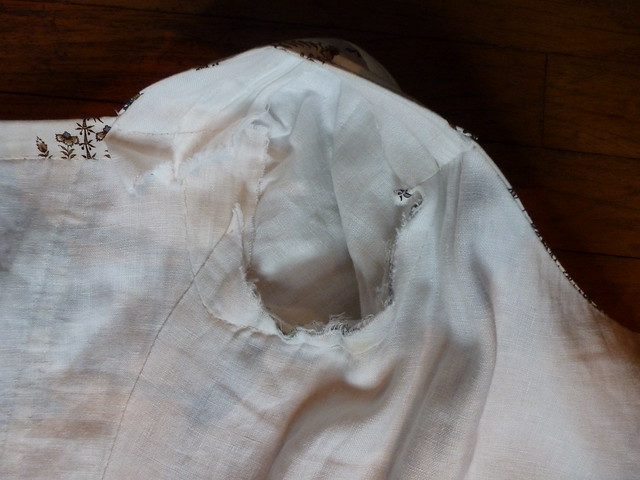
The interior of the bodice reveals the construction process of the gown, with the stitching of the back pleats visible, along with the overlapped front linings,
as well as the unfinished armscyes, common in 18th-century gown construction.
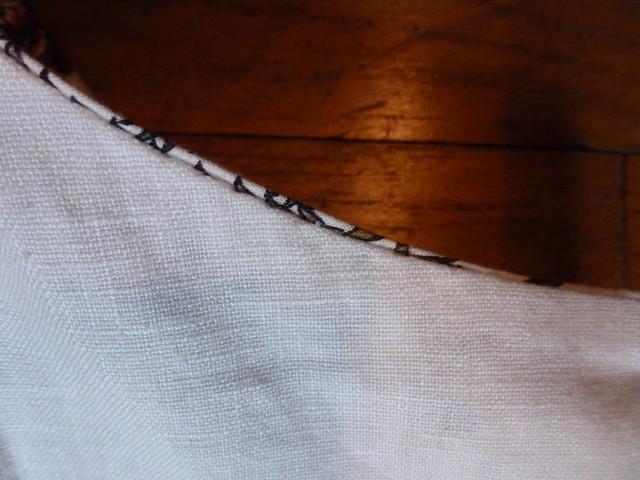
The edge of the bodice neckline and center fronts are finished by turning the edges in towards each other.
The fabric: As I mentioned above, the fabric is part of Colonial Williamsburg's exclusive line of fabrics that are reproduced from pieces in their collection. This particular one is taken from the block printed and penciled English cotton used on a fitted-back gown dating to 1780 (CW acc. no. 1991-450).
An eerily similar English chintz textile appears in Barbara Johnson's album (V&A acc. no. T.219-1973), and her dating reaffirms the 1780 date of the CW piece. Johnson records that she purchased her fabric in June of 1781 and paid thirteen shillings a yard for it. I still can't get over how very similar the motifs are.
Finishing the look: The trouble with only having a single set of photos to share with an outfit is that they don't give any sense of the sheer variety of ways that I've worn this gown. For one, it's got several other petticoats that look splendid with it (you can see one in the workshop photos), and for another, I regret that I decided to leave my neckerchief out when I wore this for the pictures because it obscures the front of the gown. The front is visible in the dance video, but not to any real satisfying degree because it's so far away (and moving!). I suppose this just means that a "Threaded Bliss Postscript" post is necessary in the near future! :-)
When I wore the gown at Christmas, I accessorized it with a windowpane checked linen neck handkerchief, left untucked and secured in front by a breastknot of purple/yellow changeable silk taffeta. A string of deep purple glass beads further underscored the "best" middling impression suggested by the gown's textile.
I also added my favorite hat, which is trimmed, edged, lined, and tied in a blue/green changeable silk taffeta, and my B and T red shoes. Somehow, both accessories just seem to coordinate so perfectly with every outfit. I especially love wearing them together!
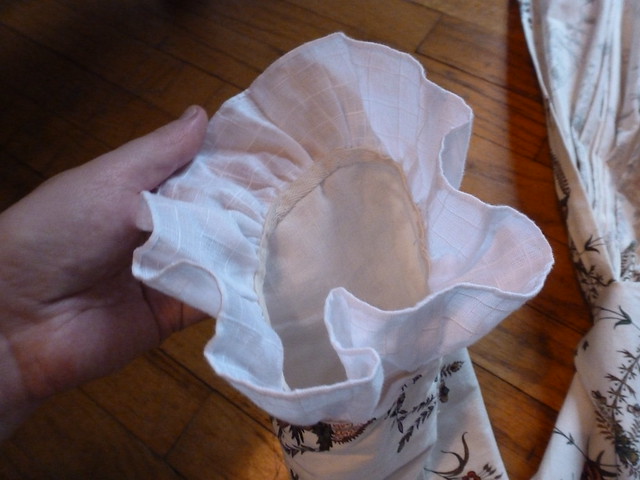
A set of removable windowpane checked white linen ruffles - part of the suit of kerchief, apron, and ruffles - are basted into the sleeves.
In the pictures, I have the gown drawn up through two sets of interior loops and ties to create a double draped look, giving a bit of extra body to the skirts. This feature it copied from the original inspiration gown.
These ties can be easily let down to allow the skirt to hang free. Next time I wear the gown, I'll be sure to get a view of the back left undraped.
Many more photos can be found in this project's flickr set. Stay tuned for a Threaded Bliss Postscript for more variations on this outfit soon!
Monday, January 13, 2014
Christmas Decorations from Colonial Williamsburg, Part Two: Windows
Following up on the preceeding post, here's a collection of 18th-century windows bedecked with holiday cheer!
Additional photos from Christmas in Colonial Williamsburg can be found in our flickr album here.
Tuesday, January 7, 2014
Christmas Decorations from Colonial Williamsburg, Part One: Doorways
As we mentioned in the last post, one of the highlights of every Christmas season at Colonial Williamsburg is the decorations. Made entirely from natural and hand-made materials, these festive wreaths, garlands, swags, and sprays add a splash of color to the often drab landscape of the winter city.
Christmas decorations were an integral part of the holiday season in England and Colonial Virginia, with candles abundant and evergreens, mistletoe, holly, and bright red berries brought into homes and churches to drape across mantles, wind around banisters, and frame windows and doorways. Yet while archival sources in the form of written descriptions and prints attests to the popular use of indoor decorations, there is little to no evidence to suggest anything similar was done out-of-doors.
With newly-restored Colonial Williamsburg less than a year old in 1935, researchers and historians were challenged with a way to cater to elaborate visitor expectations of what a "colonial" Christmas might have looked like. Using only natural materials, they envisioned a historically-inspired but not strictly historically accurate holiday display full of "old-fashioned" and "homemade" charm and character. As Oliver and Theobald explain, "Christmas in Williamsburg was never meant to be a re-creation of the eighteenth-century version" (41).
We took so many pictures of the decorations that we've decided to divide them into several posts. Here's a selection of doorways to Christmases past.
Sources and Resources:
- Colonial Williamsburg's "Christmas in Colonial America" page
- Kostyal, Christmas in Williamsburg
- Oliver and Theobald, Williamsburg Christmas: The Story of Christmas Decorations in the Colonial Capitol
- Rountree, Christmas Decorations from Williamsburg
Subscribe to:
Posts (Atom)