Monday, January 14, 2013

Heavenly Holiday Fashions in Williamsburg

Colonial Williamsburg

Though we spent over a week in Colonial Williamsburg at Christmastime, I was able to make only the shortest of visits to my favorite site in town, the Margaret Hunter shop.  I typically like to take a peek into the shop a couple of times during a visit if I'm able, just because the items on display are constantly changing, and because both the milliners/mantua makers and the tailors are always absorbed in working on some stunning new and fascinating project.

During my visit, a couple of days after Christmas, the shop was serving a dual interpretive purpose, doubling to cater to both the gentleman and the ladies.  On one side, the tailor's apprentice caught the warmth and light of the late-afternoon winter sun as he finished up a pair of breeches.

Colonial Williamsburg

On the opposite side of the shop, a table lay spread with an in-progress quilted petticoat, a finished one on a nearby counter demonstrating the completed product in which the ladies' meticulous workmanship would soon culminate. Though the ladies had stepped away from their work for a moment, a backdrop of frosted wintery pastels hung against the wall in the form of a selection of silk and cotton gowns, jackets, and petticoats.

Colonial Williamsburg

This absolutely stunning and swoon-worthy cloak or pelisse (to use the French Galerie des Modes term for it) was part of the "Spruce Sportsman" project for the 2011 accessories exhibit and symposium, and I never tire of seeing it.  It was included in the "show and tell" pile of pretties that we got to examine and admire during the symposium's muff workshop, and that fur was deliciously soft.  I've been searching for something similar ever since and haven't managed to find anything even remotely similar yet.  The hunt continues!

Colonial Williamsburg

Also on display were a delightful variety of hats...

Colonial Williamsburg

...and caps and, of course, muffs - that oh-so-essential winter accessory!

Colonial Williamsburg
 
And perched in one of the corner display cupboards was the doll's millinery shop, a CW holiday tradition!  One can't help but be just a little bit jealous of how well-dressed these little ladies are!  :-)

Colonial Williamsburg

Wednesday, January 9, 2013

Threaded Bliss

Ivory and Pearl Grey Silk Accessories,
1770s

cranberry wool jacket, 1770s
Colonial Williamsburg, December 2012.
 
Our previous Threaded Bliss post featured a red cassimere ensemble, accessorized for Christmas wear with an ivory and pearl grey silk hat and muff, and a breastknot of pearl grey ribbon and paper flowers.  Here, at last, is the promised Threaded Bliss for those accessories!

The pattern: The muff cover is taken from the pattern I made during a muff workshop at a Colonial Williamsburg conference almost two years ago; it is thus identical to the green and the black and blue muff covers.  The hat, like the purple one and the black and blue one, is covered by just fiddling and pleating by eye.

ivory and pearl grey silk covered hat, 1770s
Detail of the top of the covered hat.

Inspirations: For a brief run-down of muff history, changes in muff shapes, and trends in fashionable trim designs and materials, see these earlier posts about the green workshop muff.  Here are a couple of additional images that served as inspirations for this particular design.

As with the green workshop muff and the black and blue cover from last December, this new muff cover began with a row of trim edging each side of the muff.  This simple yet very pretty silk example from Nasjonalmuseet for kunst, arkitektur og design (via DigitaltMuseum), is dated 1780-1810.

muff and cloak digitaltmuseum
Cloak and muff, 1780-1810 (Nasjonalmuseet for kunst,
arkitektur og design acc. no.  OK-12056).

This embroidered silk satin muff (acc. no. 43.1824) in the collection of the Museum of Fine Arts in Boston is similarly dated to about 1785-1800 and features the same row of trim edging either side of the muff, this time with a design centered in between.

muff 1785-1800 MFA 43.1824
Embroidered muff in silk satin, English, 1785-1800 (MFA acc. no. 43.1824).

Both muffs reflect the more rectangular shape popular through the 1770s.  By the early 1780s, muff shapes began to trend towards squarer, more boxy designs, and fur gradually replaced silk as the dominant, most fashionable material.  While fur muffs and silk or velvet muffs trimmed in fur are certainly seen in images prior to the 1770s, prints from the 1780s and 1790s are very heavy on all-fur muffs, with silk examples being increasingly rare.  The overall size of muffs also increased (sometimes quite dramatically, much to the delight of satirists in prints!) in the final two decades of the eighteenth century.  Because my reenacting is almost exclusively concentrated during the Revolutionary War and the years just prior to it, my muff and its covers reflect the earlier fashion for rectangular muffs of silk, like these extant pieces.

Construction details: As I mentioned above, the base of the muff cover is copied from my workshop muff cover and thus replicates its construction.  The trim is simple ruched strips of self-fabric down the sides and in curves down the center, inspired by the S-curve trim designs popular on stomachers and gowns during the late 1760s and 1770s (see Ashley's blue/yellow gown for one example).  Three bows of pearl grey silk satin ribbon accent the curves of the center trim.

ivory and pearl grey silk muff, 1770s
Muff cover of ivory silk taffeta, trimmed with self-fabric ruching
and pearl grey silk satin bows.

The brim of the hat - both on top and underneath - is covered in the same way as Ashley's purple/brown changeable silk hat, featured in that earlier tutorial.  The crown is gathered and finished at the top with a covered wooden button.  Ruched self-fabric trim finishes the edges of the brim and the crown is surrounded by a collection of grey satin bows.

ivory and pearl grey silk covered hat, 1770s

P1050128
Detail of the crown, with the center covered button and lots of bows.

P1050004

The fabric: The hat blank is made of straw with the low crown fashionable through the second half of the eighteenth century.  The ivory silk taffeta is the same medium weight silk I used for the alternate petticoat to pair with my blue chintz jacket.  I had just enough left over bits to line the hood of a cloak, cover and trim the hat, and make the muff and its trimmings.  The pearl grey silk satin ribbon that forms the bows, the hat ties, and the breastknot is from Burnley and Trowbridge.

Finishing the look: You've already seen the finished look with these accessories paired with an outfit, so there isn't much left to say here!  :-)

cranberry wool jacket, 1770s

Tuesday, January 8, 2013

Gingerbread Houses 2012

Our gingerbread house-making tradition with family friends continued this year, though we were forced, for the very first time in 19 years, to forge ahead with one of the group missing.  With Ashley now living far enough away that a day-trip home is no longer possible, we were one house-maker down, so we decided to invite all of the parents to join us for a change.  The dads (surprise, surprise!) declined, but the mothers agreed, so we ended up with five houses this year between the two families!

gingerbread houses 2012
Our mini ginger-village!

Last year, we reported that 2012 would be the 20th anniversary of our house-making tradition, but after a year-long diligent search for pictures and other "archival evidence" on the part of both friend T and myself, we've come to the conclusion that we probably started our tradition a year later than we initially assumed.  That means that this year was officially our 19th (despite last year's report to the contrary), and that next year we'll be celebrating the "big" 20th.  So all of those ideas that we were brainstorming last year are still on the table for next year's round of houses!

My inspiration this year came from candy canes, though it still has a pseudo-Victorian flair.  As usual, I started by "painting" my walls with frosting, but instead of doing the standard solid color, I did a marbled look with red and white.  I wasn't quite sure if the experiment would be successful, but in the end, it worked pretty well and I was generally pleased. 

gingerbread houses 2012
Waiting for the "paint" to dry: my walls are on the left, with J's on the right.

The pillars of the front porch literalize the candy cane theme, which is carried into the tiled roof.  Green wreaths, garlands, and little sprigs of holly add a splash of green to the mix, making for the most Christmassy house I think I've ever created!

gingerbread houses 2012
My "candy cane" house...

gingerbread houses 2012
...with the front porch decorated for Christmas!

gingerbread houses 2012
Roof detail.

gingerbread houses 2012

Friend T's house came out lovely, created to echo a traditional New England farmhouse, complete with stone chimney, long back porch, and a mini grove of trees. 

gingerbread houses 2012
T's "New England farmhouse" house.

gingerbread houses 2012
T's house from above.

Her brother J's house, as expected, was yet another engineering marvel.  After last year's windmill, we wondered what new tricks he could possibly have up his sleeve, but he certainly didn't disappoint; his lighthouse actually does light up, cleverly concealing its electric components within walls of gingerbread, pretzels, and frosting.  Pretty impressive, isn't it?  It goes without saying that the bar for next year's creations has now been considerably raised by the introduction of this new potential!

gingerbread houses 2012
J's lighthouse with...you guessed it...a light!

And just in case you're wondering, T and J's mum crafted a log cabin house, decorated with Christmas lights and surrounded by a neat little pretzel fence.  My mum ended up with the most traditional house, covered in gumdrops and lots and lots of frosting.  When we arranged them all on the table for a finale photo (see above), we were quite chuffed with how cute they all looked together, clustered in their little ginger village.

gingerbread houses 2012
The gingerbread-and-pretzel log cabin crafted by T and J's mum.
 
Additional pictures can be found in the flickr set.  Stay tuned for next year's anniversary edition of the Gingerbread House Tradition!

Monday, December 31, 2012

Threaded Bliss

Cranberry Red Wool Jacket
and Matching Petticoat,
1770s

P1100974
Colonial Williamsburg, December 2012.

When I found out the family was making plans to spend Christmas week in Williamsburg, I decided I really wanted to make something new and festive to wear for the occasion.  I didn't have much time because of work deadlines that stretched until 5 days before Christmas, so I had to choose a project I knew I could finish quickly in the little time I had.  I elected to go with a matching jacket and petticoat combination for three reasons: 1) I already had a working jacket pattern that I knew worked well, so I didn't have to wait for Ashley to help drape and fit me something new; 2) a jacket is way faster than an entire gown; and 3) I had exactly 3 yards of cranberry cassimere wool that was the perfect holiday color!  So in four and a half days (which included a loooong day in the car!), I put together this jacket and petticoat, just in time for Christmas!

P1100971
Colonial Williamsburg, December 2012.

The pattern: The pattern for this jacket is largely based off of the same Janet Arnold "Jacket C" pattern that we used to make Ashley's gold linen jacket.  I made the same alterations as before, cutting the front piece completely separate from the side/back piece, and including the gusset as part of that front piece, rather than stitching it in separately.  And as with Ashley's jacket, I elected to use the sleeve pattern from the Costume Close-up jacket that I'd already tweaked to my measurements.

The primary difference in pattern between this cranberry jacket and Ashley's gold one (and the Arnold original) is that for this one, I elected to use a stomacher to close the front, rather than having the edges meet at center front.  Unlike with my blue chintz version of the Costume Close-up jacket, which uses a stomacher laced into place, this one is pinned in in the same manner as a gown stomacher.

Construction details: As with all of our eighteenth-century sewing projects, this jacket and its matching petticoat are sewn entirely by hand.  The construction details, as I mentioned in the gold jacket post, are almost identical to those featured in our jacket tutorial series, with the exception - as I mentioned above - that this jacket has a stomacher that pins into place to fill in the space at center front.

P1050096
The front of the jacket with one side folded back to reveal the interior. 
The front does not close at center front, but rather is filled in with
a pinned-in stomacher.

P1040997
The stomacher front.

As with the original Janet Arnold jacket, and Ashley's gold one, this cranberry jacket also does not include slits at the front sides; rather, that added gusset piece (here integrated into the pattern of the front piece to save time) helps provide the extra space necessary to help the jacket flare over the hips and petticoats.

P1050091
The back of the jacket, showing how the pieces are cut at angles
in the skirt to flare out at the waist over the petticoats.

P1100960
A view from the back.
Colonial Williamsburg, December 2012.

The fabric: A to-die-for lightweight cranberry red cassimere wool from Burnley and Trowbridge that I couldn't resist when I saw it at the gown workshop.  This wool is so soft and drapes so beautifully that I wish now that I'd gotten the rest of the bolt!  The jacket is lined with a medium weight ivory linen.

Finishing the look: As you can easily surmise by the color choice, the picture poses, and the accessories, this ensemble was created specifically with Christmas wear in mind.  It is worn over a linen shift, my blue-green wool fully-boned stays, and a linen underpetticoat.  A striped cotton muslin neckerchief fills in the neckline, and my cap (almost impossible to see in most of the pictures!) is made of striped linen.

P1100947
Colonial Williamsburg, December 2012.

In the pictures, I've complemented the outfit with ivory and pearl grey silk accessories: a hat, a muff, and a breastknot with a couple of paper flowers.  These were actually created to go with another outfit that I didn't have time to finish, so I just went ahead and paired them with this one instead, and I ended up really liking the way they all went together.  The black cloak in the picture below has its hood lined in the same ivory silk taffeta that is used on the hat and muff.  Since I plan to do a separate post for the hat and muff, I'll save any more details on them until then!

P1100955
Colonial Williamsburg, December 2012.

Additional images of this project can be found on its flickr page.
Sunday, December 30, 2012

Inspiring Christmas Present with Folk Art from the Past

We both apologize for being so silent of late.  With hectic work schedules and Christmas preparations, neither of us has been able to find any time to blog over the past month.  We promise a series of (we think!) exciting posts - some belated and Christmas-related, some with sewing projects, and some quite random! - coming up very soon, so stay tuned!  :-)

Abby Aldrich Rockefeller Folk Art Museum Christmas tree
A Christmas tree decorated with hand-made folk art ornaments, the
traditional holiday centerpiece of the Museums of Colonial Williamsburg.

This year, our family decided to spend Christmas week in Colonial Williamsburg.  Over the next few posts, I'll share some of my favorite sights from "Christmas past" around town, but here's a little taster to whet your appetite in the meantime.  One of my (many) favorite places to visit in Williamsburg during the Christmas season is the museum building which houses the DeWitt Wallace Decorative Arts Museum and the Abby Aldrich Rockefeller Folk Art Collection.  Every year, the museum displays a massive two-storey Christmas tree in its atrium, which is literally drowning in hand-crafted ornaments.  The ornaments, many inspired by the folk art pieces in the collection, are created by the museum staff and local volunteers.  Over the years, more and more ornaments have been added, and the tree itself has become a symbol of the tradition of American hand-crafted artistry over the centuries.

Abby Aldrich Rockefeller Folk Art Museum Christmas tree

This year, I captured a handful of the many beautiful little pieces that reflect the clothing and fashions of the past.  What fashionable miniature treasures can be you spot in the pictures?  :-)

Abby Aldrich Rockefeller Folk Art Museum Christmas tree

Abby Aldrich Rockefeller Folk Art Museum Christmas tree

Some of the ornaments, like the two above and the one below, feature portraits from the Abby Aldrich Rockefeller Folk Art Collection.  The one below is one of my favorite portraits to bring out during our interpretive fashion programs and presentations because little girls delight in giggling to learn that their brothers would have been dressed like these two little boys in the eighteenth century!

Abby Aldrich Rockefeller Folk Art Museum Christmas tree

Below is one of my absolute favorites.  Does she remind you of anything in particular?

Abby Aldrich Rockefeller Folk Art Museum Christmas tree

Abby Aldrich Rockefeller Folk Art Museum Christmas tree

Abby Aldrich Rockefeller Folk Art Museum Christmas tree

If you'd like to read more about folk art ornaments and find some inspiration for creating your own, I highly recommend The Art-Full Tree: Ornaments to Make Inspired by the Abby Aldrich Rockefeller Folk Art Museum, by Jan Gilliam and Christina Westenberger (the latter of whom we had the pleasure to meet during the recent B&T gown workshop!).  Most of the ornaments featured in the book are currently displayed on the tree in the museum.

Abby Aldrich Rockefeller Folk Art Museum Christmas tree

Wednesday, December 12, 2012

Threaded Bliss

Chocolate Brown Linen Round Gown,
1775-1780

Prelude to Victory 2012
On Palace Green after a long, hot day of cooking
and messing about in camp.
Prelude to Victory, Williamsburg, October 2012.

This gown was started at the same time that I started my peachy-pink linen gown and Ashley's tobacco-brown linen round gown (ahem...December of 2010...), and it suffered the same fate as Ashley's gown, getting buried - almost finished - in the basket of projects, until we dug both out and finished them up for Rock Ford in June.  So here, much delayed but nonetheless finished, is the long-awaited gown!

The pattern: Draped by me.

Prelude to Victory 2012
Front of the gown.
Prelude to Victory, Williamsburg, October 2012.

Construction details: This gown is entirely hand-sewn using the construction techniques detailed in multiple earlier posts, so I won't bore you with those details again!  The style is identical to that of Ashley's brown round gown, and the cut very similar to my peachy-pink linen gown, as they were all made concurrently.  The innards look exactly like those of Ashley's round gown, so I won't include any interior shots here.  If there's something you're really like to see, though, just let me know and I'd be happy to add it.

The only real difference between those other gowns and this one is that because of the limited amount of fabric I had (only 3 1/2 yards), I ended up piecing some bits here and there with this gown.  One of the sleeves, for instance, is actually made of three separate pieces.  But that just adds to my camp-following character, so I was actually quite pleased that the fabric forced me to get a bit creative!

Prelude to Victory 2012
Back of the gown.
Prelude to Victory, Williamsburg, October 2012.

The fabric: A chocolate brown medium-weight linen from, of all places, Joann, back when they actually stocked 100% linen.  I only bought 3 1/2 yards of it to add to the stash, not really thinking what I'd actually want to make out of it.  When found myself in need of new gowns for camp wear, I pulled it out and decided to see what it could do!

Finishing the look: I wore this gown (finally!) for the first time at Rock Ford Plantation in June.  Being a busy and high-traffic event, we didn't get a chance to take too many pictures during the day, so the only shots I have of it are when I was preparing supper (yes, that is kind of funny...the picture says it all...!  But you have to give me just a little credit because I didn't burn anything!).

Rock Ford Plantation, Lancaster PA
Cooking supper...yes, really...
Rock Ford Plantation, June 2012.

The gown is worn over my old Diderot stays, a linen shift, and a linen underpetticoat.  I accessorized it with a hat trimmed with forest green silk ribbons (missing in the picture, sorry!), and a red printed neck handkerchief, following the inspiration of the colors in one of my favorite prints from 1764:

A Description of a City Shower, Edward Penny, 1764.
Image linked from the Museum of London.

When I brought the gown out for wear again during Prelude to Victory a couple of months ago, I opted to go with the red handkerchief again, and added a blue checked apron to complete the look, echoing the color of the quilted petticoat in the image (see the "header" picture above).

Additional pictures of this project can be found in its flickr set here.

Saturday, December 8, 2012

Bringing Mary Todd Lincoln to Life: The First Lady's Costumes in "Lincoln"

Last weekend, I finally got to see "Lincoln," which I've been eagerly anticipating and reading about for months and months.  The film did not disappoint; all of the hype and praise being lavished on it is very well-deserved and I highly recommend it.  It sounds like a cliche, but the movie truly is very much a monument to the almost super-human accomplishments of one of our most honored presidents.  Daniel Day-Lewis does an unbelievable job at representing the intelligence, the quirkiness, and the heart of the enigma that was Abraham Lincoln, and the film is beautifully filmed with incredible details that will make your heart stop.

In this brief interview, the production designer, Rick Carter, discusses how he created a calendar of the last weeks of Lincoln's life to ensure that what emerged on screen would be as accurate as it was possible to make it.  Because so much documentation exists about what absorbed the president both personally and politically, and about what the spaces and furniture and artifacts of the rooms of Lincoln White House looked like, the production team was able to recreate what would have been in certain rooms on certain days, from the letters and books on a table, to the maps on the wall.  Even the sound of the ticking watch that emerges at moments throughout the film is accurate to the most minute degree: Spielberg had Lincoln's own pocket watch taken out of museum storage so that its own unique sound could be used in the movie.  I don't think any movie has quite captured and conveyed so completely an immersion into a historical period as this one does.  It really is quite an achievement.

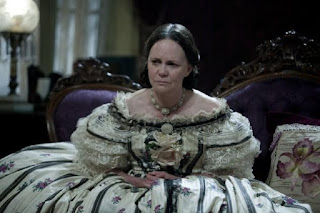
Of course, being a period film, you know where much of my visual attention was drawn!  Sally Field as Mary Todd Lincoln worked well with Day-Lewis's impression of the president, and I was very pleasantly surprised at how much she looked the part.  "Lincoln"'s costume designer, Joanna Johnston, describes in this video how Field strategically gained weight to achieve the exact waistline and body shape of the First Lady she would portray, much to Johnston's delight because it meant the original proportions of Mary Todd Lincoln's gowns could be maintained in the recreations.  Some of the gowns you see in the film were almost exactly reproduced from extant pieces.

Joanna Johnston with two of the gowns she designed for
Mary Todd Lincoln (Sally Field) for the film.
Photo linked from EW.com.

In this previous post that I did after a visit to the Mary Todd Lincoln House Museum, I mentioned the handful of clothing items and accessories that are currently in the museum's collection.  I inquired whether any additional clothes were known to exist, and the docent pointed me to the Smithsonian inauguration gown, but said she didn't know of any more.  I've since discovered a handful of other gowns held in various museums (I feel a new post coming on...!), and Johnston says she inspected many of them - in addition to the numerous photographic and artistic representations of Mary Todd Lincoln, and contemporary fashion plates - in preparation for designing and creating Mary's look for the film.

One of the extant dresses owned and worn by Mary Todd Lincoln (right).
It was one of the inspirations for the film gown below.

It is evident from Mary's gowns, visible in both extant items and in images, and by the (borderline politicized) controversy that raged throughout Lincoln's presidency over his wife's more than extravagant clothing expenditures, that the First Lady delighted in stretching fashion to its limits and was defined by a very unique sense of style.  She loved to display her shoulders (much to the chagrin of Washington society because of her age) and to indulge in bright colors (fuchsia, anyone?), heavy trims, and elaborate decorative elements.

Costume sketches from "Lincoln," by Richard Merritt.
Images linked from SAA Illustration Hub.

One particular dress (shown above and below), Johnston explains in this very interesting video overview of the costumes, is a combination of two of Mary Todd Lincoln's dresses.  Johnston had a French striped silk satin fabric overprinted with the floral design to meld the look of the two original gowns together.  The source for the floral sprays is pictured in the original gown above.  Period antique lace and a typical Mary Todd-sized corsage completes the stunning visual and historical effect of the ensemble.

Sally Field as Mary Todd Lincoln.
Photo linked from imdb.com.

Another fantastic video interview with costume designer Joanna Johnston can be found here.  And here's a link to another article with a close up of another one of Mary Todd Lincoln's movie dresses, complete with bonnet.