Thursday, June 30, 2011

Under the Redcoat 2011

I know many people from the history/costume blogging world attended Under the Redcoat this year and it was so wonderful to meet in person those of you we've had the pleasure of "meeting" online over the course of the weekend!  It will be fun to hear everyone's different perspectives of the weekend and to see pictures of things we may have missed, as we were busy in camp for the majority of the weekend.

We arrived on Thursday night and got settled in.  Friday morning, we strolled the streets of Colonial Williamsburg and reunited with our friends from Teacups in the Garden to watch some Rev City scenes and to share a peaceful lunch together.  Later in the afternoon, we were spectators for the first event of UTR as the Provost Guard marched into town to begin setting up on Market Square.  The crowd was smaller and certainly less vocal than last year, but the arrival of the British in town still drew an appropriately dismayed and angry reaction from the onlookers.
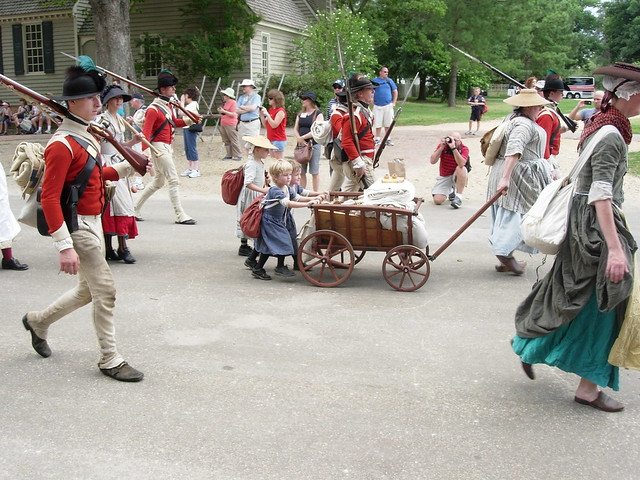
British troops march into Williamsburg with camp followers.

Saturday morning, we were up early to join our unit in their camp on Market Square.  A few of us ventured over to the CW Costume Design Center to explore their tag sale.  There was already quite a crowd gathered, but there were a few nice pieces still waiting to be discovered on the racks; we each made a small purchase and were happy to help some of our friends find some new things as well.  After our shopping excursion, we headed back to camp to help prepare the day's meals and aid with some necessary mending of uniforms.  It was great fun meeting so many new people and interacting with the eager and inquisitive visitors.  We had several curious young ones who were, for the most part, enthusiastic about learning about camp chores and what life was like in a military camp.  In the afternoon, we took one of the gents in our unit for a quick tour of some CW sites, as it was his first visit to the town.  It's always a treat introducing someone new to the wonders of CW.  Once evening descended, we all dressed in our best and gathered in a private room at King's Arms for a rousing evening of wonderful food and song.  Our apologies if our hearty eighteenth-century voices disturbed anyone belowstairs!  To cap off the day's events, a few of us ended the night by joining the large group gathered behind Chowning's, where we admired many others who had similarly donned their finest in honor of this unique yearly gathering.
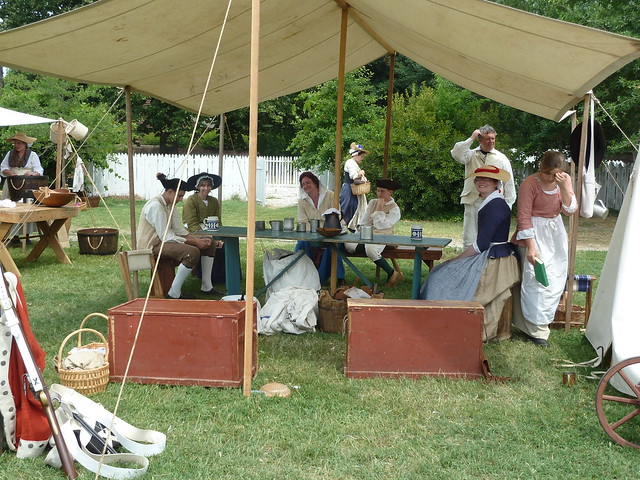
A few of our followers in camp.

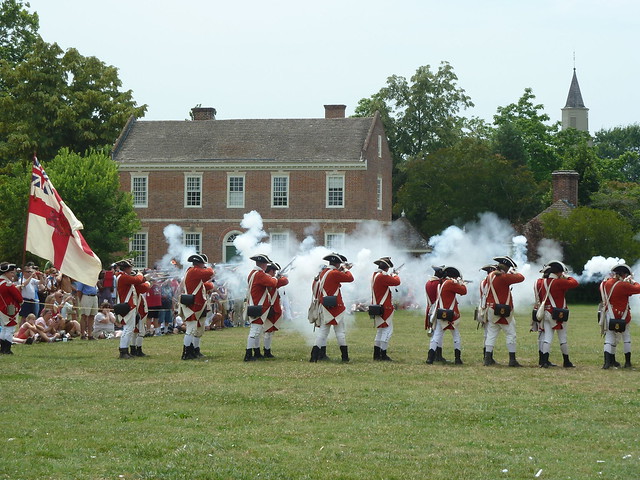
On the second full day of UTR, the men of our regiment were kept busy with guard duty and patrolling the streets of the town. Many of them were successful in making arrests of suspicious persons and searching out secret camps.  We all anxiously awaited their intriguing stories when they returned to camp!  We distaff were busy again with camp duties, preparing meals, keeping water buckets full and everything tidy, and such.  Luckily, there was again some time to visit around town, which was spent stopping in to see some CW friends and to make plans for the coming week.  After a couple of afternoon firing demonstrations, we all began breaking down camp and preparing to depart.  With a long drive ahead back to CT for most of our members, our group thinned out early in the afternoon; the rest of us enjoyed a relaxing afternoon in camp before finally packing up and saying goodbye until our next event.
]
Redcoat firing demonstration.

We had another great year at UTR, this time made even more enjoyable and memorable by the company of our unit, and we're looking forward to reading more accounts of the weekend.  There are always so many stories and threads to this event, which is what makes it so unique each and every year.  Don't forget to look at our flickr set to see some more of our pictures from this weekend, and be sure to check back here as we continue to update about our upcoming week in Williamsburg!

Saturday, June 4, 2011

Wethersfield Encampment & House Tours

First of all, we apologize for the silence on our blog recently.  Real life (and jobs... yuck!) have been very hectic lately.  We've also been busy preparing for some 18th century fun this summer, which we hope to begin sharing with you all very soon!

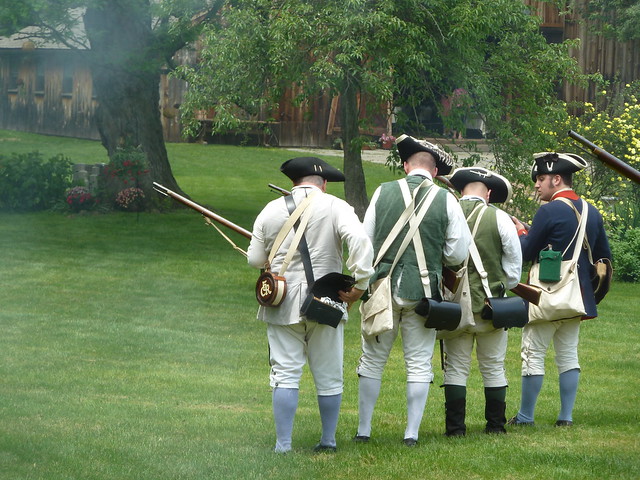
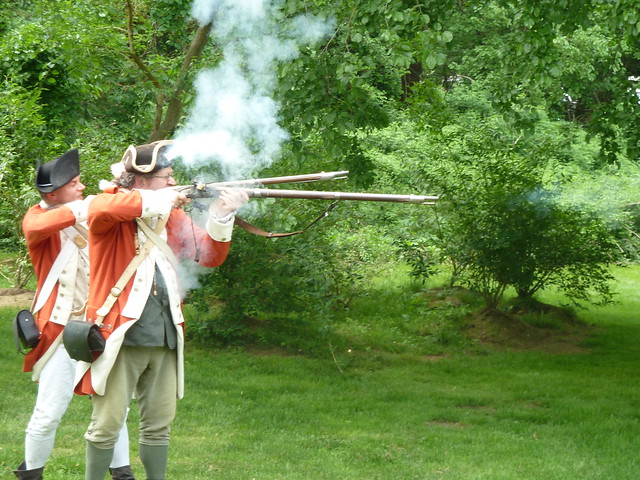
Last Saturday, we drove over to Wethersfield, CT once again, this time to visit the third annual Revolutionary War encampment hosted by the Webb-Deane-Stevens Museum and featuring the Fifth Connecticut Regiment.  Held each year in conjunction with the Memorial Day parade, the encampment showcases Rev War military camp life, as well as other aspects of 18th century life.  They even engaged in a brief skirmish with some Redcoats!

Members of the Fifth Connecticut Regiment prepare to fire at some Redcoats.

And the Redcoats retaliate!

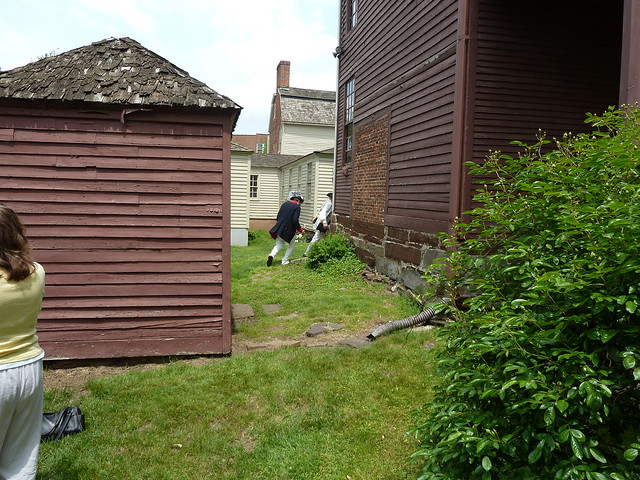
Retreat!

After visiting the camp, we took a tour of the museum.  The Webb-Deane-Stevens Museum is a collection of several buildings, owned and operated by the Colonial Dames of America.  For the Memorial Day weekend, the W-D-S tours were focused specifically on the Rev War period, so we were only brought through two of the houses which depicted that time period and the information presented was focused on the events of the late 18th century.  We will definitely need to go back to take the everyday tour to learn more about this part of Connecticut's history.

We were not permitted to take photos inside the houses, but the W-D-S Museum website offers nice overviews of each building on their website, which includes some lovely pictures that I encourage you all to check out.

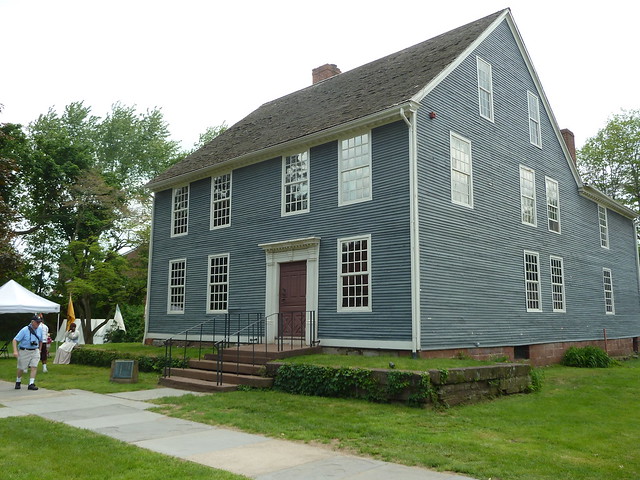
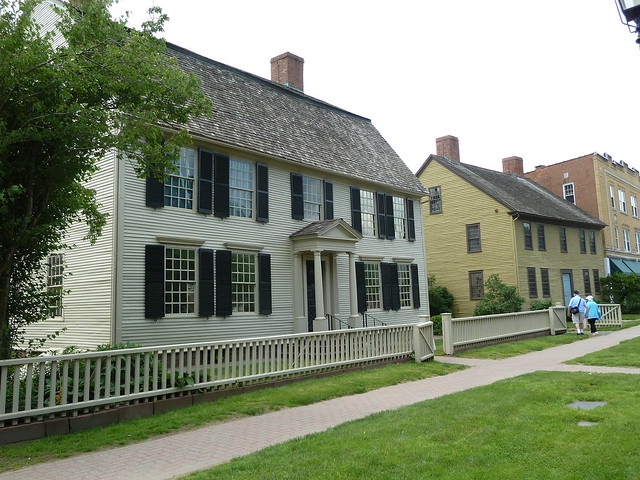
The Silas Deane House in Wethersfield, CT.
The stone wall in front is where a piazza once stood.

The first home we entered was the Silas Deane House, which is a National Historic Landmark.  (You can take a virtual tour of this house online!)  Built around 1770, Deane's home was designed to accommodate a great deal of entertaining, mostly for his political advancement.  The house included several features to cater to his frequent party needs, such as a front piazza (no longer on the house) and a ballroom.  Unfortunately, his political career kept him busy traveling and he had little time to enjoy his beautiful home with his family.  In 1774, he attended the Continental Congress as a delegate for Connecticut and in 1776 he traveld to Paris, joining Benjamin Franklin to sign treaties with France.  While he was away, his wife Elizabeth entertained prominent guests such as John Adams and General Washington.  She passed away in 1777 while her husband was away.  (His first wife, who was the widow of Joseph Webb, had passed away ten years earlier.  More on her when I discuss the next house.)  Deane was accused of misappropriating government funds and was unable to defend himself when he returned in 1778.  He soon returned to Europe in an attempt to save his reputation, but instead was deceived by his personal secretary, who was a spy for England.  Deane died in 1789 while on board a ship waiting to depart London.  There has been speculation that he was poisoned by his secretary.

The W-D-S Museum has put together an exceptional website, http://www.silasdeaneonline.org/, which provides a comprehensive look at Silas Deane and his role in the founding of America.  The website also offers primary documents, including several letters from Deane, for visitors to explore and interpret on their own.

The Joseph Webb House (left) and the Isaac Stevens House in Wethersfield, CT.

Next was a tour of the Joseph Webb House, right next door.  This house was actually built before the Deane House, in 1752, by Joseph Webb, a successful merchant.  Webb only lived nine years in this house with his wife, Mehitabel, and their children before he died in 1761.  Two years later, Mehitabel married her business adviser, Silas Deane.  By 1770, Joseph Jr. was old enough to take care of the house, which he had inherited from his father, and the Deanes moved next door into their new home.  Joseph Jr. and his wife lived in this house until they sold it in 1790.  While in residence here, they acted as hosts for George Washington and Rochambeau as plans were made for Yorktown.  These plans were discussed in this very house, and Washington stayed in one of the bedchambers upstairs.

The first room we entered had remnants of the colonial revival style.  The walls are covered in a 1916 painted mural depicting Washington’s route from the Wethersfield conference to the victory at Yorktown.  While it does display a great sense of patriotism, there are many glaring inaccuracies in the murals, the most prominent being that all of the men look like General Washington!  There were several other changes made to the house during the early 20th century, which fortunately the Colonial Dames were able to reverse upon acquiring the house.

We then went above stairs to what is now known as the Washington bedchamber.  Although there is no evidence explaining which rooms were used for the Yorktown meeting, it is certain that Washington stayed in this very bedchamber.  There has recently been a lot of work done in the room to uncover what the floors, wallpaper, and woodwork would have been like in the 1780s and our guide gave us wonderful descriptions of the processes and what they were discovering.

Following the tour, we stopped for lunch and then took a stroll down Main Street, which is littered with historic homes.  Just across the way from the W-D-S Museum is the First Church of Christ.  This church, which is still very active today, was built in 1761 as a meetinghouse for the town of Wethersfield.  Washington is known to have attended services and concerts here during his visit.  We also passed a former Masonic building, which was unfortunately quite run down and had a "for sale" sign in front.  There were also numerous other old shops and homes, some dating as far back as 1750!  If you'd like to see a couple of pictures we snapped from our walk, you can find them in our flickr set.

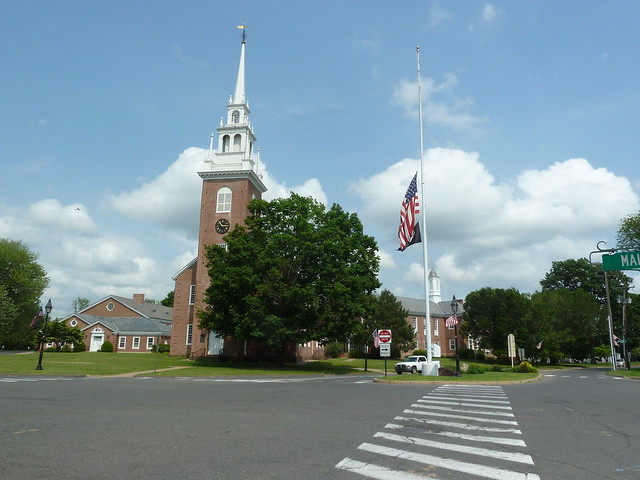
The First Church of Christ in Wethersfield, CT.

Sunday, May 22, 2011

Novel Beginnings: The "Real" Anne of Green Gables

The myths of origin and inspiration surrounding our favorite works of literature are oftentimes just as fascinating and magnetic as the works themselves.  Here's an account of how one of our personal all-time-favorite books came into being.

First edition cover of Anne of Green Gables (1908).
Linked from Wikipedia.

On 16 August 1907, Lucy Maud Montgomery recorded in her journal that her first novel, Anne of Green Gables, had just been accepted for publication by the L.C. Page Company of Boston.  She reminisced about the agony she had felt at trying to begin the book: "I have always hated beginning a story.  When I get the first paragraph written I feel as though it were half done" (Selected Journals, Vol. 1, p. 330).  Then she hit upon her inspiration:
"I have always kept a notebook in which I jotted down, as they occurred to me, ideas for plots, incidents, characters, and descriptions.  Two years ago in the spring of 1905 I was looking over this notebook in search of some suitable idea for a short serial I wanted to write for a certain Sunday School paper and I found a faded entry, written many years before: - “Elderly couple apply to orphan asylum for a boy.  By mistake a girl is sent them.”  I thought this would do.  I began to block out the chapters, devise incidents and “brood up” my heroine."
(Selected Journals, Vol. I, p. 330)
 The "faded entry" did not record a fleeting spark of imagination specifically conjured as a future plot, but rather an actual incident in the life of Maud and her family, as the writer detailed in a later journal entry on 27 January 1911: “The idea of getting a child from an orphan asylum was suggested to me years ago as a possible germ for a story by the fact that Pierce Macneill got a little girl from one, and I jotted it down in my notebook” (Selected Journals, Vol. II, p. 40).  "The "elderly couple" she noted was in fact Pierce Macneill (the cousin of LMM's grandfather) and his wife, Rachel, who lived directly across from the Green Gables property in Cavendish, PEI.  The childless couple had applied to adopt an orphan boy in 1892 to help out with the farm chores; their neighbors John and Annie Clark did the same.  But instead of two boys, the two sets of unsuspecting adoptive parents found a five-year-old boy and his three-year-old sister awaiting them at the train station.  When the Macneills contacted the orphanage about the mistake, they were told that because there were so few boys, and because they were hesitant to separate the siblings, they had sent the little girl with her brother instead.  Like Matthew and Marilla, Pierce and Rachel decided to keep and officially adopt the little girl, who they named Ellen and who took their surname.  Despite attempts by multiple researchers over the past twenty years to trace her birth name and family, no details about Ellen's origins have been found.  Even her place of birth has been questioned, with John Willoughby suggesting that Ellen and her brother were "Home Children" brought from England and Irene Gammel more recently arguing that the siblings more likely had been born in Nova Scotia. 

Ellen Macneill, ca. 1895.
Photo courtesy of Ruth Gallant and linked from Ryerson University.

Maud claimed that while the events surrounding Ellen's arrival had provided the impetus for the story of Anne of Green Gables, the character of Anne herself was nothing like the Macneill orphan.  "There is no resemblance of any kind between Anne and Ellen Macneill who is one of the most hopelessly commonplace and uninteresting girls imaginable" (Selected Journals, Vol. II, p. 40).  Either way, it's easy to see how the happy ending of the Macneill orphan mix-up would have started the wheels of Maud's vivid imagination turning.  As Mrs. Spenser said to Marilla, "I call it positively providential."


For more information on Ellen Macneill and the composition of Anne of Green Gables, take a look at:

- John Willoughby's Ellen is the only extended account of Ellen's life
- LMM-Anne.net's Anne of Green Gables "Creation and Publication" page
- The Selected Journals of Lucy Maud Montgomery, edited by Mary Rubio and Elizabeth Waterson.  There are five total volumes; volume two covers the year of Anne's publication.
- Irene Gammel's new book, Looking for Anne: How Lucy Maud Montgomery Dreamed up a Literary Classic.  A preview of the American release of the book (which has an alternate title) can be found here on googlebooks.
- The most comprehensive LMM biography, Lucy Maud Montgomery: The Gift of Wings, by Mary Rubio
- LMM's autobiography, The Alpine Path, which includes her account of her writing career

Friday, May 20, 2011

Happy Birthday, Mrs. Madison!

Portrait of Dolley Madison by Alan Dordick, after Gilbert Stuart
Courtesy of the Montpelier Foundation & Alan Dordick Studios
Linked from the Montpelier facebook page.

Today marks the 243rd anniversary of Dolley Payne Madison’s birth!  "Mrs. Madison" will be celebrating at Montpelier today where guests can join her for some birthday cake and lemonade!  Montpelier is also offering free admission to any visitors born on this date or to those who share Dolley's first name.  (You can find more details about the celebration on Montpelier's facebook page or website.)

Mr. and Mrs. Madison celebrating Mr. Madison's birthday earlier this year at Montpelier.
The Montpelier Foundation
Photo linked from the Montpelier facebook page.

Montpelier, the long-time Madison family home in Virginia, is hosting an exhibit dedicated to Mrs. Madison and her trend-setting fashion.  "Dolley Madison's Life Through Fashion: Dressing the Part" will be open at Montpelier June 15, 2011 through March 31, 2012.  The exhibit will feature costumes from the recent PBS documentary, “Dolley Madison, America’s First Lady,” and will explore the fashions and styles favored by America’s “first” First Lady.  Inspirational fashion plates and designer sketches for the costumes will also be on display.

A sketch of Dolley's "Quaker Dress" from the documentary
“Dolley Madison, America’s First Lady."
Photo courtesy of the PBS American Experience Flickr page.

The costumes were designed by Candice Donnelly and constructed by Eric Winterling, Inc. in NYC.  Constructing clothing for period accuracy and designing "costumes" for film require some of the same general concepts, but they generally have two very different purposes in terms of the final product.  In this behind the scenes feature, Ms. Donnelly describes the process of creating historic costumes for film.  She studied period prints and paintings which, she explains, not only helped her to choose fabrics, but also gave hints as to how the garments were constructed.  Since the documentary spanned a time period of approximately fifty years, the costumes needed to reflect the changing fashions of the time as well as the continuous evolution of Dolley's situation in life.  The video also shows Eve Best (Dolley Madison) during her costume fittings with Eric Winterling, which allows you to catch a closer look at some of these beautiful creations.  What I found most interesting in this feature was Ms. Donnelly's description of how the costumes are incorporated into the film and characters.  Costume designers have to think about the personality and the history of the person who will be wearing them.  They also have to consider the sets and backgrounds, as well as any furniture, props, or other characters in any given scene.  Accessories, she explains, can be used to accentuate the costumes and to keep the character from blending into the background of the shot.

Eve Best as Dolley Madison in “Dolley Madison, America’s First Lady."
Photo courtesy of the PBS American Experience Flickr page.

Fashion was changing quickly at the turn of the century and Dolley was sure to keep up with the latest styles.  As the frequent hostess for President Jefferson and then as First Lady, Mrs. Madison was a model to others who admired her and closely followed her trends.  One of her favorite new accessories was the turban.  Edward Maeder, fashion historian and milliner for the documentary, explains a brief history of the turban revival and demonstrates how he constructed the turbans used in the film in this behind-the-scenes video.
An example of Dolley wearing a turban in this portrait by Joseph Wood.
The Virginia Historical Society, Accession No. 1967.14

The documentary, which is part of the PBS series American Experience, premiered earlier this year.  You can view the show and read the transcript on the companion website.  The website also offers a host of special features and resources, from behind the scenes videos and deleted scenes to a reading list and lesson plans for teachers.

Jefferson Mays as James Madison and Eve Best as Dolley Madison
in “Dolley Madison, America’s First Lady."
Photo courtesy of the PBS American Experience Flickr page.

Dolley Payne was born in North Carolina in 1768 and moved with her family to Virginia the next year.  When Dolley was 15 years old, her father followed the trend of his fellow Quakers: he emancipated his slaves and moved the family to Philadelphia where he attempted to start a starch-manufacturing business.  By 1789, Mr. Payne's business was a failure and he was shunned from Quaker meetings due to outstanding debts.  Mrs. Payne fortunately had more business sense, and she set about establishing a successful boarding house in town, which continued to support the family following Mr. Payne's death in 1792.  In 1790 Dolley married John Todd, a Quaker man her father had chosen.  Two years later, the couple welcomed their first son, John Payne.  The year 1793 brought an epidemic of Yellow Fever, during which Dolley lost several family members including both her husband and their second son, William Temple, who was only a month old at the time.

She met James Madison the next year through their mutual friend, Aaron Burr.  Madison asked Burr to introduce them, and after a short courtship, Madison proposed.  At age 43, seventeen years Dolley's senior, Madison had never been married and was thought by many to be a lifetime bachelor.  They were married within the year and Dolley was subsequently dismissed from the Quaker community for marrying outside the group.  A few years later, they moved to Madison's home, Montpelier, only to move to the new capitol of Washington D.C. in 1801 following Madison's appointment as Secretary of State.

One of Mrs. Madison's own gowns on display in
"The First Ladies at the Smithsonian" exhibit at the National Museum of American History. 
The caption for the gown reads: "Dolley Madison’s silk satin
open robe is hand-embroidered with flowers, butterflies, dragonflies,
and phoenixes. It is typical of the style of the late 1810s."

During the couple's first years in the Capitol, Dolley took an active role in supporting the nation's new government.  Her natural ability to make guests at ease made her the perfect candidate to aid President Jefferson as White House hostess.  When Madison was elected President in 1809, Dolley began setting the precedent for political wives and First Ladies.  She set about decorating the White House in a style that was elegant yet not monarchical.  Her own clothing fashions mirrored these ideas and others began to mimic her trends.  But Dolley was always first and foremost her husband's strongest supporter in both political and personal matters.

Eve Best as Dolley Madison in “Dolley Madison, America’s First Lady."
Photo courtesy of the PBS American Experience Flickr page.

After two terms as President, leading through the War of 1812, Madison and his wife finally retired back to their home at Montpelier, where they would remain happily for the next several years.  Their 41 year marriage ended in June 1836 when James Madison passed away.  Today we have a limited glimpse into the Madison's marriage due to the lack of correspondence between the two; they were so rarely apart so that there was never a need for letter writing!  Following her husband's death, Dolley spent the majority of her time in Washington D.C.  Her only son, John Payne Todd, continuously caused distress with his constant gambling habits and he was unable successfully to manage the Madison estate.  In 1844, Dolley was forced to sell Montpelier.  Mrs. Madison passed away on July 12, 1849 at the age of 81.  Unfortunately, since Montpelier was then in private hands outside of her family, she was initially buried in Washington D.C., before finally being brought to rest next to her husband.

For more about Dolley Madison, read her biography on the Montpelier website and visit some of the links below.

Additional Links and Resources:


The White House Historical Association (White House Collection)
Acquisition Number: 994.1737.1

Image of 1817 portrait of Dolley Madison by Bass Otis
Collection of The New-York Historical Society 
Object Number: 1867.308

Image of 1848 portrait of Dolley Madison by William S. Elwell
National Portrait Gallery, Smithsonian Museum
Ref: NPG.74.6

Free iTunes Download of Poplar Forest Conversations on Democracy
featuring Lauren Leigh as Dolley Madison and Bill Barker as Thomas Jefferson

Wednesday, May 18, 2011

Threaded Bliss

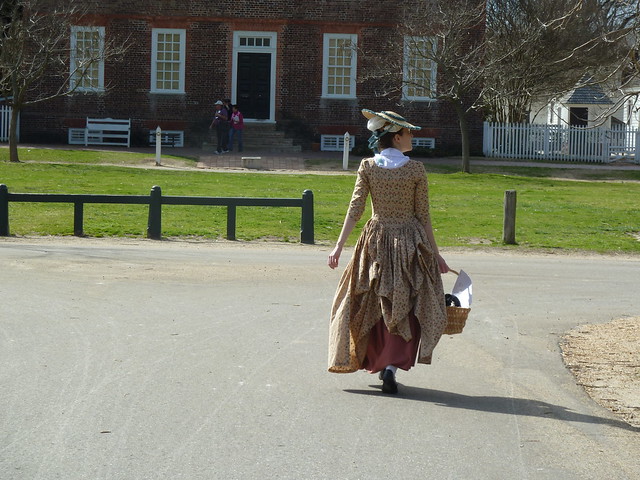
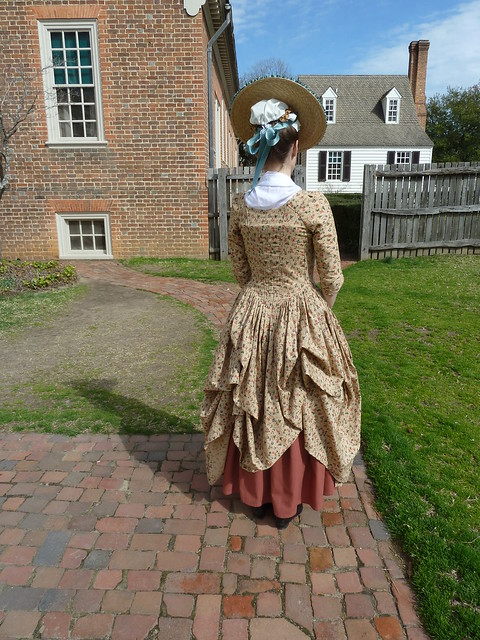
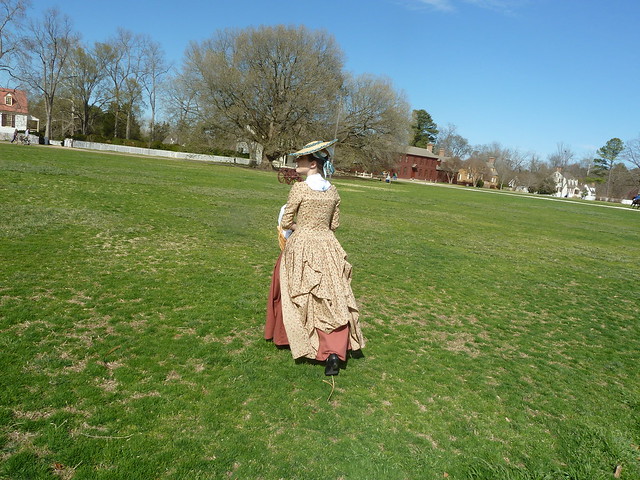
A Cotton Print Gown, 1775-1780

Ashley at Colonial Williamsburg, March 2011

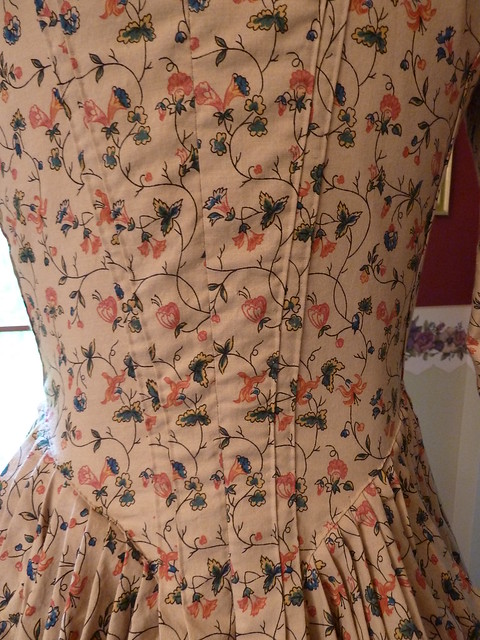
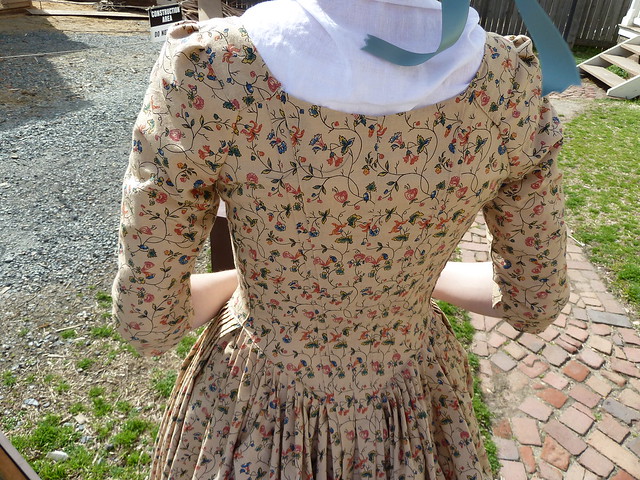
The pattern: The bodice of the gown was draped by me directly on Ashley.  The curve of the back neckline was a feature I found on the gown on page 36 of Janet Arnold's Patterns of Fashion 1; since all of Ashley's other English gowns have the pleats cut straight across the back, I thought the curve would be a nice and unique way to change things up a bit.  I borrowed the sleeve pattern from the same gown in Arnold, since I still haven't mastered the technique of draping these late-period tighter sleeves that need to curve over the elbow.  The slightly longer sleeves that fully cup over the elbow and extend a bit further onto the lower arm help to date the gown to the very late 1770s and early 1780s.

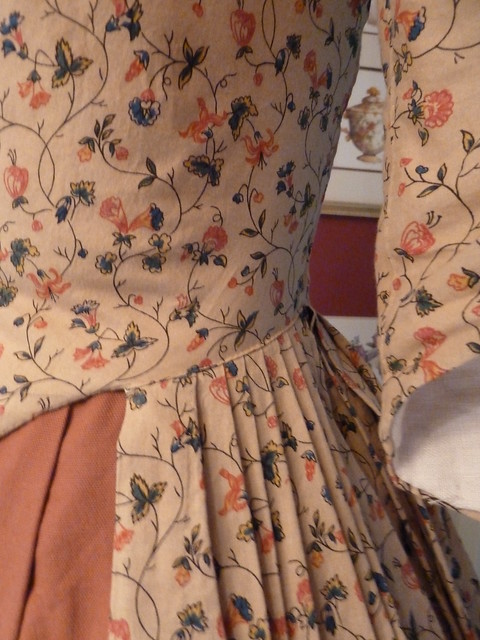
Construction Details: As always, the gown in completely hand-sewn.  First, I draped and cut the shape of the back linen lining piece and pinned it to Ashley's stays; the en fourreau pleats were then arranged and pinned in place onto the linen, kept secured very close against Ashley's body so that the width at the shoulders and at the waist was kept in proportion to both her body shape and the style of the gown.  The lining and pinned outer fabric were then unpinned from her stays and I secured the pleats down to the linen, working flat on a table to prevent puckering, with a spaced backstitch (as is consistent with most examples of en fourreau gowns).

The next step was to pin the back piece back onto Ashley's stays and make fish darts along the waistline to mark where the skirt fabric needed to be cut free from the bodice.

Detail of the back "en fourreau" pleats.


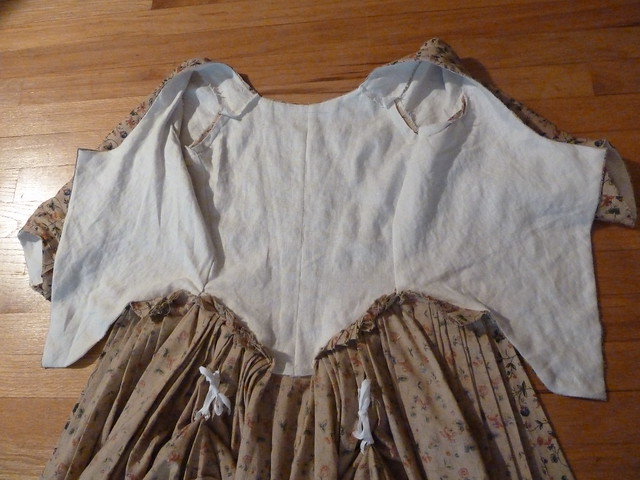
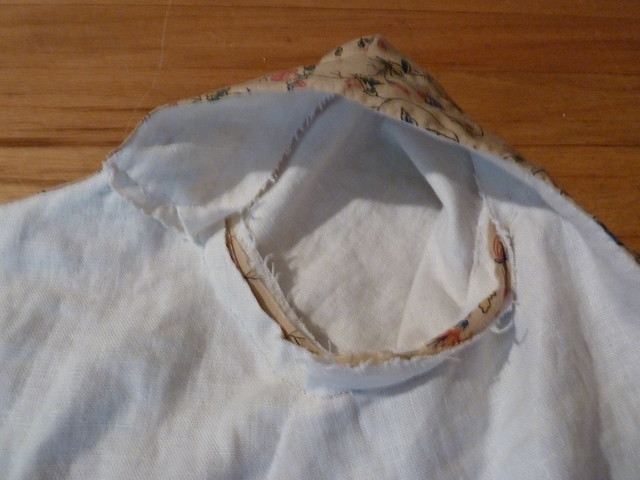
After trimming the back panel to match the lining shape on the sides, I draped the front bodice pieces in the linen lining fabric and then cut out the cotton fabric using those as my pattern. The front pieces were then lapped to the back and sewn down using spaced backstitches; their lining pieces were folded under and whipstitched into place inside to finish the seams and enclose all raw edges.

Interior of the bodice, showing the linen lining. 
The tapes used to drape up the skirts are also visible.

The sleeves came next.  Their undersides are first sewn onto the gown using a backstitch.  I then had Ashley put the gown on so that the top halves of the sleeves could be pleated to fit directly to her shoulder.  The interior seam of the armscye is left unfinished, in keeping with extant examples.

Interior view of the unfinished armscye and lapped front lining.

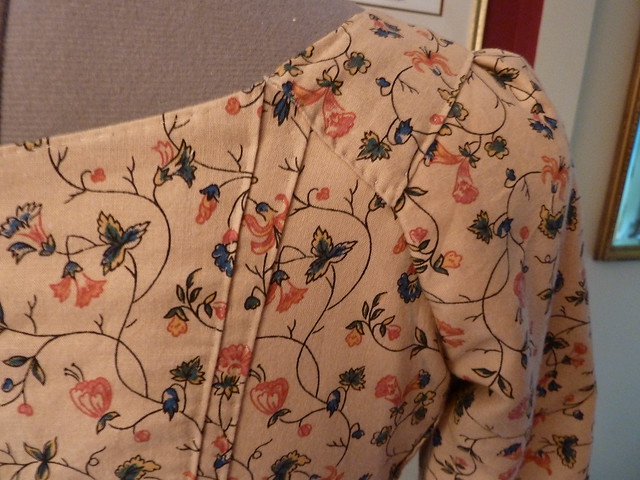
After laying the shoulder strap down over the sleeve cap, the front opening and the entire neckline of the bodice was finished by folding under the edges of the cotton and linen and stitching them together using "le point a rabattre sous la main."
Detail of the back neckline, "en fourreau" pleats, and the
shoulder strap and sleeve.

The final step was pleating the skirt to the bodice.  This can be done either with the pleats all angled towards the center back, or with the pleats angled towards the side pocket slits.  Both options are documented.  For this gown, I didn't have time to sew pocket slits, so I simulated them using the pleating-to-the-sides option.  Because of the full pleats in the skits, you can't tell at all that there aren't any real slits there!  I left enough fabric in the two side pleats so that if I (or Ashley) want to add pocket slits at a later time, it can very easily be done.  In the meantime, the pocket slits of her petticoat can be very easily accessed by pulling aside the gown's skirts, since they are set further to the side than the center, in keeping with this particular period.


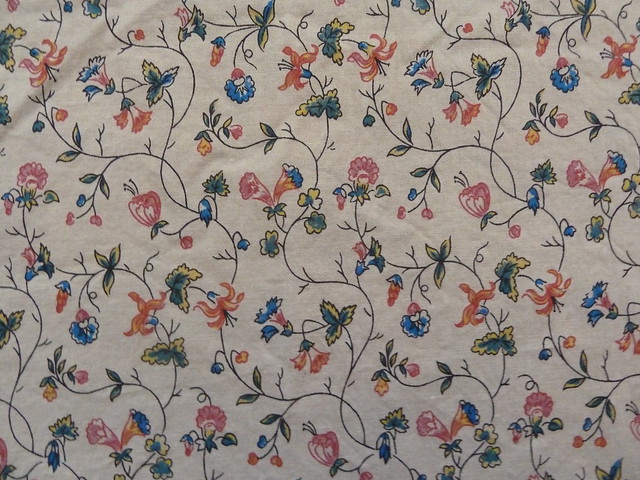
The Fabric: This is a reproduction of an original early 1780s cotton print held in the collection of the DAR Museum. Most unfortunately, it is now out of print and extraordinarily difficult to find. I was lucky and caught an auction on ebay and bought everything the seller had left, which turned out to be exactly enough to make the gown, with literally no more than a handful of scraps left over.  How period appropriate was that?!

The original "document" colorway of this print has a lighter coloring overall and is thus very typical of cotton prints from the late 1770s and early 1780s, with its cream-colored background and subtle greens, blues, and red/oranges.

The document colorway, reproduced exactly from the DAR original.

As quilting lines tend to do, the print was reproduced in its original colorway and with three additional color variations. The one I found is quite similar to the original, with the one exception that the background is a darker tan "tea-stained" shade, as opposed to the original cream. Documentation for tea-stained grounds during this period is sketchy at best, but I decided to use it anyway because the fabric is in every other way a true reproduction, from the scale, to the approximation of block printing techniques with the slightly off-set coloring, to the weight of the cotton.  As the 1780s progressed, darker grounds on fabrics were becoming increasingly popular, so a tannish background is possible once you move later into the decade.

The slightly altered colors of the variation colorway I was fortunate to find.

Finishing the Look: Ashley wears the gown with a solid rust colored cotton petticoat; the gown's skirts are pulled up "a la polonaise" to reveal a bit of the petticoat in the back.  It is worn over a linen shift with tight, elbow-length sleeves (to help accommodate the more narrow sleeve styles of the last quarter of the century), fully-boned stays, and a linen underpetticoat.

Colonial Williamsburg, March 2011.

The outfit is accessorized with a linen neckerchief to fill in the low, wide neckline, a cotton lawn cap, and a straw hat be-ribboned with aqua silk satin.

Colonial Williamsburg, March 2011.

Additional photos of this project can be found in the "DAR print en fourreau gown" flickr set on our photostream.

Monday, May 16, 2011

Another weekend, another ball... another gown!

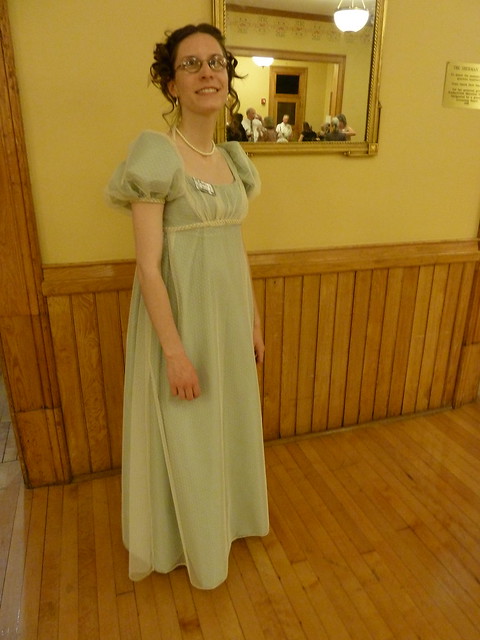
This past Saturday, we attended the annual Hartford Ball, hosted by the ECD group Reel Nutmeg.  It was held in the beautiful hall of the Keeney Memorial Cultural Center located in historic Wethersfield, CT.  During the afternoon rehearsal session, which was very well attended, we reviewed the more advanced dances on the evening's program, accompanied by the lively music of Spare Parts.  This was very helpful, since the majority of the dances were new to us.  Included in this set was a reconfiguration of "Fair and Softly"; usually a longways set, Reel Nutmeg rearranged it into a demi-mixer square!  Yikes!  We ran home afterward for a quick dinner and to change into our finery for the evening.  I finally finished my Regency gown, so I decided to wear it for this ball.  I'm not entirely happy with the way it turned out, but I'm glad to have it done.  (A separate post on that will follow soon.)

Ashley's new Regency gown at the 2011 Hartford Ball.

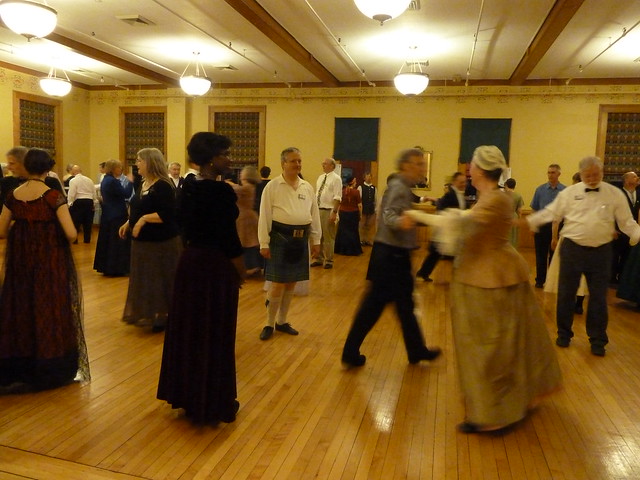
The room was full for the evening with three longways sets of dancers reaching the entire length of the hall.  As usual, there was a mix of historically inspired costumes (mostly Regency-esque) and modern formal wear.  The evening music was provided by Karen Axelrod, Ethan Hazzard-Watkins, and Anna Patton.  In addition to featuring varying degrees of difficulty, the collection of dances also ranged from the early dances of Playford ("Apley House" and "Prince William" were included) to some more modern ECD arrangements.  Reel Nutmeg was a fabulous host and in addition to keeping us well hydrated, provided the dancers with a beautiful spread of snacks and sweets!  We were both exhausted (and achy!) after a long day of dancing, but once again, it was all well worth it.  Thank you to Reel Nutmeg and all of our fellow ECD dancers for another fun event!

Dancers at the 2011 Hartford Ball.

With so much dancing, we hardly had a chance to snap some pictures!  We did manage to grab a couple quick videos, though.  Uploaded on our flickr page is a clip of Reel Nutmeg's "Fair and Softly" as "Lovely and Whispered" and another of "Prince William."  Enjoy!

Monday, May 9, 2011

New "American Revolution" website by CW

On Friday, Colonial Williamsburg launched a new website, The American Revolution, designed to provide a comprehensive online resource of information pertaining to the events, people, and significance of the fight for American independence.  Primary sources and artifacts are used to enhance the material and provide a more academic view of historical research and presentation.  I have only begun to delve through this wonderful collection of information and have already found it to be both fun and useful.  The information it presents is relevant for young students as well as more knowledgeable scholars who might be looking for something more specific.  As Jim Horn explains in the recent press release, “It engages guests with the principles that shaped our founding, the hardships endured to win independence, and the continuing struggle of those denied their rights. The Revolution was only a beginning, the start of an experiment in democracy that has continued down to our own times.”

A screen capture of the new website at http://www.ouramericanrevolution.org/.