We're so behind with blogging, and this is yet another long-delayed post that's been sitting in the drafts folder waiting to be posted for months! Back in September, Emily of My Vintage Visions nominated us for the "Versatile Blogger" award; in October, Laurie at Teacups among the Fabric honored us with the same award. Thank you both so much, ladies!
A couple of months ago, Quinn at A Quintessential Clothes Pen nominated us for the "One Lovely Blog" Award. We're so touched, and thank you prodigiously for the compliment! Then, just yesterday, Deborah at GeneologyLady.net surprised us with the "Very Inspiring Blogger Award"! This has (finally!) motivated us to move that "Versatile Blogger" acknowledgement we started after receiving Emily and Laurie's nominations from the "drafts" pile to the posted one, and we figured it would be perfectly appropriate to combine our thanks for all three awards into a single post, since their criteria for acceptance are so very similar!
The criteria for accepting "The Versatile Blogger" award is as follows:
- thank the person (in this case people!) who nominated you and provide a link back to her (their!) blog(s);
- paste the award on your blog;
- share seven things about yourself; and
- nominate fifteen other blogs.
The criteria for accepting the "One Lovely Blog Award" is:
- thank the person who nominated you;
- add the "One Lovely Blog Award" image to your post;
- share seven things about yourself;
- pass the award on to seven nominees;
- include this set of rules; and
- inform your nominees by posting a comment on their blogs.
The criteria for accepting the "Very Inspiring Blogger Award" includes:
- displaying the award and linking back to the person who nominated you;
- stating seven facts about yourself;
- nominating fifteen bloggers for the award; and
- notifying the winners.
So here goes! Fulfilling the requirements of all three awards at once, here are seven random things about us!
1) Colonial American and Revolutionary War history is a passion of both of ours, unquestionably our "first love" when it comes to historical periods (okay, so that's not too random a fact to share, since you've probably already assumed that much by now!).
2) We blame the American Girls Collection for our mutual obsession with history. Felicity was my first (and favorite) doll; I got her when I was 9 and it took me an entire year to save up to buy her. Ashley's favorite was Kirsten. She loved her doll so much that her head and two other appendages fell off.
3) We both share a prodigious affection for all things Peter Rabbit. It's safer not to ask how many stuffed Peters we have between us.
4) Mac and cheese is Ashley's favorite food; mine is Thanksgiving (yes, that's a single food).
5) When we were younger, we had a Pickwick Society (a la Little Women) in our basement with a couple of friends. We wore our dad's old suits and ties, made up "Pickwick Portfolio" newspapers, and wrote and acted out plays based on our favorite books. Can you guess which of us was which March sister? ;-)
6) Between the two of us, we play eight musical instruments.
7) Growing up, our dress-up box consisted of one old pink prom dress covered in tulle, a few of our grandmothers' old skirts, our mother's discarded nightgowns, and a big box of reject curtains, table linens, and bedsheets. Needless to say, this encouraged much creatively on our part, and we figured out how to create fashions for every character we ever wanted to become, from Laura Ingalls to Anne of Green Gables to Dr. Quinn to Elizabeth Bennett. This goes a long way towards explaining why we indulge so seriously in recreating period fashion now; the only difference is that dress-up just got a little more expensive as we got older. ;-)
The next requirement for accepting these three awards is to select additional blogs to pass each on to. In this case, we've decided to combine the stipulations for all three awards and list fifteen total.
Our nominees for five blogs that are particularly noteworthy for their stupendous displays of versatility in terms of both subject matter and their authors' talents, and thus are highly deserving of the "Versatile Blogger Award" are (in no particular order):
1) History Myths Debunked (the range of topics and depth of knowledge is prodigiously impressive here);
2) Adventures of a Costumer (although this blog also most certainly qualifies for the Lovely" award as well, we're choosing to put it here to recognize Miss Lindsey's incredible talent in costuming across an impressive variety of eras and events);
3) The Story of a Seamstress (this blog, too, could easily fall into the second category as well, but its author's talents are so versatile and wide-ranging in both the projects she creates and the topics she chooses to blog about, that it only seems appropriate to distinguish her here!).
4) American Duchess (whose range of interests, post topics, and costuming projects is amazingly versatile; she never ceases to surprise with her newest, exciting venture!);
5) The World Turn'd Upside Down (a tremendous range of knowledge here, on all sorts of intriguing tidbits to do with history and reenacting).
Our nominees for the "One Lovely Blog Award" continue our list with four additional admirable and quite lovely blogs, including (in no particular order):
6) My Vintage Visions (for continuing to share her exciting and ever-growing vintage clothing and pattern collection, and for some truly lovely vintage and historical fashion sewing projects and tips);
7) All the Pretty Dresses (I think the name pretty much underlines the loveliness of this blog!);
8) Diary of a Mantua Maker (always something lovely and drool-worthy to sigh over here);
9) Born in 1808 (loads of period images and interesting discussions);
10) Frolicking Frocks (stunning creations, oh so lovely!).
We would like to offer the "Very Inspiring Blogger Award" to the following bloggers who continue to inspire us with their unfailing passion for all that they do, with thanks for sharing your journeys as a way to encourage others (again, in no particular order):
11) Teacups in the Garden (inspiring not only for her costuming adventures, but also for her fascinating insights in teaching, particularly when it comes to history);
12) The Couture Courtesan (who never ceases to inspire with every project she sets her hands to);
13) Festive Attyre (inspiring costuming projects across three centuries with loads of gorgeous pictures and helpful tutorials);
14) A Fractured Fairytale (for creating some lovely and (awe-)inspiring historical costumes);
15) Natalie Garbett's blog (we never tire of looking at the incredible reproduction work Natalie produces!).
Thank you again to both My Vintage Visions and Teacups among the Fabric for honoring us with the "Versatile Blogger" award, to The Quintessential Clothes Pen for sending us the "One Lovely Blog Award," and to Geneology Lady for sharing the "Very Inspiring Blogger Award"! We're so, so chuffed! :-)
And while we're on the subject of awards, just one final random bit of news: our Rev War unit awarded me with the "Distaff of the Year" award at our annual meeting a few months ago! I'm so chuffed and humbled to recognized in such a way. :-) And now the pressure is on to live up to it...hence the serious throwing-of-self into learning how to cook properly lately...!
Tuesday, March 26, 2013
Wednesday, March 6, 2013
A Glimpse into the Creation of a True "Reproduction" Gown
A screencap from the vodcast, to lure you into watching it!
Captured from "A Dress in a Day" on history.org.
Yesterday, Colonial Williamsburg posted a new vodcast, "A Dress in a Day," which offers a fascinating glimpse into the work performed by the mantua-makers and milliners of the past. The video - the first in a two-part series - profiles the reproduction of an original gown from CW's collection using only the materials, techniques, and time span historically appropriate to the moment of the gown's creation. As I'm sure many of you will recognize, this gown is one of the several featured in Costume Close-up.
The original gown being reproduced in the vodcast,
dated to the late 1770s or early 1780s (CW acc. no. 1983-233).
Image linked from Colonial Williamsburg's e-museum.
Interviews with CW's costume and textiles curator and the skilled members of the Margaret Hunter Shop address numerous details of the gown's production - and reproduction! - process, from the width of the original silk to how integral that width was to the gown's construction. The working conditions and experiences of the tradeswomen who created garments like these are also discussed, as is the delight their twenty-first-century counterparts took in capturing them all over again.
Keep an eye out for the concluding part next month to see how the gown turns out!
(PS - SPOILER ALERT! - If you can't wait another month to see the finished product, the Margaret Hunter Shop's facebook page has posted "behind the scenes" photos of the filming of the vodcast, which include the finished gown.)
Tuesday, February 26, 2013
Threaded Bliss
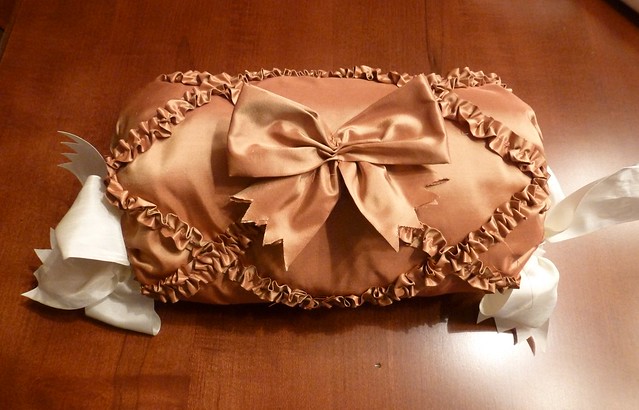
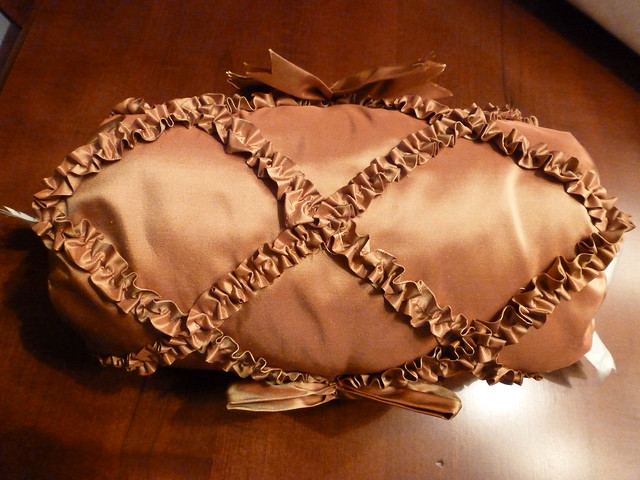
A 1770s Muff in "Aurora" Silk Taffeta
Our regiment's annual George Washington Ball is this coming weekend. This year, unfortunately, neither Ashley nor I are able to attend, but we'll most certainly be there in spirit! A traditional part of the ball is an auction of Rev War- and reenacting-related items donated by members to help raise funds for the upcoming season of events. The majority of the items up for auction each year tend to appeal more to the gentlemen and men-at-arms than to the ladies, so I decided to create something this year that might catch the eye of the fairer sex!
The pattern: The pattern, like that of all the muffs previously featured here, is from a Colonial Williamsburg muff workshop from March 2011.
Construction details: The construction details of both muff pillow and cover have been provided in earlier muff posts (here, here, and here), so I won't be tedious and repeat them again! I'll simply say that the muff cover is decorated with self-fabric trim, created by ruching strips of taffeta and criss-crossing them into a diamond pattern. The changeable taffeta was so pretty by itself that it really didn't require anything additional to make it stand out; all it needed was a little dimension to highlight the changeable colors, which the ruching provided quite nicely. Two self-fabric bows give a final accent to the criss-crossed strips. The muff cover ties with ivory silk taffeta ribbons.
The fabric: An absolutely stunning silk taffeta in "aurora," which is a carnation-pink shot with golden yellow, from Burnley and Trowbridge. According to the Burnleys' research, "The color aurora appears in 18th c advertisements and Lady’s magazines. It was said to be named after the “Aurora Borealis” and described as a vibrant orange/pink tone," as they indicate on the website. The overall effect of the fabric is truly difficulr to describe, being a bit like coral, but not quite. I took photos in multiple rooms and light settings, trying to capture the exact shade, but it's proven elusive and these shots are as close as I can get. It really is one of the prettiest changeable taffetas I've ever seen.
Finishing the look: Since this project is to be enjoyed by someone other than us, I'll have to leave this section blank...until whoever wins the muff uses it and shares a picture! :-) Stay tuned!
Saturday, February 23, 2013
Upcoming Events of Interest in Historical Fashion
This is just a quick post to share a few upcoming events and opportunities that might be of interest to historical fashion enthusiasts.
- On the second Saturday of every month, the Connecticut Historical Society will be hosting a special "behind the scenes" tours of their storage and collections facilities to give visitors a rare glimpse of items and museum areas not often accessible to the public. In March, the tour will emphasize items from CHS's comprehensive textiles and costume collection, with a focus on Women's History Month. The tour, entitled "From Corsets to Spanx: Have We Come a Long Way, Baby?", will examine the ways in which fashion both influenced and was influenced by the changing social and political roles of women across the last two centuries. Tickets for this and other special tours can be purchased online or by calling CHS directly. Ticket prices include all-day admission to the museum's current public exhibits (their "Making Connecticut" exhibit is fantastic!) and one-day access to the research library.
- "'They Called Me Lizzy': From Slavery to the White House," a one-woman show performed by Stephanie Jackson, will be presented at three different locations throughout CT during the months of March and April. The play recounts the true story of Elizabeth Keckly, dressmaker and confidante to Mary Todd Lincoln, as she retrospectively shares in first-person her extraordinary life experiences, from her birth into slavery, to her purchase of her own freedom, to her rise as one of the most recognizable figures in Washington society. A video clip of the performance can be found here.
- On the slightly-more-distant horizon are two academic events at Colonial Williamsburg. The first is the much-publicized and highly-anticipated symposium, "Threads of Feeling Unraveled: The London Foundling Hospital's Textile Tokens," which coincides with CW's very special hosting of the Threads of Feeling exhibit that garnered such a tremendous response when it opened in London in 2010. The three-day symposium, taking place 20-22 October 2013, will feature a keynote lecture by the exhibit's curator, John Styles, and promises to be a fascinating glimpse into 18th-century textile history and the very human lives around which it wove itself.
The second event, a conference focusing on "Millinery through Time," is scheduled to take place 16-19 March 2014, to mark the celebration of the 60th anniversary of the opening of Colonial Williamsburg's Margaret Hunter Shop and CW's resurrection of the millinery trade as integral parts of their telling of our nation's social history. They are currently accepting paper proposals, so keep an eye out for the final list of presentations!
- On the second Saturday of every month, the Connecticut Historical Society will be hosting a special "behind the scenes" tours of their storage and collections facilities to give visitors a rare glimpse of items and museum areas not often accessible to the public. In March, the tour will emphasize items from CHS's comprehensive textiles and costume collection, with a focus on Women's History Month. The tour, entitled "From Corsets to Spanx: Have We Come a Long Way, Baby?", will examine the ways in which fashion both influenced and was influenced by the changing social and political roles of women across the last two centuries. Tickets for this and other special tours can be purchased online or by calling CHS directly. Ticket prices include all-day admission to the museum's current public exhibits (their "Making Connecticut" exhibit is fantastic!) and one-day access to the research library.
- "'They Called Me Lizzy': From Slavery to the White House," a one-woman show performed by Stephanie Jackson, will be presented at three different locations throughout CT during the months of March and April. The play recounts the true story of Elizabeth Keckly, dressmaker and confidante to Mary Todd Lincoln, as she retrospectively shares in first-person her extraordinary life experiences, from her birth into slavery, to her purchase of her own freedom, to her rise as one of the most recognizable figures in Washington society. A video clip of the performance can be found here.
- On the slightly-more-distant horizon are two academic events at Colonial Williamsburg. The first is the much-publicized and highly-anticipated symposium, "Threads of Feeling Unraveled: The London Foundling Hospital's Textile Tokens," which coincides with CW's very special hosting of the Threads of Feeling exhibit that garnered such a tremendous response when it opened in London in 2010. The three-day symposium, taking place 20-22 October 2013, will feature a keynote lecture by the exhibit's curator, John Styles, and promises to be a fascinating glimpse into 18th-century textile history and the very human lives around which it wove itself.
The second event, a conference focusing on "Millinery through Time," is scheduled to take place 16-19 March 2014, to mark the celebration of the 60th anniversary of the opening of Colonial Williamsburg's Margaret Hunter Shop and CW's resurrection of the millinery trade as integral parts of their telling of our nation's social history. They are currently accepting paper proposals, so keep an eye out for the final list of presentations!
Monday, February 18, 2013
18th-Century Hearth Cooking Workshop
Over the weekend, our regiment's very own expert in eighteenth-century foodways led a workshop in hearth cooking at a lovely 1765 house owned by another couple from our group. It was a prodigiously educational day and I learned enough to finally feel like I'll actually be comfortable not only preparing meals during events, but even intelligently conversing with visitors about what I'm doing! Yes, folks, progress has been made with me and cooking! ;-)
We began our day with a lesson in how to date 18th-century houses based on the location of their fireplace bakeovens, and in how to heat, test, and use a bakeoven to make a variety of different baked goods. We then turned to how to build and maintain a fire, a skill relevant to both hearth and camp cooking which I have yet to master (one day...!). Then Luisa, our instructor, split us into teams and assigned us each two period receipts that allowed us the opportunity to practice different cooking techniques. There were six total groups, and between the thirteen of us, we prepared quite a feast. In just over five hours, we ended up with three meat dishes (mostly prepared by Luisa, which included chicken, cornish hens, and a pork tenderloin), a host of vegetable sides (green beans in a creamy sauce, carrots with lemon and ginger, corn pudding, and a couple others I'm forgetting now...), an onion pie, spoon bread, and apples and bacon, in addition to a cranberry pudding and a cherry pie for dessert. It looked like way too much food for our modest gathering, but very little was left over when it came time to clear the table afterwards!
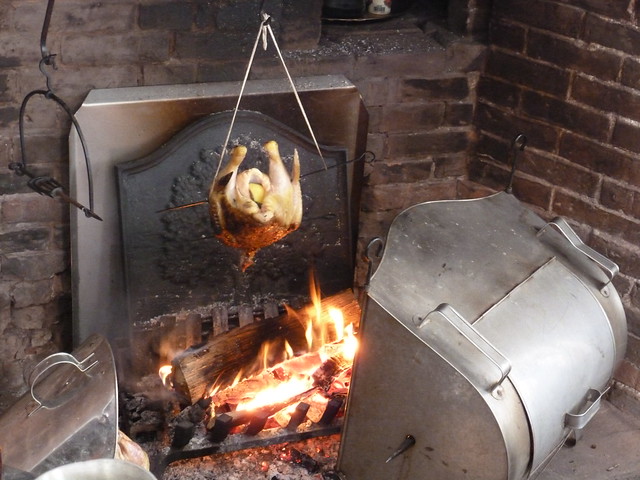
Because there were so many of us working and we were preparing so many dishes simultaneously, we took full advantage of being in a period house and used two of the three original fireplaces on the ground floor. On the smaller hearth in the front room, we perched the hens and the pork, which both cooked in reflector ovens. Luisa hung a chicken on a string from the crane and demonstrated the proper techniques to manage it as it cooked to ensure it was done evenly and would not become dry.
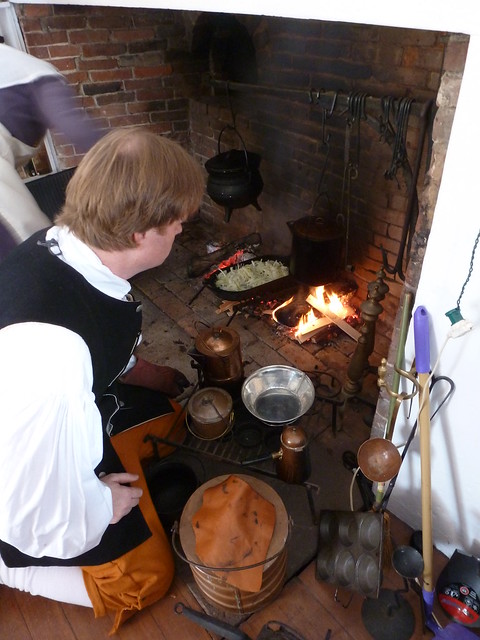
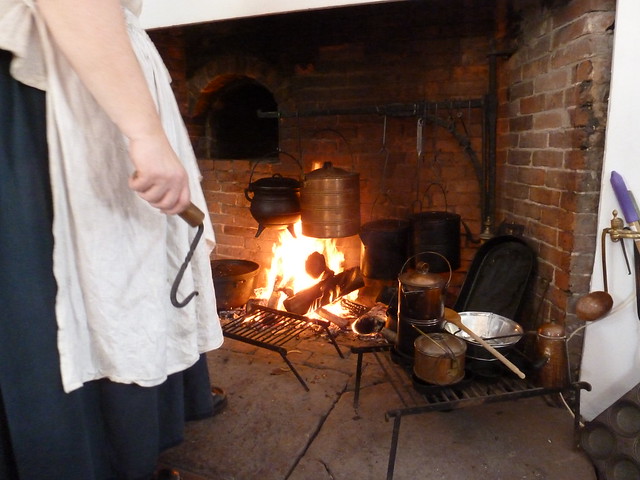
The larger hearth in the house's designated kitchen became the primary cooking area for the rest of our dishes. From the large crane hung a collection of bulge pots and tin pots that kept coming on and off of the fire as their ingredients were perfected and their cooking progress monitored by their respective teams.
My cooking partner C (a newly-inaugurated member of our unit!) and I were assigned the task of preparing an onion pie and a dish of apples and bacon. Despite one minor mishap involving too much eggs and cream, our pie turned out most beautifully, and I can now count the successful managing of a Dutch oven, properly called a bake kettle in the eighteenth century, amongst my period accomplishments. Huzzah!
Our apples and bacon also turned out most heavenly indeed, loaded with cinnamon and maple syrup. They were the perfect complement to the roasted pork and definitely one of my favorite products of the day's efforts.

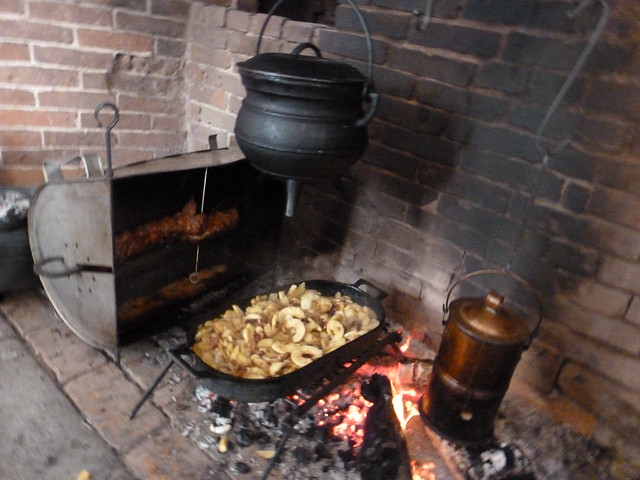
The pork relocated to finish cooking in the kitchen hearth, with our
apples and bacon just starting to melt beside it.
We began our day with a lesson in how to date 18th-century houses based on the location of their fireplace bakeovens, and in how to heat, test, and use a bakeoven to make a variety of different baked goods. We then turned to how to build and maintain a fire, a skill relevant to both hearth and camp cooking which I have yet to master (one day...!). Then Luisa, our instructor, split us into teams and assigned us each two period receipts that allowed us the opportunity to practice different cooking techniques. There were six total groups, and between the thirteen of us, we prepared quite a feast. In just over five hours, we ended up with three meat dishes (mostly prepared by Luisa, which included chicken, cornish hens, and a pork tenderloin), a host of vegetable sides (green beans in a creamy sauce, carrots with lemon and ginger, corn pudding, and a couple others I'm forgetting now...), an onion pie, spoon bread, and apples and bacon, in addition to a cranberry pudding and a cherry pie for dessert. It looked like way too much food for our modest gathering, but very little was left over when it came time to clear the table afterwards!
D feeding the fire to help bring his pot to boil.
Because there were so many of us working and we were preparing so many dishes simultaneously, we took full advantage of being in a period house and used two of the three original fireplaces on the ground floor. On the smaller hearth in the front room, we perched the hens and the pork, which both cooked in reflector ovens. Luisa hung a chicken on a string from the crane and demonstrated the proper techniques to manage it as it cooked to ensure it was done evenly and would not become dry.
Cooking pork and two types of poultry in the front room's fire.
The larger hearth in the house's designated kitchen became the primary cooking area for the rest of our dishes. From the large crane hung a collection of bulge pots and tin pots that kept coming on and off of the fire as their ingredients were perfected and their cooking progress monitored by their respective teams.
Dinner cooking...mmmm!
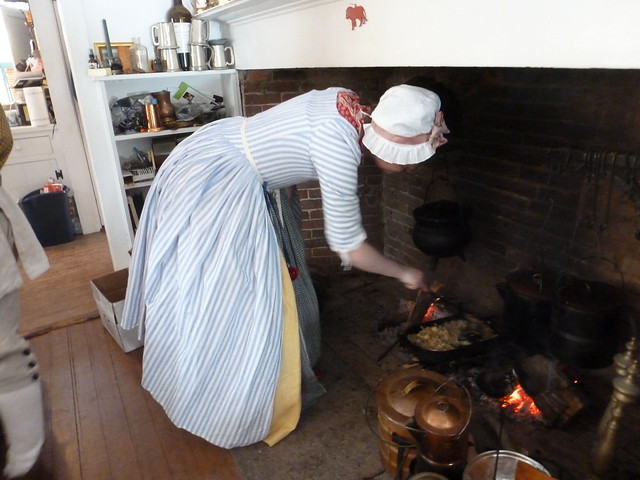
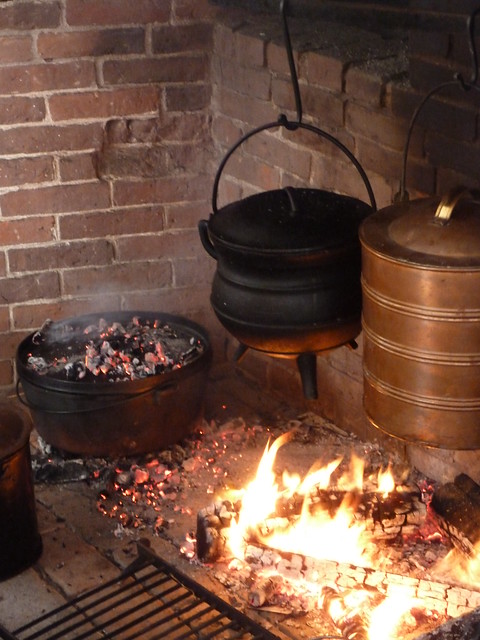
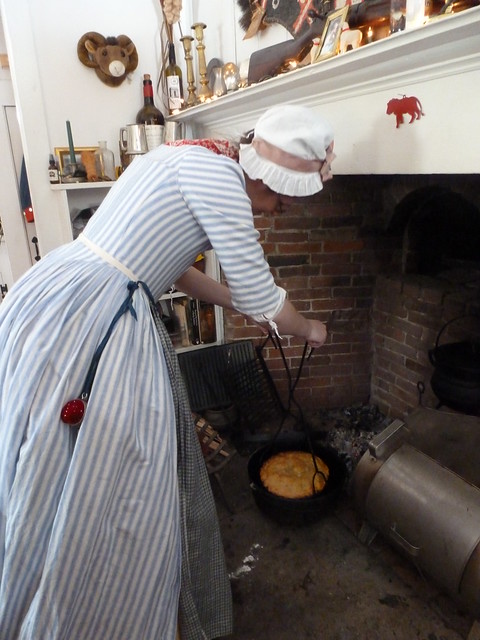
My cooking partner C (a newly-inaugurated member of our unit!) and I were assigned the task of preparing an onion pie and a dish of apples and bacon. Despite one minor mishap involving too much eggs and cream, our pie turned out most beautifully, and I can now count the successful managing of a Dutch oven, properly called a bake kettle in the eighteenth century, amongst my period accomplishments. Huzzah!
Me tending to the onions, preparing them for the pie.
Red-hot coals piled on top of the bake kettle, our onion pie nestled inside.
Our beauteous onion pie, perfectly baked in the Dutch oven.
Me removing the pie (ever so carefully!) to cool.
Our apples and bacon also turned out most heavenly indeed, loaded with cinnamon and maple syrup. They were the perfect complement to the roasted pork and definitely one of my favorite products of the day's efforts.

The pork relocated to finish cooking in the kitchen hearth, with our
apples and bacon just starting to melt beside it.
Slicing the pork out of the reflector oven.
I unfortunately didn't manage to get a picture of our finished repast, all laid out on the dining room table, but it was quite a spread indeed and tasted all the better for knowing we'd all just spent five and a half hours hard at work making it!
A huge thank you to Luisa for sharing your immeasurable knowledge and skills with us, and to P and D for opening your lovely period home (and hearths!) for the purpose. It was a day spent in true eighteenth-century style with good company and good food, the ideal way to help wish away those chilly New England winter winds.
Labels:
18th century foodways,
18th century life,
5th CT,
workshops
Saturday, February 16, 2013
Introducing Young Students to 18th-Century Clothing
In addition to attending the large reenactment events we always blog about, our Rev War unit also presents a number of educational programs each year to schools, historical sites, groups, and museums throughout the state. Yesterday was one of our many yearly school shows, which provides local students with a full day of interactive instruction in military and civilian life during the Revolutionary War to supplement their standard history curriculum. My work schedule over the past few years hasn't allowed me to take part in any of these school shows, so I was thrilled when things finally fell into place to enable me to lend a hand this time around!
Our program divides students into ten different stations, each focusing on a different aspect of the Rev War period. The topics for each station vary, depending on both the specialties and the current research interests of the individual unit members able to attend. Yesterday's program included, among other things, foodways, the life of a Continental solider, pirates, a conversation with a British marine, spies during the Revolution, the military surgeon, CT Rev War battles, and clothing, but we've done everything from music and dance to battle tactics to drilling instruction in the past. The students spend the day moving from station to station, taking about 20 minutes at each to learn a bit about all of the different subject areas. Our day concludes with a "tavern scene" that stages a political conversation between patriots and loyalists on the eve of the Revolution, presenting both sides of the argument and asking students in the end to decide for themselves which side they think they might have chosen, had they lived in the shoes of their colonial ancestors. I only wish I had had something like this to inspire me when I was in grade school!
As you can well imagine, I offered to do the clothing station and was thus faced with the challenge of how to introduce all those layers of clothes (for both men and women) to our middle school students in only 20 minutes - and make it exciting and relevant enough to capture their imaginations. In the end, I elected to "dress" three student volunteers (in this brief block of time, that meant having them hold up the layers as we talked through them): one was a farmer who represented the majority of CT's men-at-arms during the Revolution, another was a farmer's wife, and the third was a lady who was a member of the gentry class. I went dressed as one of the middling sort, so that all three primary levels of society would be represented to the students.
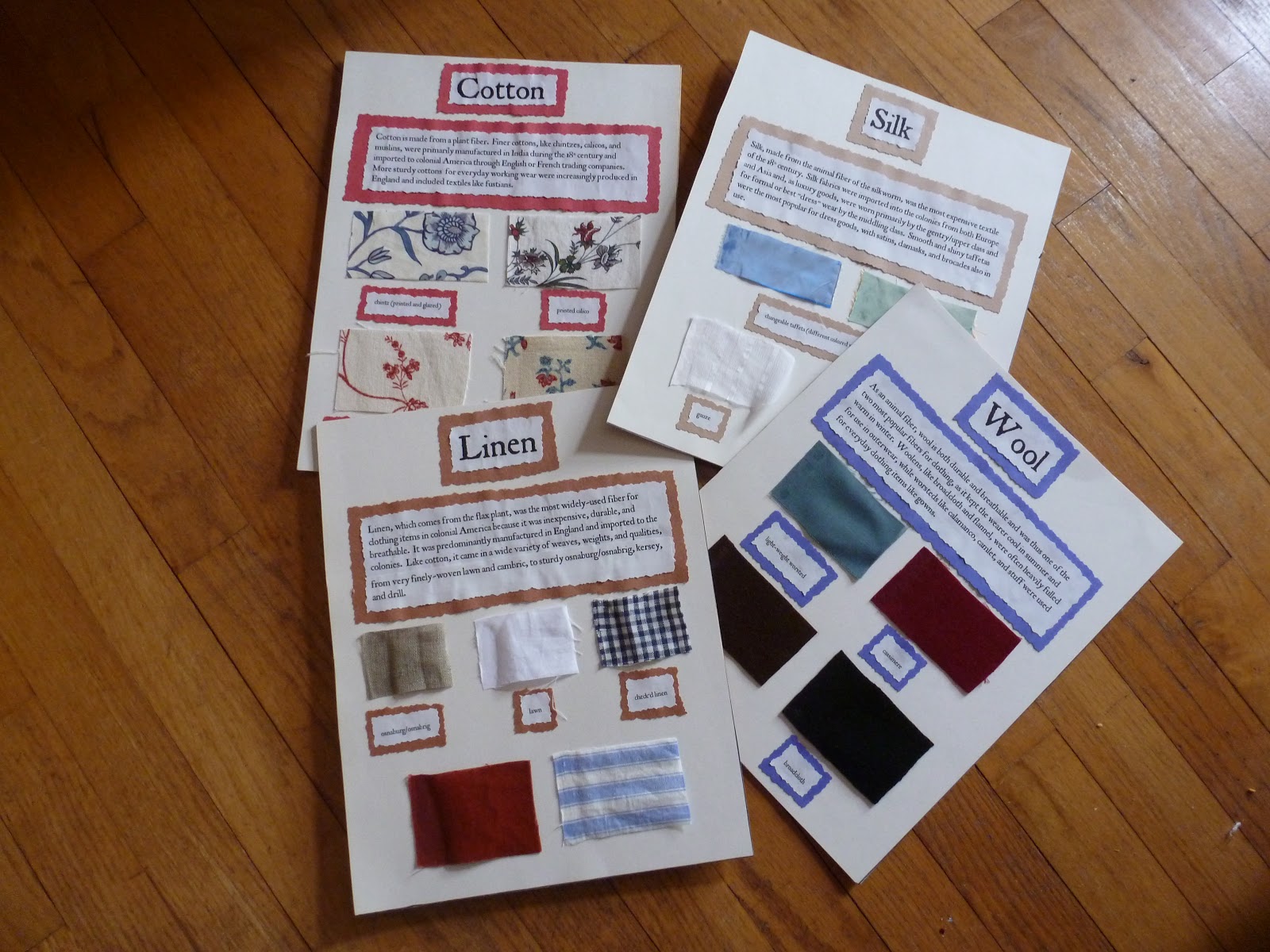
To help explain to the students both the highly stratified structure of society in colonial America and the function that clothing served to help mark those social boundaries, we began by discussing the four fibers from which textiles were made - linen, wool, cotton, and silk - and how, in many respects, there was a sort of "language" of clothing during the period that helped people distinguish, just by looking at a person, into which social level they most likely fell, and thus what type of work they most likely did in their clothes. I asked the students if they thought we used clothing in the same way today, and why or why not? This approach, of course, was made at the risk of being quite reductive, which was necessitated by the 20-minute session limit and the fact that our seventh-grade audience was coming to this conversation with very little context; had I been speaking to an older audience or one with any kind of previous background in the period, I would certainly have been much more cautious about qualifying such sweeping statements and discussing the complexities of both colonial social stratification and "reading" clothing in such a simplistic way. But needs must in this case, and it seemed to work quite well in conveying such new and broad concepts.
We then passed around swatch boards of each type of fiber and I asked the students to think about which social level they thought each fabric might be associated with. Which type of fabric felt most durable, like it could withstand many washings and harsh wear out in a field or while doing strenuous household chores? Would a textile like silk be practical for a farmer or his wife to wear, considering the type of work they had to do? Which fabric looks and feels the most delicate and expensive, and in what type of activity might a person wearing it be engaged?
We also talked about styles and "reading" clothing with this additional dimension in mind. After thinking about why people choose the specific styles we wear today, we discussed how styles varied across social levels during the Revolution. Would it have been practical (and safe) for a farmer's wife to wear the large side hoops modeled by our gentry lady? Why do you think items like jackets and shortgowns were seen mostly on members of the lower class? Who did those of the middling sort try to emulate with their fashion choices and why?
Considering we had all of twenty minutes in which to accomplish all of this, the students impressed me no end with how quickly they latched on to the broader concepts and how readily they were able to identify and discuss similarities and differences in social identities as we went along. Their history teacher mentioned that they will be assigned a first-person character project soon, which will ask them to use the information they collected throughout the day to assume the persona of a individual living during the Revolution. I'd be very curious to see if any of them draw upon their brief experience with clothing to help them discover and fashion their historical personalities!
Our program divides students into ten different stations, each focusing on a different aspect of the Rev War period. The topics for each station vary, depending on both the specialties and the current research interests of the individual unit members able to attend. Yesterday's program included, among other things, foodways, the life of a Continental solider, pirates, a conversation with a British marine, spies during the Revolution, the military surgeon, CT Rev War battles, and clothing, but we've done everything from music and dance to battle tactics to drilling instruction in the past. The students spend the day moving from station to station, taking about 20 minutes at each to learn a bit about all of the different subject areas. Our day concludes with a "tavern scene" that stages a political conversation between patriots and loyalists on the eve of the Revolution, presenting both sides of the argument and asking students in the end to decide for themselves which side they think they might have chosen, had they lived in the shoes of their colonial ancestors. I only wish I had had something like this to inspire me when I was in grade school!
As you can well imagine, I offered to do the clothing station and was thus faced with the challenge of how to introduce all those layers of clothes (for both men and women) to our middle school students in only 20 minutes - and make it exciting and relevant enough to capture their imaginations. In the end, I elected to "dress" three student volunteers (in this brief block of time, that meant having them hold up the layers as we talked through them): one was a farmer who represented the majority of CT's men-at-arms during the Revolution, another was a farmer's wife, and the third was a lady who was a member of the gentry class. I went dressed as one of the middling sort, so that all three primary levels of society would be represented to the students.
To help explain to the students both the highly stratified structure of society in colonial America and the function that clothing served to help mark those social boundaries, we began by discussing the four fibers from which textiles were made - linen, wool, cotton, and silk - and how, in many respects, there was a sort of "language" of clothing during the period that helped people distinguish, just by looking at a person, into which social level they most likely fell, and thus what type of work they most likely did in their clothes. I asked the students if they thought we used clothing in the same way today, and why or why not? This approach, of course, was made at the risk of being quite reductive, which was necessitated by the 20-minute session limit and the fact that our seventh-grade audience was coming to this conversation with very little context; had I been speaking to an older audience or one with any kind of previous background in the period, I would certainly have been much more cautious about qualifying such sweeping statements and discussing the complexities of both colonial social stratification and "reading" clothing in such a simplistic way. But needs must in this case, and it seemed to work quite well in conveying such new and broad concepts.
Swatch boards I created to provide the students with a tactile way to
learn about the functions and social distinctions of dress during the Revolution.
We then passed around swatch boards of each type of fiber and I asked the students to think about which social level they thought each fabric might be associated with. Which type of fabric felt most durable, like it could withstand many washings and harsh wear out in a field or while doing strenuous household chores? Would a textile like silk be practical for a farmer or his wife to wear, considering the type of work they had to do? Which fabric looks and feels the most delicate and expensive, and in what type of activity might a person wearing it be engaged?
We also talked about styles and "reading" clothing with this additional dimension in mind. After thinking about why people choose the specific styles we wear today, we discussed how styles varied across social levels during the Revolution. Would it have been practical (and safe) for a farmer's wife to wear the large side hoops modeled by our gentry lady? Why do you think items like jackets and shortgowns were seen mostly on members of the lower class? Who did those of the middling sort try to emulate with their fashion choices and why?
Considering we had all of twenty minutes in which to accomplish all of this, the students impressed me no end with how quickly they latched on to the broader concepts and how readily they were able to identify and discuss similarities and differences in social identities as we went along. Their history teacher mentioned that they will be assigned a first-person character project soon, which will ask them to use the information they collected throughout the day to assume the persona of a individual living during the Revolution. I'd be very curious to see if any of them draw upon their brief experience with clothing to help them discover and fashion their historical personalities!
Labels:
18th century fashion,
5th CT,
educational programs
Saturday, February 2, 2013
1870s Costume for Sale!
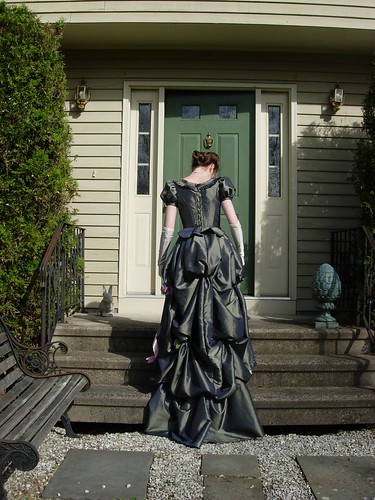
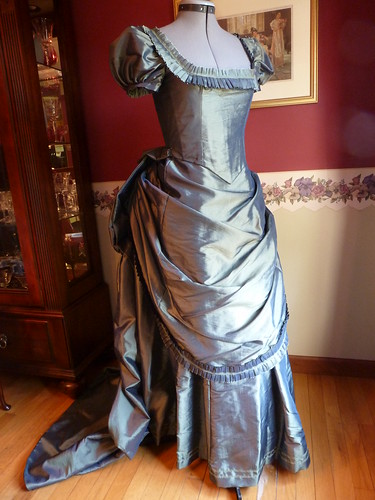
About ten years ago, before Ashley and I really got into historical fashion on a serious, research-oriented level, I made an 1870s gown, based off a commercial pattern (I honestly don't remember which one now, especially since I ended up entirely re-drafting the bodice), to wear to a Victorian-themed fundraising event. I wore it only that once and it's been hanging in the closet ever since, and I think it is now officially time to bid it farewell. My loss is your gain, as it is now listed on ebay!
Additional photos can be found here if you're interested in the details. If you'd like to bid, please be aware that this is very much a costume - not a meticulously researched "reproduction" piece like those we typically share on the blog. This was one of my first sewing endeavors and as such, it certainly has its flaws, though I still really like the way it came out. It is entirely machine-sewn, trim and all, with only the tiniest details (hook and eyes, seam binding, flowers, etc.) sewn by hand.
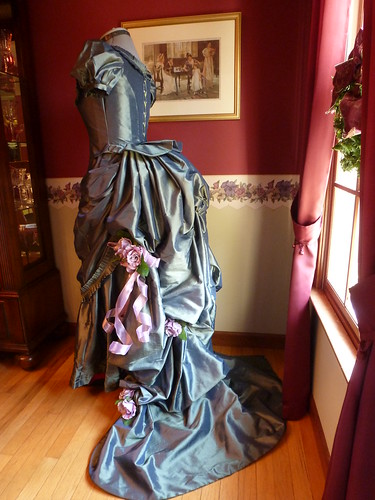
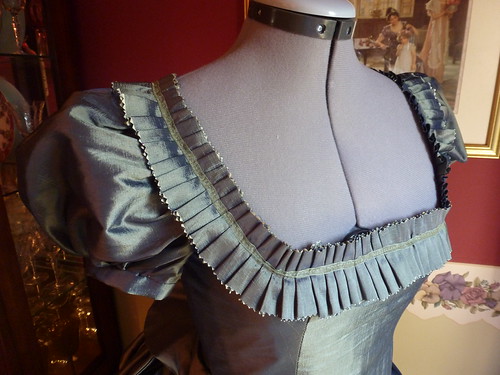
The fabric is a very pretty green shot blue faux taffeta. Green organza ribbon holds down the pleated trim along the square neckline and along the bottom of the skirt's apron, and also encircles the hem in two parallel lines.
The bodice is boned with plastic boning and interlined with interfacing to stiffen it, and then fully lined in self-fabric. The sleeves are also lined, which helps them maintain their poofiness. The bustle is a separate piece, attached to the waistband with hooks and eyes and attached to the back of the skirt with a series of ties and plastic rings. The bustle is fully lined and is interlined with crinoline to give it some structure.
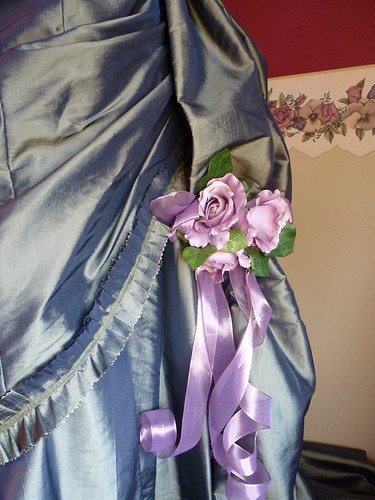
Six lavender roses and a bow of lavender organza embellish one side of the bustle; the other side is left plain. This detail was copied from an early 1880s Godey's fashion plate and just adds a little splash of color.

The bodice and skirt are separate pieces. The bodice, which has a pointed front, laces up the back through metal lacing holes with an olive green satin ribbon. A little peplum poofs over the top of the bustle in back.
Please see the listing for measurements, pricing, and further details. I'll be very glad to see this go to a good home!
Subscribe to:
Posts (Atom)