Friday, September 30, 2011

(Re-)Making Royal Fashion History

Because we've discussed Kate Middleton's wedding gown at such length and admired and sighed over its details in such depth, I thought it would be fun to share something I just so happened to stumble across yesterday.  Butterick has designed a pattern (#B5731) so that you, too, can make and wear a copy of the Duchess of Cambridge's Sarah Burton/Alexander McQueen wedding gown!  From the photos and line drawings on the pattern envelope, it seems to be a fairly good replica, though they didn't quite capture the clever and oh-so-elegant way the skirts of the original were draped (which was one of my favorite parts of the gown).  And, of course, any recreation won't be able to boast the world-renowned handiwork of the Royal School of Needlework, and few reproductions can incorporate genuine Irish Carrickmacross lace, and I don't think that Butterick notes any of the placement and patterning of the applique lace designs that added such an amazing texture and dimension to the skirts of the original.  But then again, the rest of us wouldn't be marrying a future king in our reproduction gown, so these are tiny details indeed!  So in general, I think they did quite a nice job with the pattern; visit the Edelweiss Patterns blog for a more detailed comparison of the pattern and the original.  If anyone attempts a reproduction using this pattern, we'd love to see your final product and how it turns out!

Kate Middleton's wedding gown (left), with its Butterick (B5731) counterpart.
To purchase the Butterick pattern, click here.
Left photo linked from wallang; Butterick photo (right) linked from the Butterick website.

And for a bit of added fun, Butterick has also released a pattern (#B5710) that closely replicates the style of Phillipa Middleton's bridesmaid's gown and another that copies the adorable dresses of the young flower girls (#BP248)!  Now if we can just convince them to pattern some of the other historic royal wedding gowns...  :-)

Monday, September 26, 2011

Current Exhibit: "Revolutionary Fashion 1790-1820" at Fairfax House, York

For our friends and readers across the pond - or those of you with the means to travel there! - a new exhibit of late-Georgian and Regency fashion has just gone on display at York's Fairfax House.  As a sequel to last year's "Dress to Impress: Revealing Georgian Fashion 1730-1780," this exhibition, which runs through the end of the year, draws upon a number of UK costume collections to offer a beautifully varied look at the evolution of dress during this revolutionary period.  Clothing and accessories displayed against the backdrop of the restored Georgian Fairfax House narrate the story of how dramatic political and social changes - the French Revolution and the Napoleonic Wars, as well as the Industrial Revolution - were reflected in the increasingly naturalistic silhouettes of both male and female clothing.  A splendid (and pretty lengthy!) video tour of the exhibit that showcases (up close, huzzah!) a number of the items on display is available to view here and helps to introduce the socio-political context in which this exhibit intends to function.

Stunning pelisse from the Olive Matthews Collection at the
Chertsey Museum, currently on display in this exhibit. 
Photo linked from CraftsCouncil.org.uk.

Further information on "Revolutionary Fashion 1790-1820" can be found on Fairfax House's blog, in this article from The Press, and in this neat little press release from the University of York.  And for additional photos of many of the items on display, be sure to check out the official photo gallery!  Now if only we can convince them to produce a catalog...:-)

Painted leather slippers made by Brucknell for Princess Amelia.
Photo linked from The Press.

This coming Wednesday, the 28th of September, Fairfax House is hosting a fashion seminar as a special event to coincide with the exhibit.  Entitled "Ridicules and Indispensibles: Fashion and a War of Words in Late Georgian England," the talk will explore the shift from the tie-on pocket so ubiquitous to the 18th century to the hand-held reticule, and address the charged political and social ramifications of this "newest" fashion accessory.  For more information and for tickets. follow the link above.  This sounds fascinating and I so wish I could go!  If anyone does, do please let us know how it is and what is discussed!

Wednesday, September 14, 2011

Current Exhibit and Upcoming Conference: "With Cunning Needle: Four Centuries of Embroidery"

From 21-22 October 2011, Winterthur will hold a conference, "With Cunning Needle: Four Centuries of Needlework."  The two days of lectures, workshops, and half-day seminar sessions will focus on the techniques, materials, heritage, and artistry of needleworkers and their creations from the seventeenth century through the present day.  The conference is scheduled as a complement to Winterthur's current exhibit of the same name, which explores the history of embroidery and other needlework arts by showcasing extant pieces that highlight not only the tremendous skill involved in producing these heirloom items, but also the lives of the individuals who invested themselves in these creations, and the lives of those fortunate enough to own and wear such treasured objects of art.  The exhibition premiered on 3 September and will remain open until 8 January 2012.

The Plimoth Jacket.
Photo linked from the Winterthur Museum.

The "Plimoth Jacket," currently on loan to Winterthur from Plimoth Plantation, forms the inspiration and heart of the new exhibit and the conference.  For those of you who have not yet heard about the project, the Plimoth Jacket is a conglomerative reproduction of two 1620s jackets held in the collection of the V&A; one jacket (the "Margaret Laton" jacket, V&A #T.228-1994) served as the pattern base, while the other (V&A #1359-1900) provided the embroidery design that was reproduced in exact detail for the project.  This jaw-dropping piece was brought to life by more than 300 hard-working hands that used only early-seventeenth-century tools, materials, and techniques to recreate the sequins, lace, threads, and fabric that make up this jacket.  More than 3,700 hours were invested in this exploration of seventeenth-century needlework culture and practice.  The product is a triumph of research, art, meticulous skill, and a passionate devotion to the skills of the artisans of the past.  Plimoth Plantation's The Embroiderer's Story blog and Tricia Wilson's Thistle Threads blog provide detailed records of the creation of the jacket.  Winterthur has also put together a fabulous presentation full of great images and lots of additional information about the production process from inspiration to pattern to progress to product; be sure not to miss it!

If you are interested in attending the October conference, the conference brochure and registration form can be found in .pdf form here.  Further information on Winterthur's extensive permanent Textiles and Needlework Collection (including virtual catalogues and past exhibits) can be found here.

For more on the patterning and construction of garments like the Plimoth Jacket, take a look at Janet Arnold's Patterns of Fashion 4 (which Tricia Wilson discusses in her blog account of the jacket project here and here) and Jenny Tiramani's new book, Seventeenth-Century Women's Dress Patterns (which we heard her speak about at the March CW conference!).

Wednesday, September 7, 2011

Threaded Bliss

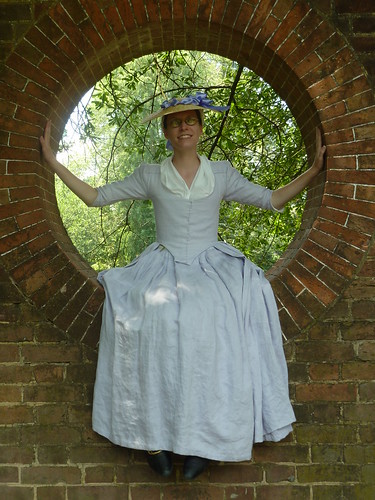
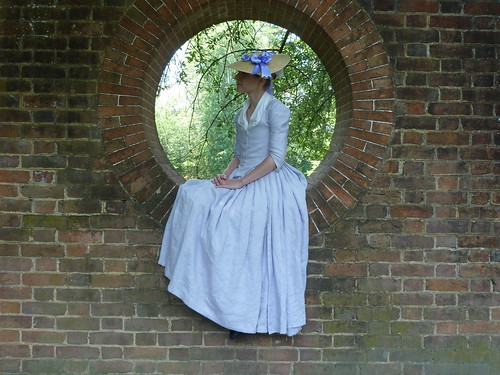
Lavender Linen English Gown
with Matching Petticoat,
1775-1780

Lavendar linen gown, 1775-1780
Colonial Williamsburg, July 2011.

The Pattern: Draped by me, with the exception (as I'm sure you've come to expect by now!) of the sleeves, which I took (with slight alterations to fit this new bodice) from the DAR gown, whose sleeves were originally patterned from the gown on page 36 of Janet Arnold's Patterns of Fashion 1.


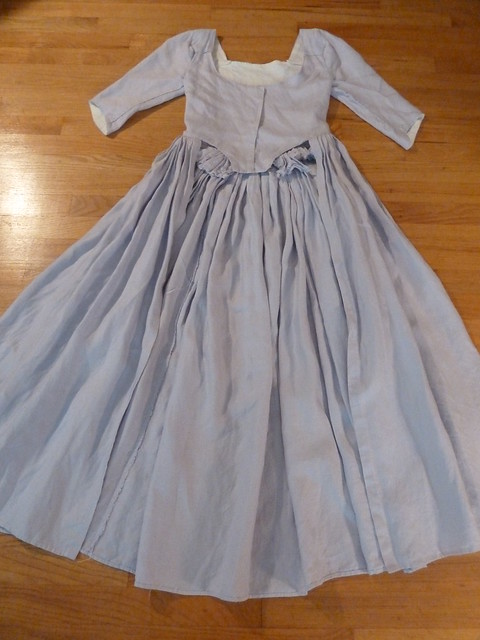
Construction Details: Because this gown is the same style as the DAR gown, the construction process was identical, so please see that earlier post if you want specifics on how it was made.  To avoid repeating too much information, I'll just offer a brief overview of the process here, along with some pictures.

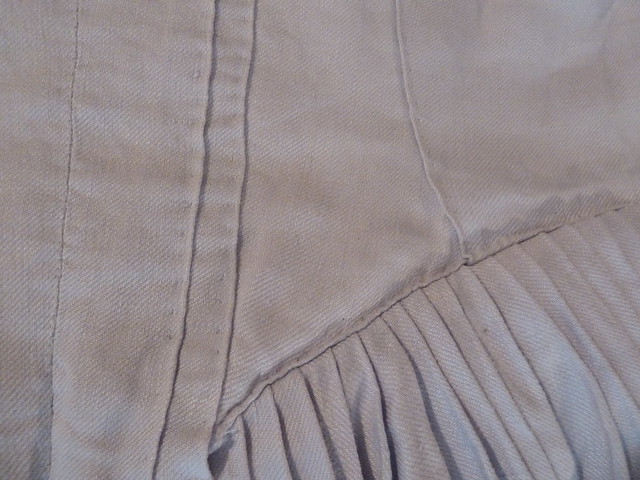
The back "en fourreau" pleats, which extend from the back
shoulders all the way down the full length of the gown's skirts. 
The lapped seams on the bodice and shoulder straps can also be seen.

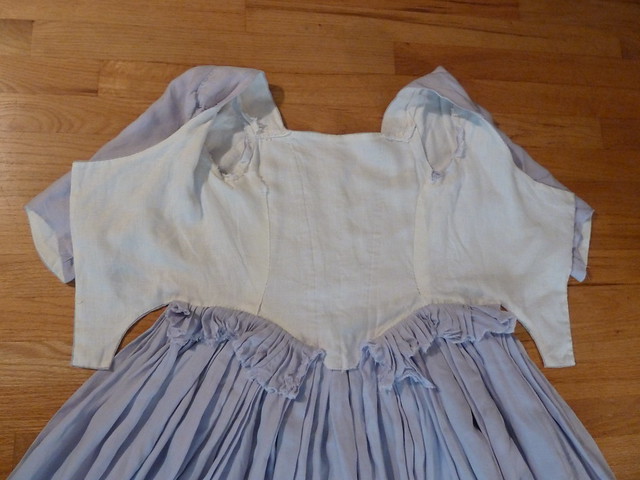
After draping the lining over Ashley's stays, the back en fourreau pleats are formed and stitched to the back lining.  The draped front bodice lining pieces are used to cut out the front pieces in the lavender linen.  These front pieces are then lapped over the back panel and stitched down, and their corresponding lining pieces folded under and stitched to the lining to conceal the raw edges inside. 

The interior of the gown's bodice.  The top of the skirts remain uncut
and are simply folded and left to hang free inside. This helps pad out the skirts
and makes later alterations easier.

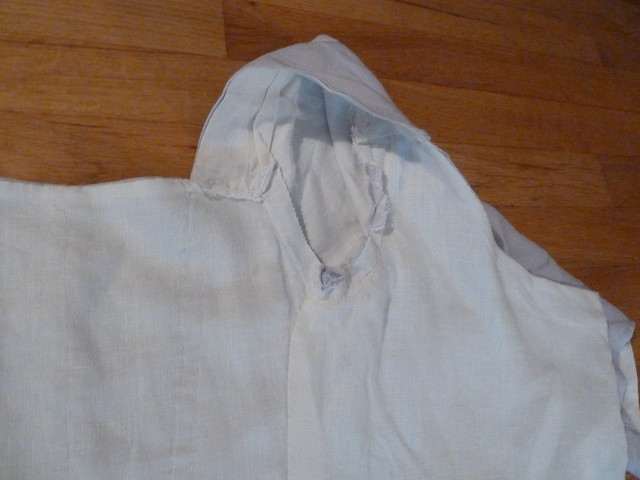
Detail of the gown's interior, showing the unfinished armscye.  This is
consistent with extant examples, which rarely wasted time, energy, or materials
on areas of a garment that would not be seen.

After finishing the outer edges of the bodice and neckline, the sleeves are fitted while on Ashley and the shoulder straps stitched down.  Finally, the skirts are pleated and secured to the bottom of the bodice.

The back right side of the gown.  The center back "en fourreau" pleating is on the left.

The Fabric: A pale lavender 100% linen twill, one of those rare but exciting Denver Fabrics sale finds.  The linen is a lovely mid-weight that drapes beautifully in the skirts.  The bodice and sleeves are lined in a light-weight cream linen.

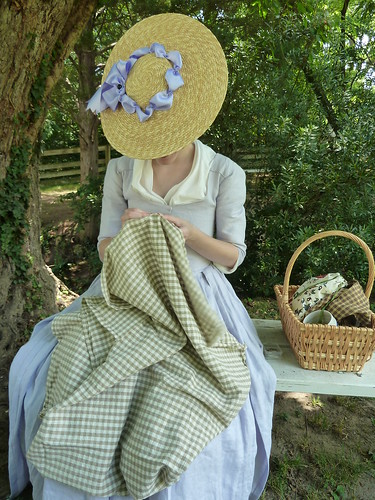
Finishing the Look: The front of the gown pins closed with straight pins.  Ashley wears this gown over a linen shift with tight, elbow-length sleeves, fully-boned stays, a linen underpetticoat, and a matching pale lavender linen petticoat.  A white linen neckerchief fills in the low neckline, and a cotton lawn cap covers her head.  She also wears a new straw hat beribboned with lavender satin that I bought years ago and have been hoarding until I found the perfect use for it.  The decoration is simple big poofs with a double bow at one side, copied from the print below (though the exact same trim is seen on numerous images dating between 1770 and 1785).

"Rural Life," 1782: the inspiration for Ashley's lavender hat. 
Because of the number of images which feature this exact same trim
design, it seems to have been quite a popular and fashionable one!
Image linked from the Lewis Walpole Library, Yale University.

Lavendar linen gown, 1775-1780
A view of the side of the hat with the double bow.
Colonial Williamsburg, July 2011.

An 18th Century Seamstress
Another view of the hat, this time from the top,
showing the big poofs that surround the crown.
Under the Redcoat, Colonial Williamsburg, June 2011.

As always, I ran out of room to post all of the pictures, so if you'd like to see additional views and detail shots, check out this project's flickr set!

Monday, August 15, 2011

Redcoats & Rebels at Old Sturbridge Village 2011

The weekend of August 6 & 7, I attended the ninth annual Redcoats & Rebels at Old Sturbridge Village.  I was present for last year's events as a spectator and experienced a very different perspective this year as distaff with the 5th CT.  It was reported that this year provided record numbers for both participating reenactors and for visitors, and I can easily believe it!

 
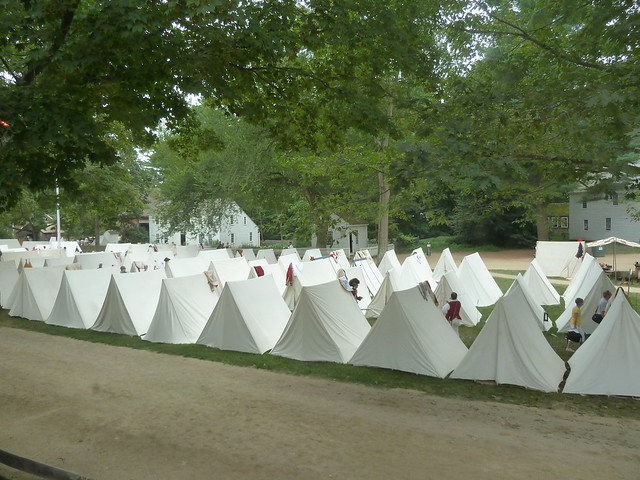
British tents on the Old Sturbridge Village Common for Redcoats & Rebels, 2011. 

Saturday morning I arrived and upon registration was directed to the area where our regiment was supposedly encamped.  Since I've been to OSV before and knew the layout pretty well, I didn't think finding our group would be a difficult task.  Unfortunately, I was directed to the complete opposite side of town from where our camp actually was.  After a great deal of wandering and several inquiries, I made my way to the lower fields and luckily ran into our Commander as he was leaving the morning meeting.  We then walked over to our camp, which was hidden in a back field covered with furrows and where the grass was quite overgrown (oh the grasshoppers!), which made spotting the furrows difficult as you walked.  Despite our unlucky camp ground, it was wonderful to see everyone and to have the opportunity to bond with some more members of the group.

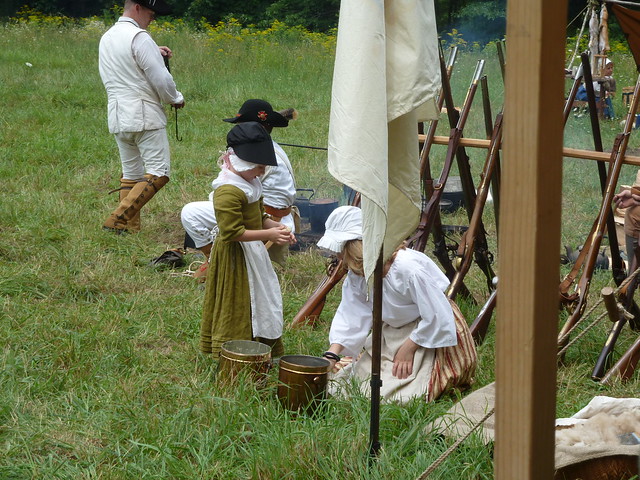
Girls dipping candles in camp at Redcoats & Rebels, OSV 2011

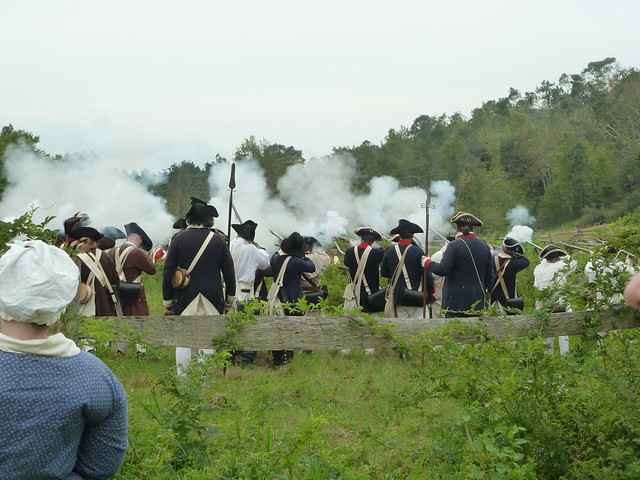
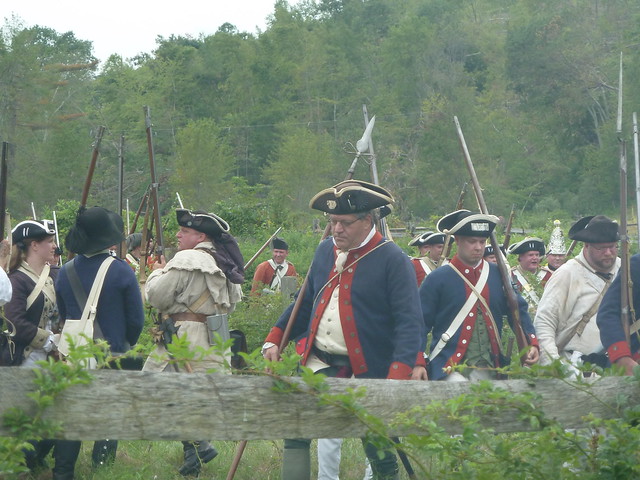
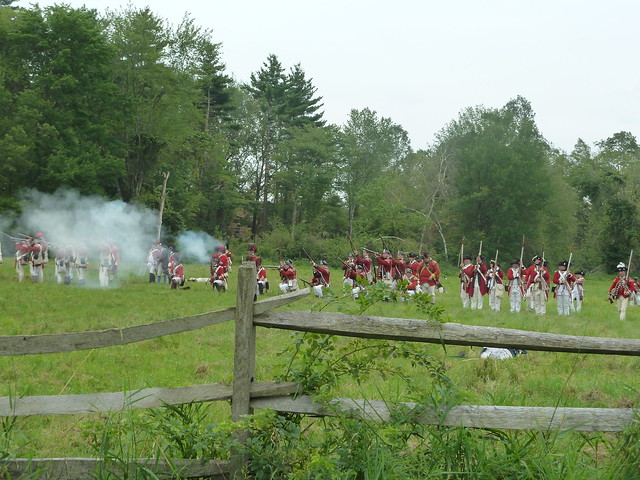
After lunch, the ladies followed the men to the field for the battle reenactment.  We staked a position near the fence in order to capture some action shots.  Unfortunately, as they started retreating, we ended up in the line of the redcoats' fire and we had to retreat as well!


Saturday's Redcoats & Rebels battle reenactment at Old Sturbridge Village.

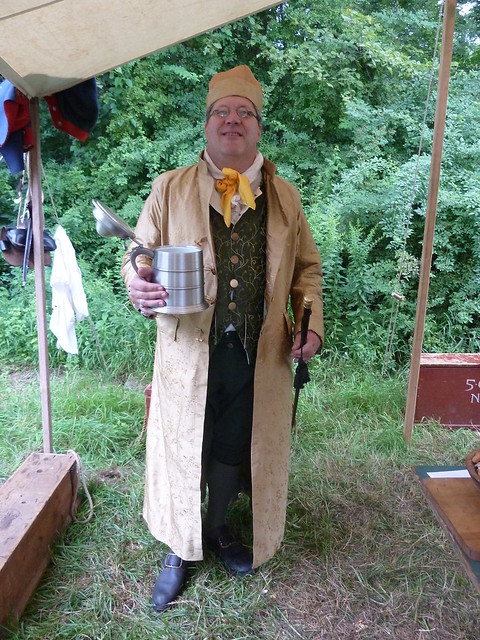
 Since our camp was rather distant from the other sites, we unfortunately did not have many visitors to interact with on Saturday.  Some of the children in the camp next to us dipped candles and I managed to get a few stitches done on a new jacket.  In the afternoon a few of us took a stroll through town to enjoy the fife and drum music and to visit some of the other camps and open exhibits.  We ran into a few acquaintances (although I am sorry to have missed Mary from An Historical Lady!) and stopped for some photo ops along the way.  After dinner, some of our members presented an evening of music in the tavern and we all gathered to attend.  Our Commander debuted his gorgeous new gold silk banyan (lined with sea green silk) and cap, both his own creations!

Our Commander prepared for a fun evening in his new gold silk banyan and cap
(this photo, unfortunately, does not do his work or the stunning color justice!),
with his new friend Franken-Stein in hand.

I did not stay for the Jolly and as I drove out of the parking lot to head home for the night, the rain began to fall.  That was an interesting drive home.  It poured all night and was still coming down in the morning.  Even with the inevitable mud and the probability of canceled events, I drove back to OSV on Sunday morning.  On my way to our camp, I stopped at some shops to catch brief reprieves from the rain (and to make some purchases as well!).  We remained gathered under our fly until the rain ceased just after noon and the humidity and sun came rushing back.  With the battle called off, we began packing up and bid farewell to each other until our next event together.  Most of the other groups had gone or were packing up early as well, so I took some time to visit some more exhibits before leaving town.

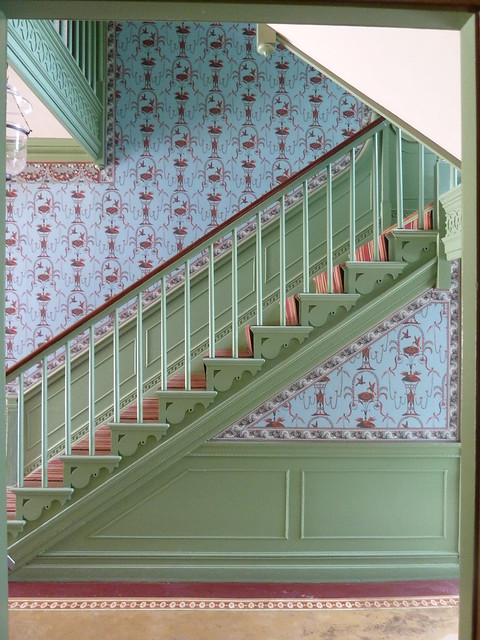
The main staircase at the Salem Towne House, Old Sturbridge Village

As always, I've included a few photos from the weekend in a flickr set for your enjoyment.

Friday, August 12, 2011

18th Century Shoemaking Workshop!

I’m sure by now most of you have seen Nicole’s exquisite pair of hand-made silk shoes on her blog, Diary of a Mantua Maker.  I am also confident that many of you have heard that her most competent instructor, Mr. Walker, will be hosting a week-long ladies shoemaking workshop in New York in just a few weeks!  It will be held at the idyllic Eastfield Village near Nassau, NY, August 20-27.  We are both already registered to attend what promises to be an enlightening and fun week.  Believe it or not, there is still time for you to register, too!  Nicole posted a nice overview of what the workshop entails.  If you have any inquiries or curiosities concerning the workshop, please contact us or comment on this post and we will get you in touch with Mr. Walker (due to possible spam issues we are not posting his e-mail address here).  If you are interested in participating, please get in touch posthaste to ensure your inclusion in this most unique opportunity.  For any of you who might not be able to attend the entire workshop or who are interested in learning about working with leather without investing in an entire pair of shoes, a general leather stitching class on Saturday, August 20 is being offered to the public for a nominal fee and is also still open for registration.

For those of you who are unable to attend, be sure to check back here for updates during the workshop!

Wednesday, August 3, 2011

Finding the Faces of Pride and Prejudice in San Francisco

I'm currently on a two-week trip to CA for a conference and am taking advantage of my time here to visit with some west coast friends I rarely get to see. On Thursday, my friend Kathey and I took a trip into San Francisco to see the SFS perform Music for the Royal Fireworks and both Vivaldi's and Piazzola's Four Seasons, the latter two with Lara St John. It was fantastic, and by far one of the best performances of the Four Seasons I've ever heard, either live or recorded.

But anyway, I digress. Before the concert, we stopped by the Legion of Honor to see the Dutch and Flemish masterworks exhibition currently on display there (quite lovely and worth the trip if you live close enough to go!). After spending some time in there, we explored the rest of the museum and Kathey (who has been to the LOH numerous times before) brought me to what she fondly calls the "Pride and Prejudice" room.  Hung entirely in European (mostly British) portraiture from the eighteenth and early nineteenth centuries, this one particular gallery contains within it faces which look curiously familiar.  Bringing me from one portrait to the next, Kathey would say, "And who's this?" and somehow my answer was always consistent with hers.  It was such fun that I thought I'd share our little adventure in character-finding with you.  See if you can't identify which fictional characters from Pride and Prejudice we found so eerily reflected in these well-known portraits of real people from the past!

First we encountered this gentleman:

Sir Duncan Campbell, Bart., by Henry Raeburn (1812).
Image linked from worldvisitguide.com.

Look familiar?  What about this chap, who we discovered peering at us from the opposite side of the doorway?

Alexander Carre of Cavers, by Henry Raeburn (1802).
Image linked from worldvisitguide.com.

Hung directly to his right (rather condescending of him, don't you think?) was this dashing gentleman who I am sure you must know by sight:

Sir William Napier, Bart., by Henry Raeburn (1811-21).
Image linked from worldvisitguide.com.

Imposingly displayed in another corner was this lady, painted in her youth, of course, and oh-so-appropriately by none other than Sir Joshua Reynolds:

Anne, Viscountess Townshend, by Sir Joshua Reynolds (1779-80).
Image linked from worldvisitguide.com.

And opposite her, we espied this fine looking pair (it looks like they've risen quite nicely in the world, doesn't it?):

Mary, Countess of Plymouth, by Thomas Lawrence (1817).
Image linked from worldvisitguide.com.

Other Archer, Earl of Plymouth, by Thomas Lawrence (1817).
Image linked from worldvisitguide.com.

I hereby issue a challenge to you all, dear readers, to put forth your suppositions as to the identities of these fair-faced personages!  A rousing "Huzzah!" to anyone who can identify them all!

Incidentally, Jane Austen herself also enjoyed the pastime of searching out the faces of her fictional characters in the real-life portraits of her contemporaries.  In a letter to her sister Cassandra on 24 May 1813, she wrote:
"Henry and I went to the exhibition in Spring Gardens. It is not thought a good collection, but I was very well pleased, particularly (pray tell Fanny) with a small portrait of Mrs. Bingley, excessively like her.
I went in hopes of seeing one of her sister, but there was no Mrs. Darcy. Perhaps, however, I may find her in the great exhibition, which we shall go to if we have time. I have no chance of her in the collection of Sir Joshua Reynolds's paintings, which is now showing in Pall Mall, and which we are also to visit.
Mrs. Bingley's is exactly herself -- size, shaped face, features, and sweetness; there never was a greater likeness. She is dressed in a white gown, with green ornaments, which convinces me of what I had always supposed, that green was a favourite colour with her. I dare say Mrs. D. will be in yellow."
                                                        Jane Austen's Letters, p. 212
The actual portrait Austen singled out as very like "Mrs Bingley" in green ornaments has been identified as "Portrait of Mrs Q (Mrs Harriet Quentin)," by William Blake.  Although our Mrs Bingley isn't sporting green, we felt pretty confident that she was quite fond of pink as well, and that Mr Bingley certainly loved her enough to commission two portraits, at the very least.  :-)

Portrait of Mrs Q, by William Blake (1820).
Linked from arttattler.com.