Thursday, October 13, 2011

Threaded Bliss

A Black Silk Bonnet,
1770-1790

black silk bonnet, 1770-1790

The Pattern: Drafted by me, by trial and error, with multiple mock-ups until I got the shape of brim and volume of crown that I wanted.

mock-up of a bonnet, 1770-1790
The final mock-up of my pattern!

Inspirations: Although there are scores upon scores of prints, engravings, paintings, and textual descriptions representing a wide variety of bonnet styles from throughout the 18th century, only one extant example of an actual bonnet can be confidently dated to that period (as far as I'm aware).  This one, owned by Colonial Williamsburg (acc. no. 1993-335), has served as my primary point of reference for my project. 

The only extant bonnet that can be confidently dated to the 18th century.
It is owned by CW, acc. no. 1993-335.

It is made of black ribbed silk and features a doubled brim supported by baleen.  CW's description further says its "puffy, mushroom-shaped crown is pleated to the boned brim, adjusted with a ribbon drawstring at center back," that is it unlined, and that the ruffled trim and the bow are made of fabric and tacked in place at the point where the crown meets the brim.

My other primary reference for this project is George Stubbs's well-known painting of The Haymakers, dated 1785, which features a bonnet similar in style, though with a slightly larger crown and wider brim, and the latter appears to be lined in white (see the detail below).  Although this is clearly a working woman (however idealized, in her white accessories!), her bonnet could still be made of silk, but wool is another close possibility.

George Stubbs, The Haymakers (1785).
Image linked from the Tate Gallery.

The Haymakers, detail of the bonnet.  Note the white lining of the brim.

If you're interested in seeing more images of a variety of bonnet styles, be sure to check out Nicole's three fantastic posts on bonnets (one, two, three) on her blog, Diary of a Mantua Maker.  Karen's 18th Century Notebook page on bonnets also offers a list of images and further resources.

Construction Details: I have not examined the CW bonnet in person, and I freely admit to knowing next to nothing about millinery techniques in general (though I'd love to learn!), so my construction method was based on the details provided on the CW e-museum listing and on 18th century cap construction techniques.  Whether I've done it "the" period way, I don't know, but considering there's only one extant example to study, I figure it's anyone's best guess how these things were put together!  If any of you have done bonnets like this, I'd love to compare notes and hear how your assembly process differs from mine!

black silk bonnet, 1770-1790
Side view of the bonnet.

First, I made up my brim out of a couple layers of cotton buckram and sewed a light-weight wire along the edge to help the brim maintain its shape.  The CW original uses baleen to achieve its shape, but the baleen substitute I used in my stays (ash splints) was just too heavy to use in the brim, so I adapted the buckram and wire method instead, which worked quite well.

I then covered the brim, top and underside, with silk and finished it along the inside edge.  The crown is unlined, as is the CW example, so I sewed a drawstring channel for the ribbon adjustment at the back and then finished the other edges of the crown before I whipped it onto the brim, just as I would do for a cap.

black silk bonnet, 1770-1790
Front view, with the self-fabric decoration copied from the original.

Finally, I created self-fabric poofs and a big self-fabric bow at the front, based on the CW original, and voila!  A bonnet!

The Fabric: A beautiful Italian black silk taffeta that is the ideal weight for something like this - stiff enough to hold its shape well in the crown and brim, and well worth the "designer" price.  I found it on a mini shopping spree to the incomparable Banksville Fabrics over the summer.  Just wait till you see what Ashley walked out with...but that's something for an entirely separate post!  :-)
black silk bonnet, 1770-1790

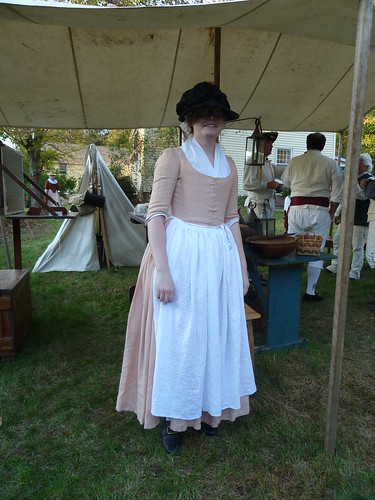
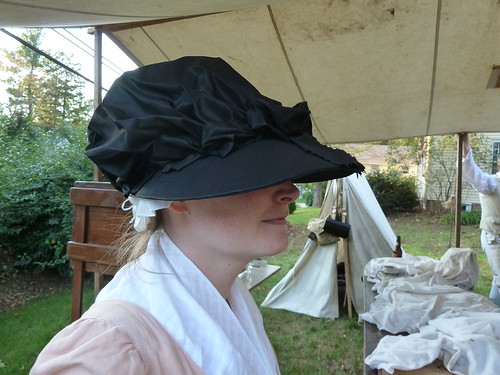
Finishing the Look: Although I started this bonnet before UTR and fully intended to have it done by then, I got tangled up in other projects and ended up putting it aside for months.  I picked it up again a few weeks ago to finish it and finally gave it its first airing this past weekend at our local event.  For this event, I gave it a "nicer" working-class look based off the Stubbs painting above, wearing it over a linen cap and paired with white linen accessories and a linen gown (which was supposed to be done in June for summer camp-wear, but didn't get finished until mid-July.  Hmm...do I sense a pattern here?!  More on that gown coming in the next Threaded Bliss post, so stay tuned!).

black silk bonnet, 1770-1790
Pray forgive the weird way the shadows fall here - you can't really tell
where the bonnet brim ends and my face begins, but you get the general idea!
Photo taken during "1776: South Britain Comes Alive," 8 October 2011.

Tuesday, October 11, 2011

"1776: South Britain Comes Alive!" local event

1776: South Britain Comes Alive 2011

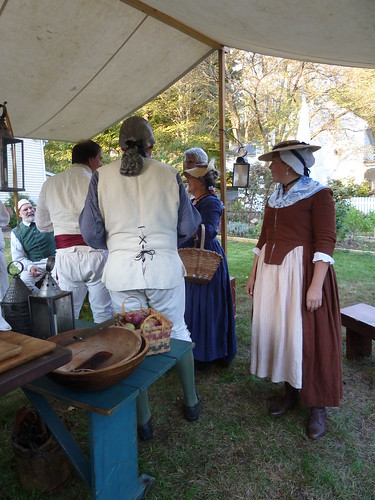
This weekend, we of the 5th CT Regiment helped to promote local Revolutionary War history with the third annual "1776: South Britain Comes Alive" event, a fundraiser for the Southbury Historical Society.  The event took local residents and visitors on a horse-drawn wagon tour of the town's historic district.  Along the route, groups stopped to sample tidbits of town history, which included a drilling demonstration by members of our regiment, the re-enactment of an 18th-century style service in the 1825 church, costumed tours of several privately-owned and recently restored 18th century homes, a visit to our kitchen fly and camp, a demonstration of spinning techniques by a local artisan, 18th century ghost stories, and an open house in the museum of the Historical Society. 

1776: South Britain Comes Alive 2011
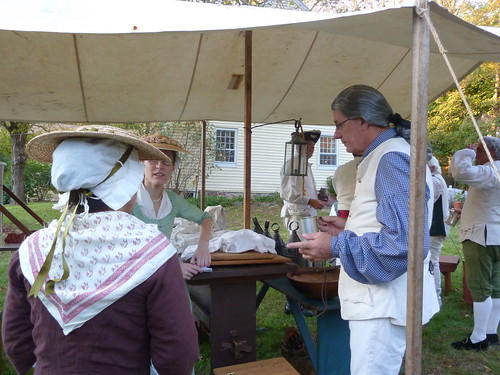
Chatting under the kitchen fly during dinner, before the festivities began
(with prodigious admiration for the new wig, Mr. S!).

1776: South Britain Comes Alive 2011

The evening weather was balmy and perfect for the walking crowds, and we enjoyed spending time chatting with the guests and responding to their eager and often thoughtful questions about 18th century life, both from the "history book" perspective and from the perspective of one who regularly re-enacts it.  It was a unique and fantastic opportunity for us all to share our passion for this period, and to teach those close to home about the very rich and valuable Revolutionary War history of our little corner of the former colony of Connecticut.

1776: South Britain Comes Alive 2011
One of the house tours included a tavern scene that enacted the capture
of a British soldier, who spoke to the visitors about his views on the trouble
with the "traitor" colonists.  Unfortunately, none of our pictures of the Brit on his
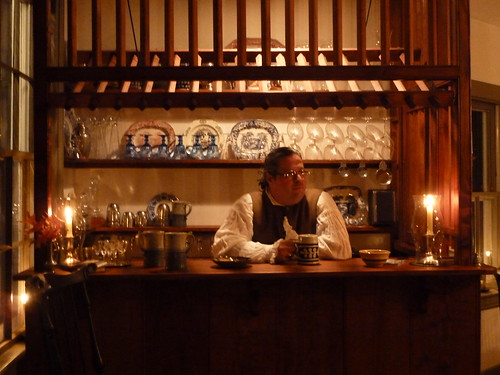
(brilliant!) tirade came out, but here's Mr.S.. (the other one!) minding the bar during the scene.

After the event concluded, we reconvened as a group to enjoy each other's company for a bit longer, sampling all of the tasty 18th century goodies that remained from the evening and enjoying a round of songs and good cheer before bed.  Many thanks to those who hosted the events of the evening, for your very generous hospitality!

1776: South Britain Comes Alive 2011
Letting our hair down, period style, for some...

1776: South Britain Comes Alive 2011
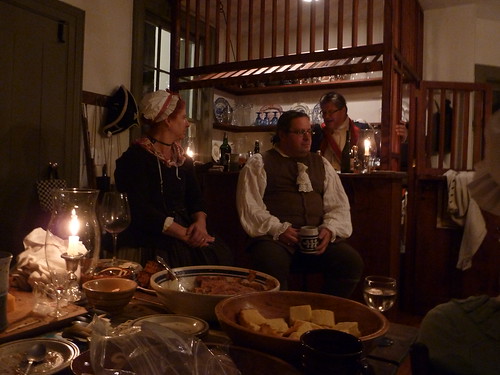
...after-hours socializing in the Golden Dog, sampling all of the
leftover 18th-century treats.

Saturday, October 1, 2011

(Re-)Making Royal Fashion History, Pt. 2

After reading our post yesterday about Butterick's new Kate Middleton-inspired wedding gown pattern (#B5731), our friend Laurie from Teacups in the Garden alerted us to two additional royal wedding gowns that have been commercially patterned.  The first is Grace Kelly's iconic 1956 gown for her wedding to Prince Rainier of Monaco.  The gown was designed by Helen Rose and made by the costume department at MGM, as a gift to the bride from her former studio.  It was reportedly made of 25 yards silk taffeta and almost 100 yards of silk tulle.  Valenciennes rose point lace decorated the bodice and sleeves, and the veil was trimmed with lovebirds in appliquéd lace and embellished with thousands of tiny seed pearls.

Grace Kelly's wedding gown.
Photo linked from fashionbride.wordpress.com.

Vogue has created a lovely Grace Kelly look-alike pattern (#V2979) that closely adheres to the details of the original and successfully captures its old time Hollywood glamour.  That this is a recent pattern release is unsurprising, considering the degree to which Kate Middleton's gown (and her overall sense of style) has been compared to Grace Kelly's.

Grace Kelly in her wedding gown (left), with the Vogue reproduction V2979 on the right.
Photo of Grace Kelly linked from Hollywooddame.com.
Vogue photo linked from Voguepatterns.mccall.com; follow the link to purchase the pattern.

The second pattern Laurie discovered is an old and (alas!) now out-of-print Burda pattern (#7940) for Princess Diana's wedding dress. I wish this was easier to find now because it would be such fun to try to recreate such a fairy tale gown, with the big poofy sleeves and all the lacy frills and bows.  This pattern seems to appear occasionally on ebay and etsy, so check those sites if you're looking for one.  If you'd like to read more about the original gown, visit our earlier post here.

Burda pattern envelope for Princess Diana's wedding dress.
Photo linked from a recent etsy listing.

A big thank you to Laurie for sending us these links and permitting us to share them with you!

And while we're still on the topic, just two final notes.  To complement your reproduction Kate Middleton wedding gown, a reproduction of the diamond Cartier tiara lent to her by the Queen is, of course, an absolute must (because who can resist a tiara?!). This is by far the closet reproduction I've been been able to find (and it's even affordable, too!): click here.  If you'd like to compare it to the original, check out the photos here.

And if you're interested in recreating Kate's sapphire blue Issa engagement dress to add to your royal wardrobe, a combination of Simplicity 2145 (quite obviously inspired by Kate's) and McCalls 5974 should do the trick.  Happy sewing and don't forget to let us see what you create!

Friday, September 30, 2011

(Re-)Making Royal Fashion History

Because we've discussed Kate Middleton's wedding gown at such length and admired and sighed over its details in such depth, I thought it would be fun to share something I just so happened to stumble across yesterday.  Butterick has designed a pattern (#B5731) so that you, too, can make and wear a copy of the Duchess of Cambridge's Sarah Burton/Alexander McQueen wedding gown!  From the photos and line drawings on the pattern envelope, it seems to be a fairly good replica, though they didn't quite capture the clever and oh-so-elegant way the skirts of the original were draped (which was one of my favorite parts of the gown).  And, of course, any recreation won't be able to boast the world-renowned handiwork of the Royal School of Needlework, and few reproductions can incorporate genuine Irish Carrickmacross lace, and I don't think that Butterick notes any of the placement and patterning of the applique lace designs that added such an amazing texture and dimension to the skirts of the original.  But then again, the rest of us wouldn't be marrying a future king in our reproduction gown, so these are tiny details indeed!  So in general, I think they did quite a nice job with the pattern; visit the Edelweiss Patterns blog for a more detailed comparison of the pattern and the original.  If anyone attempts a reproduction using this pattern, we'd love to see your final product and how it turns out!

Kate Middleton's wedding gown (left), with its Butterick (B5731) counterpart.
To purchase the Butterick pattern, click here.
Left photo linked from wallang; Butterick photo (right) linked from the Butterick website.

And for a bit of added fun, Butterick has also released a pattern (#B5710) that closely replicates the style of Phillipa Middleton's bridesmaid's gown and another that copies the adorable dresses of the young flower girls (#BP248)!  Now if we can just convince them to pattern some of the other historic royal wedding gowns...  :-)

Monday, September 26, 2011

Current Exhibit: "Revolutionary Fashion 1790-1820" at Fairfax House, York

For our friends and readers across the pond - or those of you with the means to travel there! - a new exhibit of late-Georgian and Regency fashion has just gone on display at York's Fairfax House.  As a sequel to last year's "Dress to Impress: Revealing Georgian Fashion 1730-1780," this exhibition, which runs through the end of the year, draws upon a number of UK costume collections to offer a beautifully varied look at the evolution of dress during this revolutionary period.  Clothing and accessories displayed against the backdrop of the restored Georgian Fairfax House narrate the story of how dramatic political and social changes - the French Revolution and the Napoleonic Wars, as well as the Industrial Revolution - were reflected in the increasingly naturalistic silhouettes of both male and female clothing.  A splendid (and pretty lengthy!) video tour of the exhibit that showcases (up close, huzzah!) a number of the items on display is available to view here and helps to introduce the socio-political context in which this exhibit intends to function.

Stunning pelisse from the Olive Matthews Collection at the
Chertsey Museum, currently on display in this exhibit. 
Photo linked from CraftsCouncil.org.uk.

Further information on "Revolutionary Fashion 1790-1820" can be found on Fairfax House's blog, in this article from The Press, and in this neat little press release from the University of York.  And for additional photos of many of the items on display, be sure to check out the official photo gallery!  Now if only we can convince them to produce a catalog...:-)

Painted leather slippers made by Brucknell for Princess Amelia.
Photo linked from The Press.

This coming Wednesday, the 28th of September, Fairfax House is hosting a fashion seminar as a special event to coincide with the exhibit.  Entitled "Ridicules and Indispensibles: Fashion and a War of Words in Late Georgian England," the talk will explore the shift from the tie-on pocket so ubiquitous to the 18th century to the hand-held reticule, and address the charged political and social ramifications of this "newest" fashion accessory.  For more information and for tickets. follow the link above.  This sounds fascinating and I so wish I could go!  If anyone does, do please let us know how it is and what is discussed!

Wednesday, September 14, 2011

Current Exhibit and Upcoming Conference: "With Cunning Needle: Four Centuries of Embroidery"

From 21-22 October 2011, Winterthur will hold a conference, "With Cunning Needle: Four Centuries of Needlework."  The two days of lectures, workshops, and half-day seminar sessions will focus on the techniques, materials, heritage, and artistry of needleworkers and their creations from the seventeenth century through the present day.  The conference is scheduled as a complement to Winterthur's current exhibit of the same name, which explores the history of embroidery and other needlework arts by showcasing extant pieces that highlight not only the tremendous skill involved in producing these heirloom items, but also the lives of the individuals who invested themselves in these creations, and the lives of those fortunate enough to own and wear such treasured objects of art.  The exhibition premiered on 3 September and will remain open until 8 January 2012.

The Plimoth Jacket.
Photo linked from the Winterthur Museum.

The "Plimoth Jacket," currently on loan to Winterthur from Plimoth Plantation, forms the inspiration and heart of the new exhibit and the conference.  For those of you who have not yet heard about the project, the Plimoth Jacket is a conglomerative reproduction of two 1620s jackets held in the collection of the V&A; one jacket (the "Margaret Laton" jacket, V&A #T.228-1994) served as the pattern base, while the other (V&A #1359-1900) provided the embroidery design that was reproduced in exact detail for the project.  This jaw-dropping piece was brought to life by more than 300 hard-working hands that used only early-seventeenth-century tools, materials, and techniques to recreate the sequins, lace, threads, and fabric that make up this jacket.  More than 3,700 hours were invested in this exploration of seventeenth-century needlework culture and practice.  The product is a triumph of research, art, meticulous skill, and a passionate devotion to the skills of the artisans of the past.  Plimoth Plantation's The Embroiderer's Story blog and Tricia Wilson's Thistle Threads blog provide detailed records of the creation of the jacket.  Winterthur has also put together a fabulous presentation full of great images and lots of additional information about the production process from inspiration to pattern to progress to product; be sure not to miss it!

If you are interested in attending the October conference, the conference brochure and registration form can be found in .pdf form here.  Further information on Winterthur's extensive permanent Textiles and Needlework Collection (including virtual catalogues and past exhibits) can be found here.

For more on the patterning and construction of garments like the Plimoth Jacket, take a look at Janet Arnold's Patterns of Fashion 4 (which Tricia Wilson discusses in her blog account of the jacket project here and here) and Jenny Tiramani's new book, Seventeenth-Century Women's Dress Patterns (which we heard her speak about at the March CW conference!).

Wednesday, September 7, 2011

Threaded Bliss

Lavender Linen English Gown
with Matching Petticoat,
1775-1780

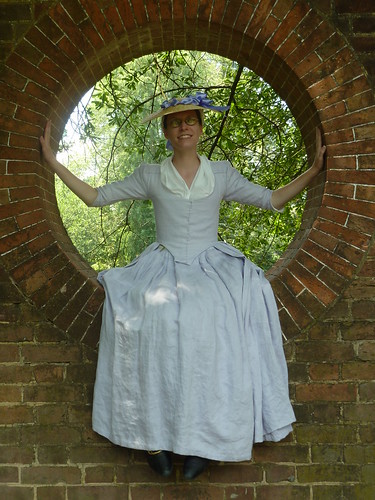
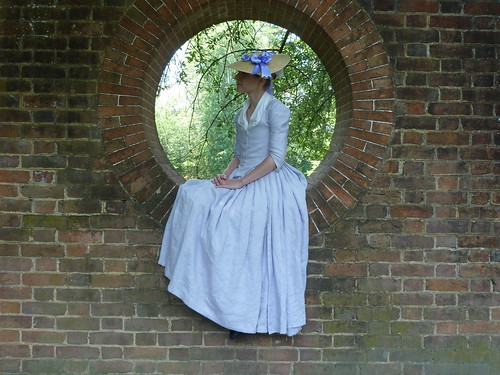
Lavendar linen gown, 1775-1780
Colonial Williamsburg, July 2011.

The Pattern: Draped by me, with the exception (as I'm sure you've come to expect by now!) of the sleeves, which I took (with slight alterations to fit this new bodice) from the DAR gown, whose sleeves were originally patterned from the gown on page 36 of Janet Arnold's Patterns of Fashion 1.


Construction Details: Because this gown is the same style as the DAR gown, the construction process was identical, so please see that earlier post if you want specifics on how it was made.  To avoid repeating too much information, I'll just offer a brief overview of the process here, along with some pictures.

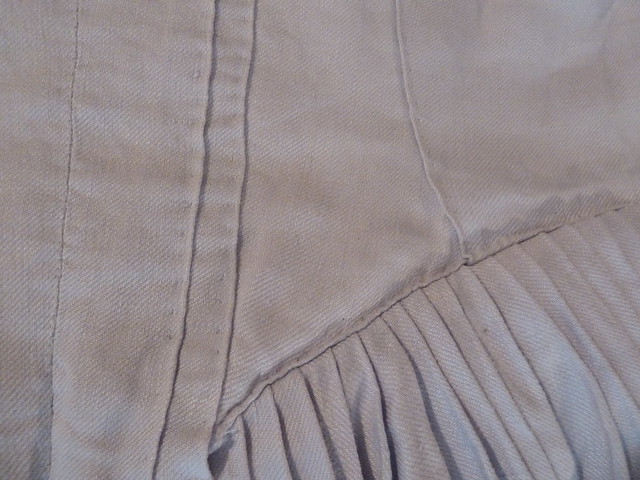
The back "en fourreau" pleats, which extend from the back
shoulders all the way down the full length of the gown's skirts. 
The lapped seams on the bodice and shoulder straps can also be seen.

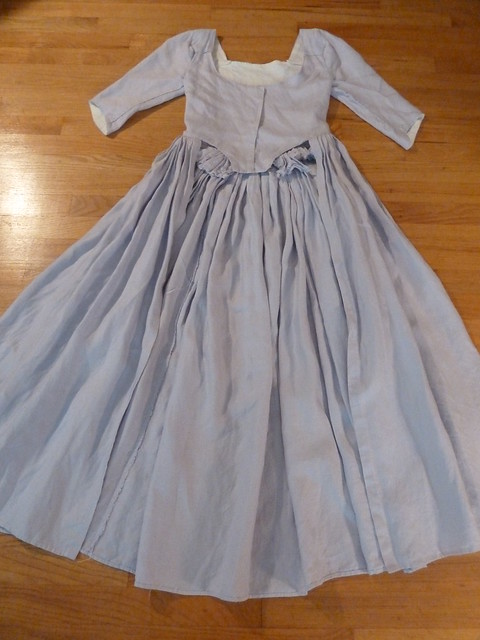
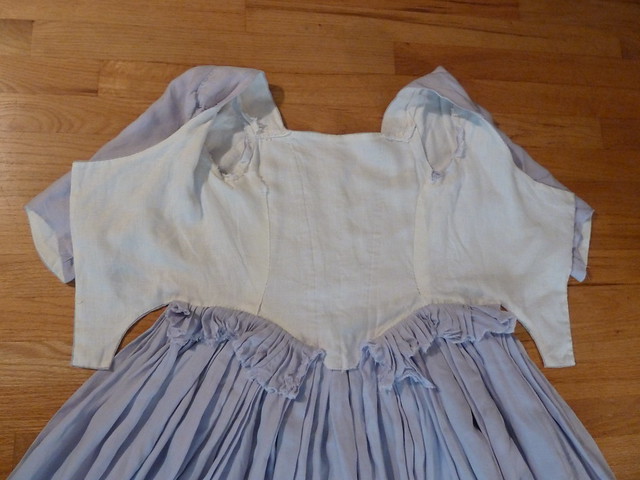
After draping the lining over Ashley's stays, the back en fourreau pleats are formed and stitched to the back lining.  The draped front bodice lining pieces are used to cut out the front pieces in the lavender linen.  These front pieces are then lapped over the back panel and stitched down, and their corresponding lining pieces folded under and stitched to the lining to conceal the raw edges inside. 

The interior of the gown's bodice.  The top of the skirts remain uncut
and are simply folded and left to hang free inside. This helps pad out the skirts
and makes later alterations easier.

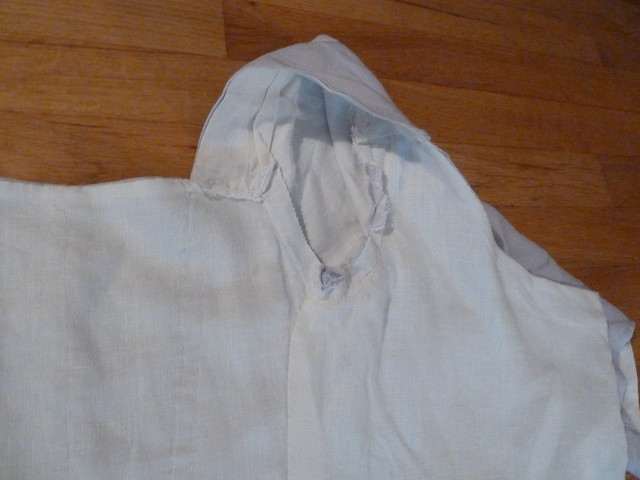
Detail of the gown's interior, showing the unfinished armscye.  This is
consistent with extant examples, which rarely wasted time, energy, or materials
on areas of a garment that would not be seen.

After finishing the outer edges of the bodice and neckline, the sleeves are fitted while on Ashley and the shoulder straps stitched down.  Finally, the skirts are pleated and secured to the bottom of the bodice.

The back right side of the gown.  The center back "en fourreau" pleating is on the left.

The Fabric: A pale lavender 100% linen twill, one of those rare but exciting Denver Fabrics sale finds.  The linen is a lovely mid-weight that drapes beautifully in the skirts.  The bodice and sleeves are lined in a light-weight cream linen.

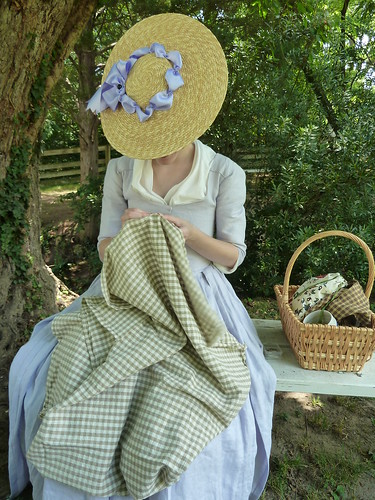
Finishing the Look: The front of the gown pins closed with straight pins.  Ashley wears this gown over a linen shift with tight, elbow-length sleeves, fully-boned stays, a linen underpetticoat, and a matching pale lavender linen petticoat.  A white linen neckerchief fills in the low neckline, and a cotton lawn cap covers her head.  She also wears a new straw hat beribboned with lavender satin that I bought years ago and have been hoarding until I found the perfect use for it.  The decoration is simple big poofs with a double bow at one side, copied from the print below (though the exact same trim is seen on numerous images dating between 1770 and 1785).

"Rural Life," 1782: the inspiration for Ashley's lavender hat. 
Because of the number of images which feature this exact same trim
design, it seems to have been quite a popular and fashionable one!
Image linked from the Lewis Walpole Library, Yale University.

Lavendar linen gown, 1775-1780
A view of the side of the hat with the double bow.
Colonial Williamsburg, July 2011.

An 18th Century Seamstress
Another view of the hat, this time from the top,
showing the big poofs that surround the crown.
Under the Redcoat, Colonial Williamsburg, June 2011.

As always, I ran out of room to post all of the pictures, so if you'd like to see additional views and detail shots, check out this project's flickr set!